P56480
Gene name |
Atp5f1b |
Protein name |
ATP synthase subunit beta, mitochondrial |
Names |
ATP synthase F1 subunit beta |
Species |
Mus musculus (Mouse) |
KEGG Pathway |
mmu:11947 |
EC number |
7.1.2.2: Hydron translocation linked to the hydrolysis of a nucleoside triphosphate |
Protein Class |
|
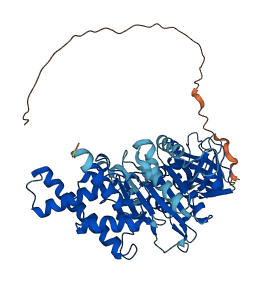
Descriptions
The autoinhibited protein was predicted that may have potential autoinhibitory elements via cis-regPred.
Autoinhibitory domains (AIDs)
Target domain |
|
Relief mechanism |
|
Assay |
cis-regPred |
Accessory elements
No accessory elements
Autoinhibited structure

Activated structure
1 structures for P56480
| Entry ID | Method | Resolution | Chain | Position | Source |
|---|---|---|---|---|---|
| AF-P56480-F1 | Predicted | AlphaFoldDB |
12 variants for P56480
| Variant ID(s) | Position | Change | Description | Diseaes Association | Provenance |
|---|---|---|---|---|---|
| rs36597143 | 22 | P>S | No | EVA | |
| rs3389133302 | 117 | E>G | No | EVA | |
| rs3389109788 | 120 | V>D | No | EVA | |
| rs3401168722 | 121 | R>LK* | No | EVA | |
| rs3389127397 | 201 | K>T | No | EVA | |
| rs3389133418 | 224 | A>P | No | EVA | |
| rs3389135735 | 226 | A>P | No | EVA | |
| rs3389133082 | 227 | H>Q | No | EVA | |
| rs3389135990 | 239 | R>K | No | EVA | |
| rs3389109777 | 276 | P>T | No | EVA | |
| rs3389142882 | 280 | A>S | No | EVA | |
| rs3389133312 | 309 | F>V | No | EVA |
No associated diseases with P56480
4 regional properties for P56480
| Type | Name | Position | InterPro Accession |
|---|---|---|---|
| domain | ATPase, F1/V1/A1 complex, alpha/beta subunit, nucleotide-binding domain | 186 - 405 | IPR000194 |
| domain | AAA+ ATPase domain | 198 - 382 | IPR003593 |
| domain | ATPase, F1/V1/A1 complex, alpha/beta subunit, N-terminal domain | 63 - 129 | IPR004100 |
| active_site | ATPase, alpha/beta subunit, nucleotide-binding domain, active site | 396 - 405 | IPR020003 |
Functions
| Description | ||
|---|---|---|
| EC Number | 7.1.2.2 | Hydron translocation linked to the hydrolysis of a nucleoside triphosphate |
| Subcellular Localization |
|
|
| PANTHER Family | ||
| PANTHER Subfamily | ||
| PANTHER Protein Class | ||
| PANTHER Pathway Category | No pathway information available | |
13 GO annotations of cellular component
| Name | Definition |
|---|---|
| cell surface | The external part of the cell wall and/or plasma membrane. |
| membrane | A lipid bilayer along with all the proteins and protein complexes embedded in it an attached to it. |
| membrane raft | Any of the small (10-200 nm), heterogeneous, highly dynamic, sterol- and sphingolipid-enriched membrane domains that compartmentalize cellular processes. Small rafts can sometimes be stabilized to form larger platforms through protein-protein and protein-lipid interactions. |
| mitochondrial inner membrane | The inner, i.e. lumen-facing, lipid bilayer of the mitochondrial envelope. It is highly folded to form cristae. |
| mitochondrial membrane | Either of the lipid bilayers that surround the mitochondrion and form the mitochondrial envelope. |
| mitochondrial nucleoid | The region of a mitochondrion to which the DNA is confined. |
| mitochondrial proton-transporting ATP synthase complex | A proton-transporting ATP synthase complex found in the mitochondrial membrane. |
| mitochondrial proton-transporting ATP synthase complex, catalytic sector F(1) | The catalytic sector of the mitochondrial hydrogen-transporting ATP synthase; it comprises the catalytic core and central stalk, and is peripherally associated with the mitochondrial inner membrane when the entire ATP synthase is assembled. |
| mitochondrion | A semiautonomous, self replicating organelle that occurs in varying numbers, shapes, and sizes in the cytoplasm of virtually all eukaryotic cells. It is notably the site of tissue respiration. |
| myelin sheath | An electrically insulating fatty layer that surrounds the axons of many neurons. It is an outgrowth of glial cells: Schwann cells supply the myelin for peripheral neurons while oligodendrocytes supply it to those of the central nervous system. |
| plasma membrane | The membrane surrounding a cell that separates the cell from its external environment. It consists of a phospholipid bilayer and associated proteins. |
| proton-transporting ATP synthase complex | A proton-transporting two-sector ATPase complex that catalyzes the phosphorylation of ADP to ATP during oxidative phosphorylation. The complex comprises a membrane sector (F0) that carries out proton transport and a cytoplasmic compartment sector (F1) that catalyzes ATP synthesis by a rotational mechanism; the extramembrane sector (containing 3 a and 3 b subunits) is connected via the d-subunit to the membrane sector by several smaller subunits. Within this complex, the g and e subunits and the 9-12 c subunits rotate by consecutive 120 degree angles and perform parts of ATP synthesis. This movement is driven by the hydrogen ion electrochemical potential gradient. |
| proton-transporting ATP synthase complex, catalytic core F(1) | The sector of a hydrogen-transporting ATP synthase complex in which the catalytic activity resides; it comprises the catalytic core and central stalk, and is peripherally associated with a membrane, such as the plasma membrane or the mitochondrial inner membrane, when the entire ATP synthase is assembled. |
9 GO annotations of molecular function
| Name | Definition |
|---|---|
| ADP binding | Binding to ADP, adenosine 5'-diphosphate. |
| angiostatin binding | Binding to angiostatin, a proteolytic product of plasminogen or plasmin containing at least one intact kringle domain, and which is an inhibitor of angiogenesis. |
| ATP binding | Binding to ATP, adenosine 5'-triphosphate, a universally important coenzyme and enzyme regulator. |
| ATP hydrolysis activity | Catalysis of the reaction: ATP + H2O = ADP + H+ phosphate. ATP hydrolysis is used in some reactions as an energy source, for example to catalyze a reaction or drive transport against a concentration gradient. |
| calcium ion binding | Binding to a calcium ion (Ca2+). |
| lipoprotein particle receptor activity | Combining with a lipoprotein particle and delivering the lipoprotein particle into the cell via endocytosis. A lipoprotein particle, also known as a lipoprotein, is a clathrate complex consisting of a lipid enwrapped in a protein host without covalent binding in such a way that the complex has a hydrophilic outer surface consisting of all the protein and the polar ends of any phospholipids. |
| MHC class I protein binding | Binding to a major histocompatibility complex class I molecule; a set of molecules displayed on cell surfaces that are responsible for lymphocyte recognition and antigen presentation. |
| proton-transporting ATP synthase activity, rotational mechanism | Enables the synthesis of ATP from ADP and phosphate by the transfer of protons from one side of a membrane to the other by a rotational mechanism driven by a gradient according to the reaction: ADP + H2O + phosphate + H+(in) -> ATP + H+(out). |
| proton-transporting ATPase activity, rotational mechanism | Enables the transfer of protons from one side of a membrane to the other according to the reaction: ATP + H2O + H+(in) = ADP + phosphate + H+(out), by a rotational mechanism. |
11 GO annotations of biological process
| Name | Definition |
|---|---|
| angiogenesis | Blood vessel formation when new vessels emerge from the proliferation of pre-existing blood vessels. |
| ATP biosynthetic process | The chemical reactions and pathways resulting in the formation of ATP, adenosine 5'-triphosphate, a universally important coenzyme and enzyme regulator. |
| ATP metabolic process | The chemical reactions and pathways involving ATP, adenosine triphosphate, a universally important coenzyme and enzyme regulator. |
| cellular response to interleukin-7 | Any process that results in a change in state or activity of a cell (in terms of movement, secretion, enzyme production, gene expression, etc.) as a result of an interleukin-7 stimulus. |
| lipid metabolic process | The chemical reactions and pathways involving lipids, compounds soluble in an organic solvent but not, or sparingly, in an aqueous solvent. Includes fatty acids; neutral fats, other fatty-acid esters, and soaps; long-chain (fatty) alcohols and waxes; sphingoids and other long-chain bases; glycolipids, phospholipids and sphingolipids; and carotenes, polyprenols, sterols, terpenes and other isoprenoids. |
| negative regulation of cell adhesion involved in substrate-bound cell migration | The disassembly of adhesions at the front and rear of a migrating cell. At the leading edge, adhesion disassembly accompanies the formation of new protrusions; at the cell rear, it promotes tail retraction. |
| positive regulation of blood vessel endothelial cell migration | Any process that activates or increases the frequency, rate or extent of the migration of the endothelial cells of blood vessels. |
| proton motive force-driven mitochondrial ATP synthesis | The transport of protons across a mitochondrial membrane to generate an electrochemical gradient (proton-motive force) that powers ATP synthesis. |
| proton transmembrane transport | The directed movement of a proton across a membrane. |
| receptor-mediated endocytosis | An endocytosis process in which cell surface receptors ensure specificity of transport. A specific receptor on the cell surface binds tightly to the extracellular macromolecule (the ligand) that it recognizes; the plasma-membrane region containing the receptor-ligand complex then undergoes endocytosis, forming a transport vesicle containing the receptor-ligand complex and excluding most other plasma-membrane proteins. Receptor-mediated endocytosis generally occurs via clathrin-coated pits and vesicles. |
| regulation of intracellular pH | Any process that modulates the internal pH of a cell, measured by the concentration of the hydrogen ion. |
6 homologous proteins in AiPD
| UniProt AC | Gene Name | Protein Name | Species | Evidence Code |
|---|---|---|---|---|
| P00829 | ATP5F1B | ATP synthase subunit beta, mitochondrial | Bos taurus (Bovine) | PR |
| Q5ZLC5 | ATP5F1B | ATP synthase subunit beta, mitochondrial | Gallus gallus (Chicken) | PR |
| Q05825 | ATPsynbeta | ATP synthase subunit beta, mitochondrial | Drosophila melanogaster (Fruit fly) | PR |
| P06576 | ATP5F1B | ATP synthase subunit beta, mitochondrial | Homo sapiens (Human) | PR |
| P10719 | Atp5f1b | ATP synthase subunit beta, mitochondrial | Rattus norvegicus (Rat) | PR |
| P46561 | atp-2 | ATP synthase subunit beta, mitochondrial | Caenorhabditis elegans | PR |
| 10 | 20 | 30 | 40 | 50 | 60 |
| MLSLVGRVAS | ASASGALRGL | SPSAALPQAQ | LLLRAAPAGV | HPARDYAAQA | SAAPKAGTAT |
| 70 | 80 | 90 | 100 | 110 | 120 |
| GRIVAVIGAV | VDVQFDEGLP | PILNALEVQG | RDSRLVLEVA | QHLGESTVRT | IAMDGTEGLV |
| 130 | 140 | 150 | 160 | 170 | 180 |
| RGQKVLDSGA | PIKIPVGPET | LGRIMNVIGE | PIDERGPIKT | KQFAPIHAEA | PEFIEMSVEQ |
| 190 | 200 | 210 | 220 | 230 | 240 |
| EILVTGIKVV | DLLAPYAKGG | KIGLFGGAGV | GKTVLIMELI | NNVAKAHGGY | SVFAGVGERT |
| 250 | 260 | 270 | 280 | 290 | 300 |
| REGNDLYHEM | IESGVINLKD | ATSKVALVYG | QMNEPPGARA | RVALTGLTVA | EYFRDQEGQD |
| 310 | 320 | 330 | 340 | 350 | 360 |
| VLLFIDNIFR | FTQAGSEVSA | LLGRIPSAVG | YQPTLATDMG | TMQERITTTK | KGSITSVQAI |
| 370 | 380 | 390 | 400 | 410 | 420 |
| YVPADDLTDP | APATTFAHLD | ATTVLSRAIA | ELGIYPAVDP | LDSTSRIMDP | NIVGNEHYDV |
| 430 | 440 | 450 | 460 | 470 | 480 |
| ARGVQKILQD | YKSLQDIIAI | LGMDELSEED | KLTVSRARKI | QRFLSQPFQV | AEVFTGHMGK |
| 490 | 500 | 510 | 520 | ||
| LVPLKETIKG | FQQILAGEYD | HLPEQAFYMV | GPIEEAVAKA | DKLAEEHGS |