P46561
Gene name |
atp-2 |
Protein name |
ATP synthase subunit beta, mitochondrial |
Names |
|
Species |
Caenorhabditis elegans |
KEGG Pathway |
cel:CELE_C34E10.6 |
EC number |
7.1.2.2: Hydron translocation linked to the hydrolysis of a nucleoside triphosphate |
Protein Class |
|
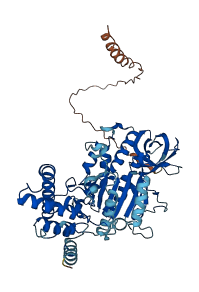
Descriptions
The autoinhibited protein was predicted that may have potential autoinhibitory elements via cis-regPred.
Autoinhibitory domains (AIDs)
Target domain |
|
Relief mechanism |
|
Assay |
cis-regPred |
Accessory elements
No accessory elements
Autoinhibited structure

Activated structure
1 structures for P46561
| Entry ID | Method | Resolution | Chain | Position | Source |
|---|---|---|---|---|---|
| AF-P46561-F1 | Predicted | AlphaFoldDB |
No variants for P46561
| Variant ID(s) | Position | Change | Description | Diseaes Association | Provenance |
|---|---|---|---|---|---|
| No variants for P46561 | |||||
No associated diseases with P46561
4 regional properties for P46561
| Type | Name | Position | InterPro Accession |
|---|---|---|---|
| domain | ATPase, F1/V1/A1 complex, alpha/beta subunit, nucleotide-binding domain | 195 - 414 | IPR000194 |
| domain | AAA+ ATPase domain | 207 - 391 | IPR003593 |
| domain | ATPase, F1/V1/A1 complex, alpha/beta subunit, N-terminal domain | 72 - 138 | IPR004100 |
| active_site | ATPase, alpha/beta subunit, nucleotide-binding domain, active site | 405 - 414 | IPR020003 |
Functions
| Description | ||
|---|---|---|
| EC Number | 7.1.2.2 | Hydron translocation linked to the hydrolysis of a nucleoside triphosphate |
| Subcellular Localization |
|
|
| PANTHER Family | ||
| PANTHER Subfamily | ||
| PANTHER Protein Class | ||
| PANTHER Pathway Category | No pathway information available | |
5 GO annotations of cellular component
| Name | Definition |
|---|---|
| cilium | A specialized eukaryotic organelle that consists of a filiform extrusion of the cell surface and of some cytoplasmic parts. Each cilium is largely bounded by an extrusion of the cytoplasmic (plasma) membrane, and contains a regular longitudinal array of microtubules, anchored to a basal body. |
| mitochondrial proton-transporting ATP synthase complex | A proton-transporting ATP synthase complex found in the mitochondrial membrane. |
| mitochondrion | A semiautonomous, self replicating organelle that occurs in varying numbers, shapes, and sizes in the cytoplasm of virtually all eukaryotic cells. It is notably the site of tissue respiration. |
| non-motile cilium | A cilium which may have a variable array of axonemal microtubules but does not contain molecular motors. |
| proton-transporting ATP synthase complex, catalytic core F(1) | The sector of a hydrogen-transporting ATP synthase complex in which the catalytic activity resides; it comprises the catalytic core and central stalk, and is peripherally associated with a membrane, such as the plasma membrane or the mitochondrial inner membrane, when the entire ATP synthase is assembled. |
4 GO annotations of molecular function
| Name | Definition |
|---|---|
| ATP binding | Binding to ATP, adenosine 5'-triphosphate, a universally important coenzyme and enzyme regulator. |
| protein domain specific binding | Binding to a specific domain of a protein. |
| proton-transporting ATP synthase activity, rotational mechanism | Enables the synthesis of ATP from ADP and phosphate by the transfer of protons from one side of a membrane to the other by a rotational mechanism driven by a gradient according to the reaction: ADP + H2O + phosphate + H+(in) -> ATP + H+(out). |
| proton-transporting ATPase activity, rotational mechanism | Enables the transfer of protons from one side of a membrane to the other according to the reaction: ATP + H2O + H+(in) = ADP + phosphate + H+(out), by a rotational mechanism. |
12 GO annotations of biological process
| Name | Definition |
|---|---|
| dauer larval development | The process whose specific outcome is the progression of the dauer larva over time, through the facultative diapause of the dauer (enduring) larval stage, with specialized traits adapted for dispersal and long-term survival, with elevated stress resistance and without feeding. |
| defecation | The expulsion of feces from the rectum. |
| defense response to Gram-negative bacterium | Reactions triggered in response to the presence of a Gram-negative bacterium that act to protect the cell or organism. |
| determination of adult lifespan | The pathways that regulate the duration of the adult phase of the life-cycle of an animal. |
| embryonic morphogenesis | The process in which anatomical structures are generated and organized during the embryonic phase. The embryonic phase begins with zygote formation. The end of the embryonic phase is organism-specific. For example, it would be at birth for mammals, larval hatching for insects and seed dormancy in plants. |
| gonad development | The process whose specific outcome is the progression of the gonad over time, from its formation to the mature structure. The gonad is an animal organ that produces gametes; in some species it also produces hormones. |
| inductive cell migration | Migration of a cell in a multicellular organism that, having changed its location, is required to induce normal properties in one or more cells at its new location. An example of this would be the distal tip cells of Caenorhabditis elegans. |
| mating behavior | The behavioral interactions between organisms for the purpose of mating, or sexual reproduction resulting in the formation of zygotes. |
| negative regulation of gene expression | Any process that decreases the frequency, rate or extent of gene expression. Gene expression is the process in which a gene's coding sequence is converted into a mature gene product (protein or RNA). |
| nematode larval development | The process whose specific outcome is the progression of the nematode larva over time, from its formation to the mature structure. Nematode larval development begins with the newly hatched first-stage larva (L1) and ends with the end of the last larval stage (for example the fourth larval stage (L4) in C. elegans). Each stage of nematode larval development is characterized by proliferation of specific cell lineages and an increase in body size without alteration of the basic body plan. Nematode larval stages are separated by molts in which each stage-specific exoskeleton, or cuticle, is shed and replaced anew. |
| pharyngeal pumping | The contraction and relaxation movements of the pharyngeal muscle that mediate feeding in nematodes. |
| proton motive force-driven mitochondrial ATP synthesis | The transport of protons across a mitochondrial membrane to generate an electrochemical gradient (proton-motive force) that powers ATP synthesis. |
6 homologous proteins in AiPD
| UniProt AC | Gene Name | Protein Name | Species | Evidence Code |
|---|---|---|---|---|
| P00829 | ATP5F1B | ATP synthase subunit beta, mitochondrial | Bos taurus (Bovine) | PR |
| Q5ZLC5 | ATP5F1B | ATP synthase subunit beta, mitochondrial | Gallus gallus (Chicken) | PR |
| Q05825 | ATPsynbeta | ATP synthase subunit beta, mitochondrial | Drosophila melanogaster (Fruit fly) | PR |
| P06576 | ATP5F1B | ATP synthase subunit beta, mitochondrial | Homo sapiens (Human) | PR |
| P56480 | Atp5f1b | ATP synthase subunit beta, mitochondrial | Mus musculus (Mouse) | PR |
| P10719 | Atp5f1b | ATP synthase subunit beta, mitochondrial | Rattus norvegicus (Rat) | PR |
| 10 | 20 | 30 | 40 | 50 | 60 |
| MASRSLASIS | RSASRLLQSN | VQKCALPAAS | IRLSSNNVES | KKGIHTGVAT | QQAAAATKVS |
| 70 | 80 | 90 | 100 | 110 | 120 |
| AKATAANASG | RIVAVIGAVV | DVQFDENLPP | ILNGLEVVGR | SPRLILEVSQ | HLGDNVVRCI |
| 130 | 140 | 150 | 160 | 170 | 180 |
| AMDGTEGLVR | GQPVADTGDP | IKIPVGPETL | GRIMNVIGEP | IDERGPIASK | NFAAIHAEAP |
| 190 | 200 | 210 | 220 | 230 | 240 |
| EFVEMSVEQE | ILVTGIKVVD | LLAPYAKGGK | IGLFGGAGVG | KTVLIMELIN | NVAKAHGGYS |
| 250 | 260 | 270 | 280 | 290 | 300 |
| VFAGVGERTR | EGNDLYHEMI | EGGVIDLKGK | NSKVSLVYGQ | MNEPPGARAR | VCLTGLTVAE |
| 310 | 320 | 330 | 340 | 350 | 360 |
| YFRDQEGQDV | LLFIDNIFRF | TQAGSEVSAL | LGRIPSAVGY | QPTLATDMGS | MQERITTTKK |
| 370 | 380 | 390 | 400 | 410 | 420 |
| GSITSVQAIY | VPADDLTDPA | PATTFAHLDA | TTVLSRGIAE | LAIYPAVDPL | DSTSRIMDPN |
| 430 | 440 | 450 | 460 | 470 | 480 |
| VVGQNHYDIA | RGVQKILQDY | KSLQDIIAIL | GMDELSEEDK | LTVSRARKIQ | RFLSQPFQVA |
| 490 | 500 | 510 | 520 | 530 | |
| EVFTGHQGKF | VSLEETIRGF | TMILKGELDH | LPEVAFYMQG | GIDDVFKKAE | ELAKQHGN |