P10719
Gene name |
Atp5f1b |
Protein name |
ATP synthase subunit beta, mitochondrial |
Names |
ATP synthase F1 subunit beta |
Species |
Rattus norvegicus (Rat) |
KEGG Pathway |
rno:171374 |
EC number |
7.1.2.2: Hydron translocation linked to the hydrolysis of a nucleoside triphosphate |
Protein Class |
|
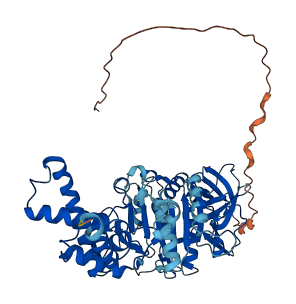
Descriptions
The autoinhibited protein was predicted that may have potential autoinhibitory elements via cis-regPred.
Autoinhibitory domains (AIDs)
Target domain |
|
Relief mechanism |
|
Assay |
cis-regPred |
Accessory elements
No accessory elements
Autoinhibited structure

Activated structure
3 structures for P10719
| Entry ID | Method | Resolution | Chain | Position | Source |
|---|---|---|---|---|---|
| 1MAB | X-ray | 280 A | B | 51-529 | PDB |
| 2F43 | X-ray | 300 A | B | 51-529 | PDB |
| AF-P10719-F1 | Predicted | AlphaFoldDB |
No variants for P10719
| Variant ID(s) | Position | Change | Description | Diseaes Association | Provenance |
|---|---|---|---|---|---|
| No variants for P10719 | |||||
No associated diseases with P10719
4 regional properties for P10719
| Type | Name | Position | InterPro Accession |
|---|---|---|---|
| domain | ATPase, F1/V1/A1 complex, alpha/beta subunit, nucleotide-binding domain | 195 - 414 | IPR000194 |
| domain | AAA+ ATPase domain | 207 - 391 | IPR003593 |
| domain | ATPase, F1/V1/A1 complex, alpha/beta subunit, N-terminal domain | 72 - 138 | IPR004100 |
| active_site | ATPase, alpha/beta subunit, nucleotide-binding domain, active site | 405 - 414 | IPR020003 |
Functions
| Description | ||
|---|---|---|
| EC Number | 7.1.2.2 | Hydron translocation linked to the hydrolysis of a nucleoside triphosphate |
| Subcellular Localization |
|
|
| PANTHER Family | ||
| PANTHER Subfamily | ||
| PANTHER Protein Class | ||
| PANTHER Pathway Category | No pathway information available | |
12 GO annotations of cellular component
| Name | Definition |
|---|---|
| cell surface | The external part of the cell wall and/or plasma membrane. |
| membrane | A lipid bilayer along with all the proteins and protein complexes embedded in it an attached to it. |
| membrane raft | Any of the small (10-200 nm), heterogeneous, highly dynamic, sterol- and sphingolipid-enriched membrane domains that compartmentalize cellular processes. Small rafts can sometimes be stabilized to form larger platforms through protein-protein and protein-lipid interactions. |
| mitochondrial inner membrane | The inner, i.e. lumen-facing, lipid bilayer of the mitochondrial envelope. It is highly folded to form cristae. |
| mitochondrial membrane | Either of the lipid bilayers that surround the mitochondrion and form the mitochondrial envelope. |
| mitochondrial nucleoid | The region of a mitochondrion to which the DNA is confined. |
| mitochondrial proton-transporting ATP synthase complex | A proton-transporting ATP synthase complex found in the mitochondrial membrane. |
| mitochondrial proton-transporting ATP synthase complex, catalytic sector F(1) | The catalytic sector of the mitochondrial hydrogen-transporting ATP synthase; it comprises the catalytic core and central stalk, and is peripherally associated with the mitochondrial inner membrane when the entire ATP synthase is assembled. |
| mitochondrion | A semiautonomous, self replicating organelle that occurs in varying numbers, shapes, and sizes in the cytoplasm of virtually all eukaryotic cells. It is notably the site of tissue respiration. |
| plasma membrane | The membrane surrounding a cell that separates the cell from its external environment. It consists of a phospholipid bilayer and associated proteins. |
| proton-transporting ATP synthase complex | A proton-transporting two-sector ATPase complex that catalyzes the phosphorylation of ADP to ATP during oxidative phosphorylation. The complex comprises a membrane sector (F0) that carries out proton transport and a cytoplasmic compartment sector (F1) that catalyzes ATP synthesis by a rotational mechanism; the extramembrane sector (containing 3 a and 3 b subunits) is connected via the d-subunit to the membrane sector by several smaller subunits. Within this complex, the g and e subunits and the 9-12 c subunits rotate by consecutive 120 degree angles and perform parts of ATP synthesis. This movement is driven by the hydrogen ion electrochemical potential gradient. |
| proton-transporting ATP synthase complex, catalytic core F(1) | The sector of a hydrogen-transporting ATP synthase complex in which the catalytic activity resides; it comprises the catalytic core and central stalk, and is peripherally associated with a membrane, such as the plasma membrane or the mitochondrial inner membrane, when the entire ATP synthase is assembled. |
9 GO annotations of molecular function
| Name | Definition |
|---|---|
| ADP binding | Binding to ADP, adenosine 5'-diphosphate. |
| angiostatin binding | Binding to angiostatin, a proteolytic product of plasminogen or plasmin containing at least one intact kringle domain, and which is an inhibitor of angiogenesis. |
| ATP binding | Binding to ATP, adenosine 5'-triphosphate, a universally important coenzyme and enzyme regulator. |
| ATP hydrolysis activity | Catalysis of the reaction: ATP + H2O = ADP + H+ phosphate. ATP hydrolysis is used in some reactions as an energy source, for example to catalyze a reaction or drive transport against a concentration gradient. |
| calcium ion binding | Binding to a calcium ion (Ca2+). |
| lipoprotein particle receptor activity | Combining with a lipoprotein particle and delivering the lipoprotein particle into the cell via endocytosis. A lipoprotein particle, also known as a lipoprotein, is a clathrate complex consisting of a lipid enwrapped in a protein host without covalent binding in such a way that the complex has a hydrophilic outer surface consisting of all the protein and the polar ends of any phospholipids. |
| MHC class I protein binding | Binding to a major histocompatibility complex class I molecule; a set of molecules displayed on cell surfaces that are responsible for lymphocyte recognition and antigen presentation. |
| proton-transporting ATP synthase activity, rotational mechanism | Enables the synthesis of ATP from ADP and phosphate by the transfer of protons from one side of a membrane to the other by a rotational mechanism driven by a gradient according to the reaction: ADP + H2O + phosphate + H+(in) -> ATP + H+(out). |
| proton-transporting ATPase activity, rotational mechanism | Enables the transfer of protons from one side of a membrane to the other according to the reaction: ATP + H2O + H+(in) = ADP + phosphate + H+(out), by a rotational mechanism. |
17 GO annotations of biological process
| Name | Definition |
|---|---|
| angiogenesis | Blood vessel formation when new vessels emerge from the proliferation of pre-existing blood vessels. |
| ATP biosynthetic process | The chemical reactions and pathways resulting in the formation of ATP, adenosine 5'-triphosphate, a universally important coenzyme and enzyme regulator. |
| ATP metabolic process | The chemical reactions and pathways involving ATP, adenosine triphosphate, a universally important coenzyme and enzyme regulator. |
| cellular response to interleukin-7 | Any process that results in a change in state or activity of a cell (in terms of movement, secretion, enzyme production, gene expression, etc.) as a result of an interleukin-7 stimulus. |
| cellular response to peptide | Any process that results in a change in state or activity of a cell (in terms of movement, secretion, enzyme production, gene expression, etc.) as a result of a peptide stimulus. |
| cold acclimation | Any process that increases freezing tolerance of an organism in response to low, nonfreezing temperatures. |
| lipid metabolic process | The chemical reactions and pathways involving lipids, compounds soluble in an organic solvent but not, or sparingly, in an aqueous solvent. Includes fatty acids; neutral fats, other fatty-acid esters, and soaps; long-chain (fatty) alcohols and waxes; sphingoids and other long-chain bases; glycolipids, phospholipids and sphingolipids; and carotenes, polyprenols, sterols, terpenes and other isoprenoids. |
| liver development | The process whose specific outcome is the progression of the liver over time, from its formation to the mature structure. The liver is an exocrine gland which secretes bile and functions in metabolism of protein and carbohydrate and fat, synthesizes substances involved in the clotting of the blood, synthesizes vitamin A, detoxifies poisonous substances, stores glycogen, and breaks down worn-out erythrocytes. |
| negative regulation of cell adhesion involved in substrate-bound cell migration | The disassembly of adhesions at the front and rear of a migrating cell. At the leading edge, adhesion disassembly accompanies the formation of new protrusions; at the cell rear, it promotes tail retraction. |
| positive regulation of blood vessel endothelial cell migration | Any process that activates or increases the frequency, rate or extent of the migration of the endothelial cells of blood vessels. |
| proton motive force-driven mitochondrial ATP synthesis | The transport of protons across a mitochondrial membrane to generate an electrochemical gradient (proton-motive force) that powers ATP synthesis. |
| proton transmembrane transport | The directed movement of a proton across a membrane. |
| receptor-mediated endocytosis | An endocytosis process in which cell surface receptors ensure specificity of transport. A specific receptor on the cell surface binds tightly to the extracellular macromolecule (the ligand) that it recognizes; the plasma-membrane region containing the receptor-ligand complex then undergoes endocytosis, forming a transport vesicle containing the receptor-ligand complex and excluding most other plasma-membrane proteins. Receptor-mediated endocytosis generally occurs via clathrin-coated pits and vesicles. |
| regulation of intracellular pH | Any process that modulates the internal pH of a cell, measured by the concentration of the hydrogen ion. |
| response to 3,3',5-triiodo-L-thyronine | Any process that results in a change in state or activity of a cell or an organism (in terms of movement, secretion, enzyme production, gene expression, etc.) as a result of a 3,3',5-triiodo-L-thyronine stimulus. |
| response to curcumin | Any process that results in a change in state or activity of a cell or an organism (in terms of movement, secretion, enzyme production, gene expression, etc.) as a result of a curcumin stimulus. |
| response to manganese ion | Any process that results in a change in state or activity of a cell or an organism (in terms of movement, secretion, enzyme production, gene expression, etc.) as a result of a manganese ion stimulus. |
6 homologous proteins in AiPD
| UniProt AC | Gene Name | Protein Name | Species | Evidence Code |
|---|---|---|---|---|
| P00829 | ATP5F1B | ATP synthase subunit beta, mitochondrial | Bos taurus (Bovine) | PR |
| Q5ZLC5 | ATP5F1B | ATP synthase subunit beta, mitochondrial | Gallus gallus (Chicken) | PR |
| Q05825 | ATPsynbeta | ATP synthase subunit beta, mitochondrial | Drosophila melanogaster (Fruit fly) | PR |
| P06576 | ATP5F1B | ATP synthase subunit beta, mitochondrial | Homo sapiens (Human) | PR |
| P56480 | Atp5f1b | ATP synthase subunit beta, mitochondrial | Mus musculus (Mouse) | PR |
| P46561 | atp-2 | ATP synthase subunit beta, mitochondrial | Caenorhabditis elegans | PR |
| 10 | 20 | 30 | 40 | 50 | 60 |
| MLSLVGRVAS | ASASGALRGL | NPLAALPQAH | LLLRTAPAGV | HPARDYAAQS | SAAPKAGTAT |
| 70 | 80 | 90 | 100 | 110 | 120 |
| GQIVAVIGAV | VDVQFDEGLP | PILNALEVQG | RESRLVLEVA | QHLGESTVRT | IAMDGTEGLV |
| 130 | 140 | 150 | 160 | 170 | 180 |
| RGQKVLDSGA | PIKIPVGPET | LGRIMNVIGE | PIDERGPIKT | KQFAPIHAEA | PEFIEMSVEQ |
| 190 | 200 | 210 | 220 | 230 | 240 |
| EILVTGIKVV | DLLAPYAKGG | KIGLFGGAGV | GKTVLIMELI | NNVAKAHGGY | SVFAGVGERT |
| 250 | 260 | 270 | 280 | 290 | 300 |
| REGNDLYHEM | IESGVINLKD | ATSKVALVYG | QMNEPPGARA | RVALTGLTVA | EYFRDQEGQD |
| 310 | 320 | 330 | 340 | 350 | 360 |
| VLLFIDNIFR | FTQAGSEVSA | LLGRIPSAVG | YQPTLATDMG | TMQERITTTK | KGSITSVQAI |
| 370 | 380 | 390 | 400 | 410 | 420 |
| YVPADDLTDP | APATTFAHLD | ATTVLSRAIA | ELGIYPAVDP | LDSTSRIMDP | NIVGSEHYDV |
| 430 | 440 | 450 | 460 | 470 | 480 |
| ARGVQKILQD | YKSLQDIIAI | LGMDELSEED | KLTVSRARKI | QRFLSQPFQV | AEVFTGHMGK |
| 490 | 500 | 510 | 520 | ||
| LVPLKETIKG | FQQILAGDYD | HLPEQAFYMV | GPIEEAVAKA | DKLAEEHGS |