P46411
Gene name |
SLC1A3 |
Protein name |
Excitatory amino acid transporter 1 |
Names |
Sodium-dependent glutamate/aspartate transporter 1, GLAST-1, Solute carrier family 1 member 3 |
Species |
Bos taurus (Bovine) |
KEGG Pathway |
bta:282354 |
EC number |
|
Protein Class |
|
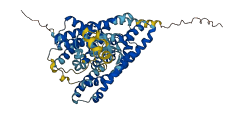
Descriptions
The autoinhibited protein was predicted that may have potential autoinhibitory elements via cis-regPred.
Autoinhibitory domains (AIDs)
Target domain |
|
Relief mechanism |
|
Assay |
cis-regPred |
Accessory elements
No accessory elements
Autoinhibited structure

Activated structure
1 structures for P46411
| Entry ID | Method | Resolution | Chain | Position | Source |
|---|---|---|---|---|---|
| AF-P46411-F1 | Predicted | AlphaFoldDB |
46 variants for P46411
| Variant ID(s) | Position | Change | Description | Diseaes Association | Provenance |
|---|---|---|---|---|---|
| rs719831416 | 41 | V>L | No | EVA | |
| rs437828262 | 51 | V>L | No | EVA | |
| rs449119845 | 53 | L>P | No | EVA | |
| rs481454956 | 54 | T>P | No | EVA | |
| rs467814485 | 56 | T>I | No | EVA | |
| rs466172134 | 56 | T>P | No | EVA | |
| rs477507843 | 59 | I>F | No | EVA | |
| rs450340366 | 60 | V>G | No | EVA | |
| rs459105828 | 60 | V>L | No | EVA | |
| rs464361529 | 67 | T>A | No | EVA | |
| rs482310608 | 69 | R>* | No | EVA | |
| rs456892089 | 70 | P>Q | No | EVA | |
| rs463855916 | 73 | M>I | No | EVA | |
| rs442137353 | 74 | S>G | No | EVA | |
| rs481618257 | 75 | Y>F | No | EVA | |
| rs459904919 | 77 | E>A | No | EVA | |
| rs441505468 | 79 | K>M | No | EVA | |
| rs471314487 | 84 | P>T | No | EVA | |
| rs476248221 | 89 | M>L | No | EVA | |
| rs454611851 | 97 | L>F | No | EVA | |
| rs472390958 | 103 | S>R | No | EVA | |
| rs453798188 | 104 | L>R | No | EVA | |
| rs452186214 | 124 | V>L | No | EVA | |
| rs433706654 | 134 | A>T | No | EVA | |
| rs444943744 | 205 | P>T | No | EVA | |
| rs518830507 | 240 | G>E | No | EVA | |
| rs521589340 | 263 | Q>H | No | EVA | |
| rs469208166 | 267 | L>M | No | EVA | |
| rs432758093 | 296 | L>M | No | EVA | |
| rs475455299 | 302 | V>L | No | EVA | |
| rs457031160 | 330 | V>G | No | EVA | |
| rs437088454 | 366 | S>P | No | EVA | |
| rs469933859 | 419 | F>L | No | EVA | |
| rs447197958 | 431 | I>S | No | EVA | |
| rs476808325 | 432 | T>S | No | EVA | |
| rs482605891 | 436 | A>S | No | EVA | |
| rs470348507 | 448 | L>V | No | EVA | |
| rs460407159 | 457 | S>T | No | EVA | |
| rs450444757 | 470 | A>E | No | EVA | |
| rs445337254 | 484 | V>G | No | EVA | |
| rs478188172 | 487 | D>E | No | EVA | |
| rs462961132 | 489 | L>I | No | EVA | |
| rs480938671 | 498 | S>* | No | EVA | |
| rs439992444 | 505 | R>G | No | EVA | |
| rs468094128 | 510 | G>V | No | EVA | |
| rs518642646 | 537 | D>Y | No | EVA |
No associated diseases with P46411
2 regional properties for P46411
| Type | Name | Position | InterPro Accession |
|---|---|---|---|
| conserved_site | Sodium:dicarboxylate symporter, conserved site | 84 - 98 | IPR018107-1 |
| conserved_site | Sodium:dicarboxylate symporter, conserved site | 392 - 415 | IPR018107-2 |
8 GO annotations of cellular component
| Name | Definition |
|---|---|
| cell surface | The external part of the cell wall and/or plasma membrane. |
| cytoplasmic vesicle | A vesicle found in the cytoplasm of a cell. |
| integral component of plasma membrane | The component of the plasma membrane consisting of the gene products and protein complexes having at least some part of their peptide sequence embedded in the hydrophobic region of the membrane. |
| neuron projection | A prolongation or process extending from a nerve cell, e.g. an axon or dendrite. |
| neuronal cell body | The portion of a neuron that includes the nucleus, but excludes cell projections such as axons and dendrites. |
| perinuclear region of cytoplasm | Cytoplasm situated near, or occurring around, the nucleus. |
| plasma membrane | The membrane surrounding a cell that separates the cell from its external environment. It consists of a phospholipid bilayer and associated proteins. |
| synapse | The junction between an axon of one neuron and a dendrite of another neuron, a muscle fiber or a glial cell. As the axon approaches the synapse it enlarges into a specialized structure, the presynaptic terminal bouton, which contains mitochondria and synaptic vesicles. At the tip of the terminal bouton is the presynaptic membrane; facing it, and separated from it by a minute cleft (the synaptic cleft) is a specialized area of membrane on the receiving cell, known as the postsynaptic membrane. In response to the arrival of nerve impulses, the presynaptic terminal bouton secretes molecules of neurotransmitters into the synaptic cleft. These diffuse across the cleft and transmit the signal to the postsynaptic membrane. |
6 GO annotations of molecular function
| Name | Definition |
|---|---|
| glutamate binding | Binding to glutamate, the anion of 2-aminopentanedioic acid. |
| glutamate:sodium symporter activity | Enables the transfer of a solute or solutes from one side of a membrane to the other according to the reaction: glutamate(out) + Na+(out) = glutamate(in) + Na+(in). |
| high-affinity L-glutamate transmembrane transporter activity | Enables the transfer of glutamate from one side of a membrane to the other. In high-affinity transport the transporter is able to bind the solute even if it is only present at very low concentrations. |
| L-glutamate transmembrane transporter activity | Enables the transfer of L-glutamate from one side of a membrane to the other. L-glutamate is the anion of 2-aminopentanedioic acid. |
| metal ion binding | Binding to a metal ion. |
| neutral amino acid transmembrane transporter activity | Enables the transfer of neutral amino acids from one side of a membrane to the other. Neutral amino acids have side chains with no charge at pH 7.3. |
24 GO annotations of biological process
| Name | Definition |
|---|---|
| auditory behavior | The behavior of an organism in response to a sound. |
| cell morphogenesis involved in neuron differentiation | The process in which the structures of a neuron are generated and organized. This process occurs while the initially relatively unspecialized cell is acquiring the specialized features of a neuron. |
| cellular response to cocaine | Any process that results in a change in state or activity of a cell (in terms of movement, secretion, enzyme production, gene expression, etc.) as a result of a cocaine stimulus. Cocaine is a crystalline alkaloid obtained from the leaves of the coca plant. |
| cellular sodium ion homeostasis | Any process involved in the maintenance of an internal steady state of sodium ions at the level of a cell. |
| chloride transmembrane transport | The process in which chloride is transported across a membrane. |
| cranial nerve development | The process whose specific outcome is the progression of the cranial nerves over time, from its formation to the mature structure. The cranial nerves are composed of twelve pairs of nerves that emanate from the nervous tissue of the hindbrain. These nerves are sensory, motor, or mixed in nature, and provide the motor and general sensory innervation of the head, neck and viscera. They mediate vision, hearing, olfaction and taste and carry the parasympathetic innervation of the autonomic ganglia that control visceral functions. |
| D-aspartate import across plasma membrane | The directed import of D-aspartate from the extracellular region across the plasma membrane and into the cytosol. |
| gamma-aminobutyric acid biosynthetic process | The chemical reactions and pathways resulting in the formation of gamma-aminobutyric acid (GABA, 4-aminobutyrate), an amino acid which acts as a neurotransmitter in some organisms. |
| L-aspartate import across plasma membrane | The directed movement of L-aspartate from outside of a cell, across the plasma membrane and into the cytosol. |
| L-aspartate transmembrane transport | The directed movement of L-aspartate across a membrane. |
| L-glutamate import across plasma membrane | The directed movement of L-glutamate from outside of a cell, across the plasma membrane and into the cytosol. |
| L-glutamate transmembrane transport | The directed movement of L-glutamate across a membrane. |
| neuromuscular process controlling balance | Any process that an organism uses to control its balance, the orientation of the organism (or the head of the organism) in relation to the source of gravity. In humans and animals, balance is perceived through visual cues, the labyrinth system of the inner ears and information from skin pressure receptors and muscle and joint receptors. |
| positive regulation of synaptic transmission | Any process that activates or increases the frequency, rate or extent of synaptic transmission, the process of communication from a neuron to a target (neuron, muscle, or secretory cell) across a synapse. |
| potassium ion transmembrane transport | A process in which a potassium ion is transported from one side of a membrane to the other. |
| response to amino acid | Any process that results in a change in state or activity of a cell or an organism (in terms of movement, secretion, enzyme production, gene expression, etc.) as a result of an amino acid stimulus. An amino acid is a carboxylic acids containing one or more amino groups. |
| response to antibiotic | Any process that results in a change in state or activity of a cell or an organism (in terms of movement, secretion, enzyme production, gene expression, etc.) as a result of an antibiotic stimulus. An antibiotic is a chemical substance produced by a microorganism which has the capacity to inhibit the growth of or to kill other microorganisms. |
| response to inorganic substance | Any process that results in a change in state or activity of a cell or an organism (in terms of movement, secretion, enzyme production, gene expression, etc.) as a result of an inorganic substance stimulus. |
| response to light stimulus | Any process that results in a change in state or activity of a cell or an organism (in terms of movement, secretion, enzyme production, gene expression, etc.) as a result of a light stimulus, electromagnetic radiation of wavelengths classified as infrared, visible or ultraviolet light. |
| response to wounding | Any process that results in a change in state or activity of a cell or an organism (in terms of movement, secretion, enzyme production, gene expression, etc.) as a result of a stimulus indicating damage to the organism. |
| response to xenobiotic stimulus | Any process that results in a change in state or activity of a cell or an organism (in terms of movement, secretion, enzyme production, gene expression, etc.) as a result of a stimulus from a xenobiotic, a compound foreign to the organim exposed to it. It may be synthesized by another organism (like ampicilin) or it can be a synthetic chemical. |
| sensory perception of sound | The series of events required for an organism to receive an auditory stimulus, convert it to a molecular signal, and recognize and characterize the signal. Sonic stimuli are detected in the form of vibrations and are processed to form a sound. |
| transepithelial transport | The directed movement of a substance from one side of an epithelium to the other. |
| transport across blood-brain barrier | The directed movement of substances (e.g. macromolecules, small molecules, ions) through the blood-brain barrier. |
5 homologous proteins in AiPD
| UniProt AC | Gene Name | Protein Name | Species | Evidence Code |
|---|---|---|---|---|
| P43003 | SLC1A3 | Excitatory amino acid transporter 1 | Homo sapiens (Human) | PR |
| O35544 | Slc1a6 | Excitatory amino acid transporter 4 | Mus musculus (Mouse) | PR |
| Q8JZR4 | Slc1a7 | Excitatory amino acid transporter 5 | Mus musculus (Mouse) | PR |
| P56564 | Slc1a3 | Excitatory amino acid transporter 1 | Mus musculus (Mouse) | PR |
| P24942 | Slc1a3 | Excitatory amino acid transporter 1 | Rattus norvegicus (Rat) | PR |
| 10 | 20 | 30 | 40 | 50 | 60 |
| MTKSNGEEAR | LGGRMERFQQ | GVRKRTLLAK | KKVQNITKED | VKSYLFRNAF | VLLTVTAVIV |
| 70 | 80 | 90 | 100 | 110 | 120 |
| GTILGFTLRP | YRMSYREVKY | FSFPGELLMR | MLQMLVLPLI | ISSLVTGMAA | LDSKASGKMG |
| 130 | 140 | 150 | 160 | 170 | 180 |
| MRAVVYYMTT | TIIAVVIGII | IVIIIHPGKG | TKENMHREGK | IVQVTAADAF | LDLIRNMFPP |
| 190 | 200 | 210 | 220 | 230 | 240 |
| NLVEACFKQF | KTNYEKRSFK | VPIQPNETLV | GAVINNVSEA | METLTRITEE | LVPVPGSVNG |
| 250 | 260 | 270 | 280 | 290 | 300 |
| VNALGLVVFS | MCFGFVIGNM | KEQGQALREF | FDSLNEAIMR | LVAVIMWYAP | LGILFLIAGK |
| 310 | 320 | 330 | 340 | 350 | 360 |
| IVEMEDMGVI | GGQLAMYTVT | VIVGLLIHAV | IVLPLLYFLV | TRKNPWVFIG | GLLQALITAL |
| 370 | 380 | 390 | 400 | 410 | 420 |
| GTSSSSATLP | ITFKCLEENN | GVDKRVTRFV | LPVGATINMD | GTALYEALAA | IFIAQVNNFE |
| 430 | 440 | 450 | 460 | 470 | 480 |
| LNFGQIITIS | ITATAASIGA | AGIPQAGLVT | MVIVLTSVGL | PTDDITLIIA | VDWFLDRLRT |
| 490 | 500 | 510 | 520 | 530 | 540 |
| TTNVLGDSLG | AGIVEHLSRH | ELKNRDVEMG | NSVIEENEMK | KPYQLISQES | EIEKSMDSET |
| KM |