O35544
Gene name |
Slc1a6 (Eaat4) |
Protein name |
Excitatory amino acid transporter 4 |
Names |
High-affinity neuronal glutamate transporter, Sodium-dependent glutamate/aspartate transporter, Solute carrier family 1 member 6 |
Species |
Mus musculus (Mouse) |
KEGG Pathway |
mmu:20513 |
EC number |
|
Protein Class |
|
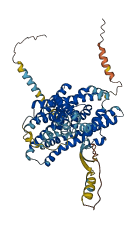
Descriptions
The autoinhibited protein was predicted that may have potential autoinhibitory elements via cis-regPred.
Autoinhibitory domains (AIDs)
Target domain |
|
Relief mechanism |
|
Assay |
cis-regPred |
Accessory elements
No accessory elements
Autoinhibited structure

Activated structure
1 structures for O35544
| Entry ID | Method | Resolution | Chain | Position | Source |
|---|---|---|---|---|---|
| AF-O35544-F1 | Predicted | AlphaFoldDB |
23 variants for O35544
| Variant ID(s) | Position | Change | Description | Diseaes Association | Provenance |
|---|---|---|---|---|---|
| rs3389110437 | 3 | S>T | No | EVA | |
| rs3389084606 | 14 | G>S | No | EVA | |
| rs227674896 | 22 | G>S | No | EVA | |
| rs3389104540 | 29 | Q>K | No | EVA | |
| rs3400202003 | 189 | E>* | No | EVA | |
| rs3413013547 | 189 | E>Q | No | EVA | |
| rs3400722232 | 191 | C>S | No | EVA | |
| rs231359427 | 221 | M>I | No | EVA | |
| rs3389116922 | 248 | I>K | No | EVA | |
| rs3389097839 | 248 | I>M | No | EVA | |
| rs3389111892 | 271 | F>L | No | EVA | |
| rs3401619240 | 273 | V>A | No | EVA | |
| rs3400722229 | 276 | G>V | No | EVA | |
| rs3401344408 | 284 | H>P | No | EVA | |
| rs3389121028 | 313 | V>M | No | EVA | |
| rs3389052747 | 383 | G>S | No | EVA | |
| rs3389112290 | 390 | T>I | No | EVA | |
| rs3389097889 | 397 | C>R | No | EVA | |
| rs3389097897 | 411 | F>L | No | EVA | |
| rs3389077711 | 432 | A>S | No | EVA | |
| rs3389084529 | 468 | A>G | No | EVA | |
| rs3389104495 | 486 | D>V | No | EVA | |
| rs3389111973 | 552 | R>M | No | EVA |
No associated diseases with O35544
2 regional properties for O35544
| Type | Name | Position | InterPro Accession |
|---|---|---|---|
| conserved_site | Sodium:dicarboxylate symporter, conserved site | 89 - 103 | IPR018107-1 |
| conserved_site | Sodium:dicarboxylate symporter, conserved site | 414 - 437 | IPR018107-2 |
10 GO annotations of cellular component
| Name | Definition |
|---|---|
| glutamatergic synapse | A synapse that uses glutamate as a neurotransmitter. |
| Golgi apparatus | A membrane-bound cytoplasmic organelle of the endomembrane system that further processes the core oligosaccharides (e.g. N-glycans) added to proteins in the endoplasmic reticulum and packages them into membrane-bound vesicles. The Golgi apparatus operates at the intersection of the secretory, lysosomal, and endocytic pathways. |
| integral component of plasma membrane | The component of the plasma membrane consisting of the gene products and protein complexes having at least some part of their peptide sequence embedded in the hydrophobic region of the membrane. |
| integral component of postsynaptic membrane | The component of the postsynaptic membrane consisting of the gene products and protein complexes having at least some part of their peptide sequence embedded in the hydrophobic region of the membrane. |
| integral component of presynaptic membrane | The component of the presynaptic membrane consisting of the gene products and protein complexes having at least some part of their peptide sequence embedded in the hydrophobic region of the membrane. |
| intermediate filament cytoskeleton | Cytoskeletal structure made from intermediate filaments, typically organized in the cytosol as an extended system that stretches from the nuclear envelope to the plasma membrane. Some intermediate filaments run parallel to the cell surface, while others traverse the cytosol; together they form an internal framework that helps support the shape and resilience of the cell. |
| membrane | A lipid bilayer along with all the proteins and protein complexes embedded in it an attached to it. |
| membrane protein complex | Any protein complex that is part of a membrane. |
| parallel fiber to Purkinje cell synapse | An excitatory synapse formed by the parallel fibers of granule cells synapsing onto the dendrites of Purkinje cells. |
| plasma membrane | The membrane surrounding a cell that separates the cell from its external environment. It consists of a phospholipid bilayer and associated proteins. |
7 GO annotations of molecular function
| Name | Definition |
|---|---|
| anion transmembrane transporter activity | Enables the transfer of a negatively charged ion from one side of a membrane to the other. |
| glutamate:sodium symporter activity | Enables the transfer of a solute or solutes from one side of a membrane to the other according to the reaction: glutamate(out) + Na+(out) = glutamate(in) + Na+(in). |
| high-affinity L-glutamate transmembrane transporter activity | Enables the transfer of glutamate from one side of a membrane to the other. In high-affinity transport the transporter is able to bind the solute even if it is only present at very low concentrations. |
| L-aspartate transmembrane transporter activity | Enables the transfer of L-aspartate from one side of a membrane to the other. L-aspartate is the anion derived from aspartic acid. |
| L-glutamate transmembrane transporter activity | Enables the transfer of L-glutamate from one side of a membrane to the other. L-glutamate is the anion of 2-aminopentanedioic acid. |
| metal ion binding | Binding to a metal ion. |
| neutral amino acid transmembrane transporter activity | Enables the transfer of neutral amino acids from one side of a membrane to the other. Neutral amino acids have side chains with no charge at pH 7.3. |
6 GO annotations of biological process
| Name | Definition |
|---|---|
| establishment of localization in cell | Any process, occuring in a cell, that localizes a substance or cellular component. This may occur via movement, tethering or selective degradation. |
| L-aspartate import across plasma membrane | The directed movement of L-aspartate from outside of a cell, across the plasma membrane and into the cytosol. |
| L-glutamate import across plasma membrane | The directed movement of L-glutamate from outside of a cell, across the plasma membrane and into the cytosol. |
| L-glutamate transmembrane transport | The directed movement of L-glutamate across a membrane. |
| neurotransmitter uptake | The directed movement of neurotransmitters into neurons or glial cells. This process leads to inactivation and recycling of neurotransmitters. |
| regulation of membrane potential | Any process that modulates the establishment or extent of a membrane potential, the electric potential existing across any membrane arising from charges in the membrane itself and from the charges present in the media on either side of the membrane. |
5 homologous proteins in AiPD
| UniProt AC | Gene Name | Protein Name | Species | Evidence Code |
|---|---|---|---|---|
| P46411 | SLC1A3 | Excitatory amino acid transporter 1 | Bos taurus (Bovine) | PR |
| P43003 | SLC1A3 | Excitatory amino acid transporter 1 | Homo sapiens (Human) | PR |
| P56564 | Slc1a3 | Excitatory amino acid transporter 1 | Mus musculus (Mouse) | PR |
| Q8JZR4 | Slc1a7 | Excitatory amino acid transporter 5 | Mus musculus (Mouse) | PR |
| P24942 | Slc1a3 | Excitatory amino acid transporter 1 | Rattus norvegicus (Rat) | PR |
| 10 | 20 | 30 | 40 | 50 | 60 |
| MSSHGNSLFL | RESGAGGGCL | QGLQDSLQQR | ALRTRLRLQT | MTREHVRRFL | RRNAFILLTV |
| 70 | 80 | 90 | 100 | 110 | 120 |
| SAVIIGVSLA | FALRPYQLSY | RQIKYFSFPG | ELLMRMLQML | VLPLIVSSLV | TGMASLDNKA |
| 130 | 140 | 150 | 160 | 170 | 180 |
| TGRMGMRAAV | YYMVTTVIAV | FIGILMVTII | HPGKGSKEGL | HREGRIETVP | TADAFMDLVR |
| 190 | 200 | 210 | 220 | 230 | 240 |
| NMFPPNLVEA | CFKQFKTQYS | TRVVTRTIVR | TDNGSELGAS | MSPTSSVENE | TSILENVTRA |
| 250 | 260 | 270 | 280 | 290 | 300 |
| LGTLQEVISF | EETVPVPGSA | NGINALGLVV | FSVAFGLVIG | GMKHKGRVLR | DFFDSLNEAI |
| 310 | 320 | 330 | 340 | 350 | 360 |
| MRLVGIIIWY | APVGILFLIA | GKILEMEDMA | VLGGQLGMYT | LTVIVGLFLH | AGGVLPLIYF |
| 370 | 380 | 390 | 400 | 410 | 420 |
| LVTHRNPFPF | IGGMLQALIT | AMGTSSSSAT | LPITFRCLEE | GLGVDRRITR | FVLPVGATVN |
| 430 | 440 | 450 | 460 | 470 | 480 |
| MDGTALYEAL | AAIFIAQVNN | YELNLGQITT | ISITATAASV | GAAGIPQAGL | VTMVIVLTSV |
| 490 | 500 | 510 | 520 | 530 | 540 |
| GLPTEDITLI | IAVDWFLDRL | RTMTNVLGDS | IGAAVIEHLS | QRELELQEAE | LTLPSLGKPY |
| 550 | 560 | ||||
| KSLMAQEKGA | SRGRGGNESV | M |