P43545
Gene name |
SNZ3 (YFL059W) |
Protein name |
Probable pyridoxal 5'-phosphate synthase subunit SNZ3 |
Names |
PLP synthase subunit SNZ3, PDX1 homolog 3, Pdx1.3 |
Species |
Saccharomyces cerevisiae (strain ATCC 204508 / S288c) (Baker's yeast) |
KEGG Pathway |
sce:YFL059W |
EC number |
4.3.3.6: Amine-lyases |
Protein Class |
|
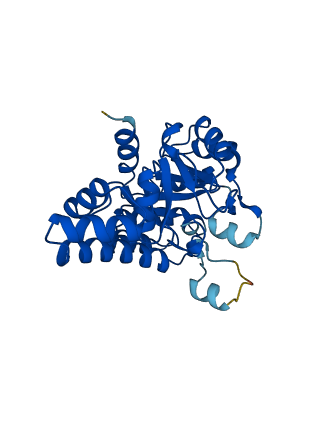
Descriptions
The autoinhibited protein was predicted that may have potential autoinhibitory elements via cis-regPred.
Autoinhibitory domains (AIDs)
Target domain |
|
Relief mechanism |
|
Assay |
cis-regPred |
Accessory elements
No accessory elements
Autoinhibited structure

Activated structure
1 structures for P43545
| Entry ID | Method | Resolution | Chain | Position | Source |
|---|---|---|---|---|---|
| AF-P43545-F1 | Predicted | AlphaFoldDB |
6 variants for P43545
| Variant ID(s) | Position | Change | Description | Diseaes Association | Provenance |
|---|---|---|---|---|---|
| s06-11547 | 62 | R>H | No | SGRP | |
| s06-11844 | 161 | I>N | No | SGRP | |
| s06-11858 | 166 | A>T | No | SGRP | |
| s06-11896 | 178 | E>D | No | SGRP | |
| s06-11941 | 193 | D>E | No | SGRP | |
| s06-11955 | 198 | T>I | No | SGRP |
No associated diseases with P43545
1 regional properties for P43545
| Type | Name | Position | InterPro Accession |
|---|---|---|---|
| domain | PdxS/SNZ N-terminal domain | 4 - 211 | IPR033755 |
Functions
| Description | ||
|---|---|---|
| EC Number | 4.3.3.6 | Amine-lyases |
| Subcellular Localization |
|
|
| PANTHER Family | ||
| PANTHER Subfamily | ||
| PANTHER Protein Class | ||
| PANTHER Pathway Category | No pathway information available | |
No GO annotations of cellular component
| Name | Definition |
|---|---|
| No GO annotations for cellular component |
2 GO annotations of molecular function
| Name | Definition |
|---|---|
| amine-lyase activity | Catalysis of the release of amines by the cleavage of a carbon-nitrogen bond or the reverse reaction with an amine as a substrate. |
| pyridoxal 5'-phosphate synthase (glutamine hydrolysing) activity | Catalysis of the reaction: D-ribose 5-phosphate + D-glyceraldehyde 3-phosphate + L-glutamine = pyridoxal 5'-phosphate + L-glutamate + 3 H2O + phosphate. The reaction occurs in two steps: L-glutamine + H2O = L-glutamate + NH3, and subsequently D-ribose 5-phosphate + D-glyceraldehyde 3-phosphate + NH3 = pyridoxal 5'-phosphate + 4 H2O + phosphate. |
4 GO annotations of biological process
| Name | Definition |
|---|---|
| cellular amino acid metabolic process | The chemical reactions and pathways involving amino acids, carboxylic acids containing one or more amino groups, as carried out by individual cells. |
| pyridoxal phosphate biosynthetic process | The chemical reactions and pathways resulting in the formation of pyridoxal phosphate, pyridoxal phosphorylated at the hydroxymethyl group of C-5, the active form of vitamin B6. |
| pyridoxine biosynthetic process | The chemical reactions and pathways resulting in the formation of pyridoxine, 2-methyl-3-hydroxy-4,5-bis(hydroxymethyl)pyridine, one of the vitamin B6 compounds. |
| thiamine biosynthetic process | The chemical reactions and pathways resulting in the formation of thiamine (vitamin B1), a water soluble vitamin present in fresh vegetables and meats, especially liver. |
4 homologous proteins in AiPD
| UniProt AC | Gene Name | Protein Name | Species | Evidence Code |
|---|---|---|---|---|
| P53824 | SNZ2 | Probable pyridoxal 5'-phosphate synthase subunit SNZ2 | Saccharomyces cerevisiae (strain ATCC 204508 / S288c) (Baker's yeast) | PR |
| Q8W3D0 | PDX12 | Probable pyridoxal 5'-phosphate synthase subunit PDX1.2 | Oryza sativa subsp japonica (Rice) | PR |
| Q69LA6 | PDX11 | Probable pyridoxal 5'-phosphate synthase subunit PDX1.1 | Oryza sativa subsp japonica (Rice) | PR |
| O80448 | PDX11 | Pyridoxal 5'-phosphate synthase subunit PDX1.1 | Arabidopsis thaliana (Mouse-ear cress) | PR |
| 10 | 20 | 30 | 40 | 50 | 60 |
| MSEFKVKTGL | AQMLKGGVIM | DVVTPEQAII | AERAGACAVM | ALERIPADMR | KSGQVCRMSD |
| 70 | 80 | 90 | 100 | 110 | 120 |
| PRMIKEIMEA | VSIPVMAKVR | IGHFVEAQIL | EELQVDYIDE | SEVLTPADWT | HHIEKHNFKV |
| 130 | 140 | 150 | 160 | 170 | 180 |
| PFVCGAKDLG | EALRRINEGA | AMIRTKGEAG | TGDVSEAVKH | ITKIKAEIQQ | YKENLKTESD |
| 190 | 200 | 210 | 220 | 230 | 240 |
| FAAKATELRV | PVDLLKTTLS | EGKLPVVNFA | AGGVATPADA | ALLMQLGCEG | VFVGSGIFKS |
| 250 | 260 | 270 | 280 | 290 | |
| SDPEKLACAI | VEATTHYDNP | AKLLQVSSDL | GDLMGGISIQ | SINEAGGKNG | ARLSEIGW |