P35318
Gene name |
ADM (AM) |
Protein name |
Pro-adrenomedullin |
Names |
|
Species |
Homo sapiens (Human) |
KEGG Pathway |
hsa:133 |
EC number |
|
Protein Class |
|
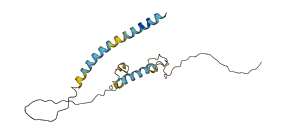
Descriptions
The autoinhibited protein was predicted that may have potential autoinhibitory elements via cis-regPred.
Autoinhibitory domains (AIDs)
Target domain |
|
Relief mechanism |
|
Assay |
cis-regPred |
Accessory elements
No accessory elements
Autoinhibited structure

Activated structure
9 structures for P35318
| Entry ID | Method | Resolution | Chain | Position | Source |
|---|---|---|---|---|---|
| 2FLY | NMR | - | A | 22-41 | PDB |
| 2L7S | NMR | - | A | 95-146 | PDB |
| 4RWF | X-ray | 176 A | B | 119-146 | PDB |
| 5V6Y | X-ray | 280 A | E/F/G/H | 131-146 | PDB |
| 6UUN | EM | 300 A | P | 95-146 | PDB |
| 6UUS | EM | 240 A | P | 95-146 | PDB |
| 6V2E | X-ray | 183 A | B | 131-146 | PDB |
| 7VV0 | EM | 350 A | L | 30-41 | PDB |
| AF-P35318-F1 | Predicted | AlphaFoldDB |
178 variants for P35318
| Variant ID(s) | Position | Change | Description | Diseaes Association | Provenance |
|---|---|---|---|---|---|
|
rs766389485 CA5882259 |
4 | V>D | No |
ClinGen ExAC gnomAD |
|
|
CA5882258 rs762357404 |
4 | V>L | No |
ClinGen ExAC gnomAD |
|
|
CA5882260 rs148801166 |
6 | V>I | No |
ClinGen 1000Genomes ESP ExAC TOPMed gnomAD |
|
|
CA5882262 rs767431764 |
8 | L>V | No |
ClinGen ExAC gnomAD |
|
|
rs752472370 CA5882263 |
9 | M>I | No |
ClinGen ExAC TOPMed gnomAD |
|
|
rs1289638471 CA379849987 |
9 | M>V | No |
ClinGen gnomAD |
|
|
CA217928761 rs931123318 |
10 | Y>F | No |
ClinGen TOPMed gnomAD |
|
|
rs1438790728 CA379850020 |
14 | L>F | No |
ClinGen gnomAD |
|
|
CA5882266 rs753996172 |
15 | A>S | No |
ClinGen ExAC gnomAD |
|
| TCGA novel | 15 | A>V | Variant assessed as Somatic; impact. [NCI-TCGA] | No | NCI-TCGA |
|
CA5882267 rs565533460 |
16 | F>L | No |
ClinGen ExAC TOPMed gnomAD |
|
|
rs1316727170 CA379850042 |
18 | G>C | No |
ClinGen gnomAD |
|
|
rs1370526593 CA379850050 |
19 | A>S | No |
ClinGen TOPMed |
|
|
rs746394048 CA5882269 |
22 | A>S | No |
ClinGen ExAC TOPMed gnomAD |
|
|
rs1466904863 CA379850076 |
23 | R>Q | No |
ClinGen gnomAD |
|
|
rs758847030 CA5882270 |
23 | R>W | No |
ClinGen ExAC gnomAD |
|
|
CA5882271 rs780403470 |
24 | L>S | No |
ClinGen ExAC gnomAD |
|
|
rs1406433799 CA379850078 |
24 | L>V | No |
ClinGen TOPMed |
|
|
CA379850086 rs1175444954 |
25 | D>G | No |
ClinGen gnomAD |
|
|
CA5882272 rs747334853 |
25 | D>N | No |
ClinGen ExAC gnomAD |
|
|
CA5882275 rs772717944 |
27 | A>P | No |
ClinGen ExAC gnomAD |
|
|
rs772717944 CA379850096 |
27 | A>S | No |
ClinGen ExAC gnomAD |
|
|
rs772717944 CA5882274 |
27 | A>T | No |
ClinGen ExAC gnomAD |
|
|
rs1419432532 CA379850099 |
27 | A>V | No |
ClinGen gnomAD |
|
|
CA217928763 rs1050560995 |
28 | S>L | No |
ClinGen TOPMed gnomAD |
|
|
rs1161097911 CA379850102 |
28 | S>T | No |
ClinGen gnomAD |
|
|
CA379850104 rs1050560995 |
28 | S>W | No |
ClinGen TOPMed gnomAD |
|
|
rs1487313792 CA379850120 |
30 | F>L | No |
ClinGen TOPMed |
|
|
rs1591387661 CA379850113 |
30 | F>V | No |
ClinGen Ensembl |
|
|
rs1266925426 CA379850135 |
33 | K>E | No |
ClinGen TOPMed |
|
|
CA5882296 rs368386294 |
35 | N>K | No |
ClinGen ESP ExAC TOPMed gnomAD |
|
|
CA5882297 rs371400834 |
36 | K>E | No |
ClinGen ESP ExAC gnomAD |
|
| TCGA novel | 36 | K>N | Variant assessed as Somatic; impact. [NCI-TCGA] | No | NCI-TCGA |
|
CA379850177 CA5882298 rs775255772 |
37 | W>R | No |
ClinGen ExAC TOPMed gnomAD |
|
|
CA379850190 rs1293506682 |
38 | A>D | No |
ClinGen gnomAD |
|
|
rs374664537 CA5882300 |
40 | S>N | No |
ClinGen ESP ExAC TOPMed gnomAD |
|
|
CA379850205 rs1271690785 |
41 | R>C | No |
ClinGen gnomAD |
|
|
rs776425868 CA5882301 |
43 | K>N | No |
ClinGen ExAC gnomAD |
|
|
CA217928772 rs987918571 |
44 | R>K | No |
ClinGen TOPMed |
|
|
CA379850234 rs1360261291 |
45 | E>D | No |
ClinGen TOPMed |
|
|
CA5882302 rs761948640 |
47 | R>W | No |
ClinGen ExAC gnomAD |
|
|
rs1258470392 CA379850260 |
49 | S>C | No |
ClinGen TOPMed gnomAD |
|
|
rs5005 CA5882304 VAR_014861 RCV000959901 |
50 | S>R | No |
ClinGen ClinVar UniProt 1000Genomes ESP ExAC TOPMed dbSNP gnomAD |
|
|
rs1375373536 CA379850269 |
51 | S>G | No |
ClinGen TOPMed |
|
| TCGA novel | 53 | P>S | Variant assessed as Somatic; impact. [NCI-TCGA] | No | NCI-TCGA |
|
CA379850294 rs1184787993 |
54 | T>S | No |
ClinGen TOPMed gnomAD |
|
|
CA5882306 rs766912121 |
57 | A>P | No |
ClinGen ExAC gnomAD |
|
|
CA379850312 rs1170999530 |
57 | A>V | No |
ClinGen gnomAD |
|
|
CA379850319 rs1464091492 |
58 | D>E | No |
ClinGen TOPMed |
|
|
rs1374226848 CA379850323 |
59 | V>L | No |
ClinGen gnomAD |
|
|
rs752037871 CA5882307 |
60 | K>N | No |
ClinGen ExAC gnomAD |
|
|
CA5882308 rs755466368 |
61 | A>S | No |
ClinGen ExAC gnomAD |
|
|
CA217928774 rs1015030948 |
62 | G>R | No |
ClinGen Ensembl |
|
|
CA379850348 rs781425252 |
63 | P>L | No |
ClinGen ExAC TOPMed gnomAD |
|
|
rs781425252 CA5882309 |
63 | P>R | No |
ClinGen ExAC TOPMed gnomAD |
|
|
rs1269035117 CA379850351 |
64 | A>S | No |
ClinGen TOPMed gnomAD |
|
|
rs575977037 CA5882310 |
65 | Q>H | No |
ClinGen ExAC gnomAD |
|
|
rs573280699 CA5882311 |
66 | T>A | No |
ClinGen 1000Genomes ExAC gnomAD |
|
| TCGA novel | 66 | T>I | Variant assessed as Somatic; impact. [NCI-TCGA] | No | NCI-TCGA |
|
rs368598004 CA5882312 |
67 | L>F | No |
ClinGen ESP ExAC TOPMed gnomAD |
|
|
CA5882313 rs745407550 |
68 | I>M | No |
ClinGen ExAC TOPMed gnomAD |
|
|
rs771734789 CA5882314 |
69 | R>Q | Variant assessed as Somatic; 0.0 impact. [NCI-TCGA] | No |
ClinGen ExAC NCI-TCGA TOPMed gnomAD |
|
rs962132270 CA379850379 |
69 | R>W | No |
ClinGen TOPMed gnomAD |
|
|
rs764500142 CA217928776 |
70 | P>L | No |
ClinGen Ensembl |
|
|
rs779565271 CA5882315 |
70 | P>S | No |
ClinGen ExAC gnomAD |
|
|
CA379850392 rs1486221830 |
71 | Q>H | No |
ClinGen gnomAD |
|
|
CA5882316 rs746930372 |
72 | D>V | No |
ClinGen ExAC gnomAD |
|
|
CA5882319 rs761587575 |
73 | M>I | No |
ClinGen ExAC TOPMed gnomAD |
|
|
rs776359239 CA379850404 |
73 | M>K | No |
ClinGen ExAC TOPMed gnomAD |
|
|
rs1454223086 CA379850402 |
73 | M>L | No |
ClinGen gnomAD |
|
|
rs776359239 CA5882318 |
73 | M>R | No |
ClinGen ExAC TOPMed gnomAD |
|
| TCGA novel | 74 | K>V | Variant assessed as Somatic; impact. [NCI-TCGA] | No | NCI-TCGA |
|
CA5882320 rs770053274 |
75 | G>D | Variant assessed as Somatic; 0.0 impact. [NCI-TCGA] | No |
ClinGen ExAC NCI-TCGA gnomAD |
|
rs1317161845 CA379850423 |
76 | A>T | No |
ClinGen TOPMed gnomAD |
|
|
rs1345473085 CA379850433 |
78 | R>G | No |
ClinGen TOPMed gnomAD |
|
|
rs773393238 CA5882321 |
78 | R>Q | No |
ClinGen ExAC gnomAD |
|
|
rs1280416552 CA379850442 |
79 | S>I | No |
ClinGen TOPMed |
|
|
CA217928777 rs920639332 |
80 | P>S | No |
ClinGen TOPMed |
|
|
CA5882325 COSM3979021 rs760027500 |
81 | E>K | lung [Cosmic] | No |
ClinGen cosmic curated ExAC TOPMed gnomAD |
|
rs768053857 CA5882326 |
82 | D>H | No |
ClinGen ExAC TOPMed gnomAD |
|
|
CA379850457 rs768053857 |
82 | D>N | No |
ClinGen ExAC TOPMed gnomAD |
|
|
CA379850466 rs1348238004 |
83 | S>C | No |
ClinGen TOPMed gnomAD |
|
|
CA379850469 rs1223050872 |
83 | S>I | No |
ClinGen gnomAD |
|
|
CA5882369 rs762219274 |
84 | S>C | No |
ClinGen ExAC gnomAD |
|
|
rs762219274 CA379850791 |
84 | S>R | No |
ClinGen ExAC gnomAD |
|
|
rs1372388131 CA379850794 |
84 | S>T | No |
ClinGen gnomAD |
|
|
VAR_048205 rs2228573 RCV000956909 CA5882370 |
85 | P>R | No |
ClinGen ClinVar UniProt 1000Genomes ESP ExAC TOPMed dbSNP |
|
|
CA217928793 rs1021128489 |
85 | P>T | No |
ClinGen Ensembl |
|
|
CA5882372 rs774785781 |
87 | A>V | No |
ClinGen ExAC TOPMed gnomAD |
|
|
rs752136972 CA5882374 |
88 | A>P | No |
ClinGen ExAC gnomAD |
|
|
CA217928794 rs752136972 |
88 | A>S | No |
ClinGen ExAC gnomAD |
|
|
CA5882375 rs752136972 |
88 | A>T | No |
ClinGen ExAC gnomAD |
|
|
rs373413227 CA5882377 |
89 | R>H | No |
ClinGen ESP ExAC TOPMed gnomAD |
|
|
CA5882378 rs373413227 |
89 | R>L | Variant assessed as Somatic; 0.0 impact. [NCI-TCGA] | No |
ClinGen ESP ExAC NCI-TCGA TOPMed gnomAD |
|
rs373413227 CA379850829 |
89 | R>P | No |
ClinGen ESP ExAC TOPMed gnomAD |
|
|
rs1179357383 CA379850826 |
89 | R>S | No |
ClinGen TOPMed |
|
|
CA5882380 rs746111731 |
93 | K>N | No |
ClinGen ExAC gnomAD |
|
|
CA379850885 rs1201356245 |
96 | R>G | No |
ClinGen TOPMed |
|
|
rs769338742 CA5882384 |
97 | Q>H | No |
ClinGen ExAC gnomAD |
|
|
CA5882383 rs747075720 |
97 | Q>L | No |
ClinGen ExAC TOPMed gnomAD |
|
|
rs376677864 CA217928795 |
98 | S>G | No |
ClinGen ESP gnomAD |
|
|
CA379850905 rs1215038669 |
98 | S>R | No |
ClinGen TOPMed |
|
|
CA217928796 rs1004066005 |
98 | S>T | No |
ClinGen TOPMed |
|
|
CA217928797 rs962018945 |
99 | M>L | No |
ClinGen TOPMed |
|
|
rs777250833 CA379850909 |
99 | M>R | No |
ClinGen ExAC TOPMed gnomAD |
|
|
CA5882385 rs777250833 |
99 | M>T | No |
ClinGen ExAC TOPMed gnomAD |
|
|
rs1240234844 CA379850926 |
101 | N>T | No |
ClinGen TOPMed |
|
| TCGA novel | 103 | Q>* | Variant assessed as Somatic; impact. [NCI-TCGA] | No | NCI-TCGA |
|
CA379850954 rs1188710780 |
104 | G>D | No |
ClinGen gnomAD |
|
|
CA217928799 rs866552090 |
105 | L>P | No |
ClinGen TOPMed gnomAD |
|
|
rs866552090 CA379850964 |
105 | L>R | No |
ClinGen TOPMed gnomAD |
|
|
rs762191630 CA5882386 |
106 | R>Q | No |
ClinGen ExAC gnomAD |
|
|
rs1395485280 CA379850986 |
108 | F>L | No |
ClinGen gnomAD |
|
|
CA5882387 rs770217561 |
111 | R>H | No |
ClinGen ExAC gnomAD |
|
|
CA5882388 rs770217561 |
111 | R>L | No |
ClinGen ExAC gnomAD |
|
| TCGA novel | 111 | R>S | Variant assessed as Somatic; impact. [NCI-TCGA] | No | NCI-TCGA |
| TCGA novel | 113 | G>R | Variant assessed as Somatic; impact. [NCI-TCGA] | No | NCI-TCGA |
|
CA379851040 rs1383149401 |
114 | T>M | No |
ClinGen gnomAD |
|
|
rs1331429534 CA379851083 |
119 | K>R | No |
ClinGen TOPMed |
|
|
rs1331429534 CA379851084 |
119 | K>T | No |
ClinGen TOPMed |
|
|
CA5882391 rs752251431 |
121 | A>V | No |
ClinGen ExAC gnomAD |
|
|
rs1565453273 CA379851131 |
125 | Y>H | No |
ClinGen Ensembl |
|
|
CA379851146 rs112526486 |
126 | Q>H | No |
ClinGen 1000Genomes ESP ExAC TOPMed gnomAD |
|
|
CA5882393 rs763554599 |
128 | T>I | No |
ClinGen ExAC gnomAD |
|
|
rs140844268 CA5882394 |
129 | D>N | No |
ClinGen ESP ExAC TOPMed gnomAD |
|
|
rs1235946431 CA379851185 |
131 | D>E | No |
ClinGen gnomAD |
|
|
rs778770096 CA5882397 |
133 | D>N | No |
ClinGen ExAC TOPMed gnomAD |
|
|
rs529300345 CA5882398 |
135 | V>I | No |
ClinGen 1000Genomes ExAC TOPMed gnomAD |
|
|
CA379851225 rs1241830888 |
137 | P>R | No |
ClinGen TOPMed |
|
|
CA597905538 rs1565453297 |
139 | S>L | No |
ClinGen Ensembl |
|
|
rs371681360 CA5882400 |
139 | S>N | No |
ClinGen ExAC TOPMed gnomAD |
|
|
rs1467046970 CA379851234 |
139 | S>R | No |
ClinGen gnomAD |
|
|
CA5882401 rs747129027 |
140 | K>E | No |
ClinGen ExAC |
|
|
rs1268021154 CA379851265 |
143 | P>S | No |
ClinGen gnomAD |
|
|
rs781376753 CA5882403 |
144 | Q>E | No |
ClinGen ExAC TOPMed gnomAD |
|
|
CA5882404 rs748703275 |
144 | Q>R | No |
ClinGen ExAC TOPMed gnomAD |
|
| TCGA novel | 145 | G>D | Variant assessed as Somatic; impact. [NCI-TCGA] | No | NCI-TCGA |
|
CA217928801 rs866419823 |
145 | G>V | No |
ClinGen Ensembl |
|
|
rs773695276 CA5882406 |
147 | G>S | No |
ClinGen ExAC gnomAD |
|
|
rs771749755 CA5882408 |
152 | R>G | No |
ClinGen ExAC gnomAD |
|
|
rs1173372857 CA379851319 |
152 | R>L | No |
ClinGen gnomAD |
|
|
rs775154162 CA5882409 |
153 | S>P | No |
ClinGen ExAC gnomAD |
|
|
CA5882411 rs763603296 |
155 | P>T | No |
ClinGen ExAC gnomAD |
|
|
CA379851337 rs1269438766 |
156 | E>K | No |
ClinGen gnomAD |
|
|
CA5882413 rs761874343 |
157 | A>T | No |
ClinGen ExAC gnomAD |
|
|
CA5882414 rs765070563 |
158 | G>S | No |
ClinGen ExAC TOPMed gnomAD |
|
|
CA379851351 rs1265955887 |
158 | G>V | No |
ClinGen gnomAD |
|
| TCGA novel | 159 | P>missing | Variant assessed as Somatic; impact. [NCI-TCGA] | No | NCI-TCGA |
|
CA379851356 rs750283609 |
159 | P>L | No |
ClinGen ExAC TOPMed gnomAD |
|
|
rs750283609 CA5882416 |
159 | P>Q | No |
ClinGen ExAC TOPMed gnomAD |
|
|
rs750283609 CA5882415 |
159 | P>R | No |
ClinGen ExAC TOPMed gnomAD |
|
|
rs1489425976 CA379851355 |
159 | P>S | No |
ClinGen gnomAD |
|
|
CA5882418 rs751857285 |
160 | G>D | No |
ClinGen ExAC gnomAD |
|
|
CA379851368 rs1183124131 |
162 | T>A | No |
ClinGen gnomAD |
|
|
rs755194034 CA5882419 |
164 | V>L | No |
ClinGen ExAC gnomAD |
|
|
CA379851394 rs1327034245 |
166 | S>Y | No |
ClinGen gnomAD |
|
|
CA379851419 rs1447258473 |
170 | A>T | No |
ClinGen TOPMed |
|
|
CA217928803 rs199526740 |
170 | A>V | No |
ClinGen gnomAD |
|
|
CA379851433 rs1565453374 |
172 | G>R | No |
ClinGen Ensembl |
|
|
CA217928804 rs988335968 |
172 | G>V | No |
ClinGen TOPMed |
|
|
rs1415185208 CA379851442 |
173 | A>V | Variant assessed as Somatic; impact. [NCI-TCGA] | No |
ClinGen NCI-TCGA TOPMed |
|
rs781336657 CA5882420 |
174 | P>A | No |
ClinGen ExAC gnomAD |
|
|
CA379851444 rs781336657 |
174 | P>S | No |
ClinGen ExAC gnomAD |
|
|
CA379851451 rs1296764361 |
175 | A>V | No |
ClinGen gnomAD |
|
|
rs373588240 CA5882423 |
176 | P>H | No |
ClinGen ESP ExAC TOPMed gnomAD |
|
|
CA5882422 rs748173146 |
176 | P>S | No |
ClinGen ExAC gnomAD |
|
|
CA5882425 rs373720232 |
177 | P>A | No |
ClinGen 1000Genomes ExAC TOPMed gnomAD |
|
|
CA379851461 rs1235180995 |
177 | P>L | No |
ClinGen TOPMed |
|
| rs773405081 | 177 | P>R | Variant assessed as Somatic; 0.0 impact. [NCI-TCGA] | No | NCI-TCGA |
|
CA379851458 rs373720232 |
177 | P>S | No |
ClinGen 1000Genomes ExAC TOPMed gnomAD |
|
|
CA217928806 rs373720232 |
177 | P>T | No |
ClinGen 1000Genomes ExAC TOPMed gnomAD |
|
| rs773405081 | 178 | S>E | Variant assessed as Somatic; 0.0 impact. [NCI-TCGA] | No | NCI-TCGA |
|
rs771306099 CA5882426 |
178 | S>N | Variant assessed as Somatic; 0.0 impact. [NCI-TCGA] | No |
ClinGen ExAC NCI-TCGA TOPMed gnomAD |
|
CA379851490 rs1202392375 |
182 | P>A | No |
ClinGen gnomAD |
|
|
CA217928807 rs926266115 |
183 | H>P | No |
ClinGen Ensembl |
|
|
rs1483246640 CA379851508 |
184 | F>L | No |
ClinGen gnomAD |
|
| TCGA novel | 185 | L>I | Variant assessed as Somatic; impact. [NCI-TCGA] | No | NCI-TCGA |
|
CA5882428 rs746665872 |
185 | L>V | No |
ClinGen ExAC gnomAD |
No associated diseases with P35318
No regional properties for P35318
| Type | Name | Position | InterPro Accession |
|---|---|---|---|
| No domain, repeats, and functional sites for P35318 | |||
3 GO annotations of cellular component
| Name | Definition |
|---|---|
| cytoplasm | The contents of a cell excluding the plasma membrane and nucleus, but including other subcellular structures. |
| extracellular region | The space external to the outermost structure of a cell. For cells without external protective or external encapsulating structures this refers to space outside of the plasma membrane. This term covers the host cell environment outside an intracellular parasite. |
| extracellular space | That part of a multicellular organism outside the cells proper, usually taken to be outside the plasma membranes, and occupied by fluid. |
3 GO annotations of molecular function
| Name | Definition |
|---|---|
| adrenomedullin receptor binding | Binding to an adrenomedullin receptor. |
| hormone activity | The action characteristic of a hormone, any substance formed in very small amounts in one specialized organ or group of cells and carried (sometimes in the bloodstream) to another organ or group of cells in the same organism, upon which it has a specific regulatory action. The term was originally applied to agents with a stimulatory physiological action in vertebrate animals (as opposed to a chalone, which has a depressant action). Usage is now extended to regulatory compounds in lower animals and plants, and to synthetic substances having comparable effects; all bind receptors and trigger some biological process. |
| signaling receptor binding | Binding to one or more specific sites on a receptor molecule, a macromolecule that undergoes combination with a hormone, neurotransmitter, drug or intracellular messenger to initiate a change in cell function. |
48 GO annotations of biological process
| Name | Definition |
|---|---|
| adenylate cyclase-activating G protein-coupled receptor signaling pathway | A G protein-coupled receptor signaling pathway in which the signal is transmitted via the activation of adenylyl cyclase activity and a subsequent increase in the intracellular concentration of cyclic AMP (cAMP). |
| adrenomedullin receptor signaling pathway | The series of molecular signals initiated by an extracellular adrenomedullin combining with a dimeric adrenomedullin receptor on the surface of the target cell. |
| aging | A developmental process that is a deterioration and loss of function over time. Aging includes loss of functions such as resistance to disease, homeostasis, and fertility, as well as wear and tear. Aging includes cellular senescence, but is more inclusive. May precede death and may succeed developmental maturation (GO:0021700). |
| amylin receptor signaling pathway | A G protein-coupled receptor signaling pathway initiated by amylin binding to its receptor on the surface of a target cell, and ending with the regulation of a downstream cellular process. |
| androgen metabolic process | The chemical reactions and pathways involving androgens, C19 steroid hormones that can stimulate the development of male sexual characteristics. |
| animal organ regeneration | The regrowth of a lost or destroyed animal organ. |
| antibacterial humoral response | An immune response against bacteria mediated through a body fluid. Examples of this process are the antibacterial humoral responses in Mus musculus and Drosophila melanogaster. |
| antimicrobial humoral immune response mediated by antimicrobial peptide | An immune response against microbes mediated by anti-microbial peptides in body fluid. |
| branching involved in labyrinthine layer morphogenesis | The process in which the branches of the fetal placental villi are generated and organized. The villous part of the placenta is called the labyrinth layer. |
| calcium ion homeostasis | Any process involved in the maintenance of an internal steady state of calcium ions within an organism or cell. |
| cAMP-mediated signaling | Any intracellular signal transduction in which the signal is passed on within the cell via cyclic AMP (cAMP). Includes production of cAMP, and downstream effectors that further transmit the signal within the cell. |
| cell population proliferation | The multiplication or reproduction of cells, resulting in the expansion of a cell population. |
| defense response to Gram-negative bacterium | Reactions triggered in response to the presence of a Gram-negative bacterium that act to protect the cell or organism. |
| defense response to Gram-positive bacterium | Reactions triggered in response to the presence of a Gram-positive bacterium that act to protect the cell or organism. |
| developmental growth | The increase in size or mass of an entire organism, a part of an organism or a cell, where the increase in size or mass has the specific outcome of the progression of the organism over time from one condition to another. |
| female pregnancy | The set of physiological processes that allow an embryo or foetus to develop within the body of a female animal. It covers the time from fertilization of a female ovum by a male spermatozoon until birth. |
| G protein-coupled receptor internalization | The process that results in the uptake of a G protein-coupled receptor into an endocytic vesicle. |
| heart development | The process whose specific outcome is the progression of the heart over time, from its formation to the mature structure. The heart is a hollow, muscular organ, which, by contracting rhythmically, keeps up the circulation of the blood. |
| hormone secretion | The regulated release of hormones, substances with a specific regulatory effect on a particular organ or group of cells. |
| inflammatory response | The immediate defensive reaction (by vertebrate tissue) to infection or injury caused by chemical or physical agents. The process is characterized by local vasodilation, extravasation of plasma into intercellular spaces and accumulation of white blood cells and macrophages. |
| negative regulation of cell population proliferation | Any process that stops, prevents or reduces the rate or extent of cell proliferation. |
| negative regulation of vascular permeability | Any process that reduces the extent to which blood vessels can be pervaded by fluid. |
| negative regulation of vasoconstriction | Any process that stops, prevents, or reduces the frequency, rate or extent of vasoconstriction. |
| neural tube closure | The last step in the formation of the neural tube, where the paired neural folds are brought together and fuse at the dorsal midline. |
| neuron projection regeneration | The regrowth of neuronal processes such as axons or dendrites in response to their loss or damage. |
| odontogenesis of dentin-containing tooth | The process whose specific outcome is the progression of a dentin-containing tooth over time, from its formation to the mature structure. A dentin-containing tooth is a hard, bony organ borne on the jaw or other bone of a vertebrate, and is composed mainly of dentin, a dense calcified substance, covered by a layer of enamel. |
| positive regulation of angiogenesis | Any process that activates or increases angiogenesis. |
| positive regulation of apoptotic process | Any process that activates or increases the frequency, rate or extent of cell death by apoptotic process. |
| positive regulation of cell population proliferation | Any process that activates or increases the rate or extent of cell proliferation. |
| positive regulation of cytosolic calcium ion concentration | Any process that increases the concentration of calcium ions in the cytosol. |
| positive regulation of heart rate | Any process that activates or increases the frequency or rate of heart contraction. |
| positive regulation of progesterone biosynthetic process | Any process that activates or increases the frequency, rate or extent of progesterone biosynthetic process. |
| positive regulation of vasculogenesis | Any process that activates or increases the frequency, rate or extent of vasculogenesis. |
| receptor internalization | A receptor-mediated endocytosis process that results in the movement of receptors from the plasma membrane to the inside of the cell. The process begins when cell surface receptors are monoubiquitinated following ligand-induced activation. Receptors are subsequently taken up into endocytic vesicles from where they are either targeted to the lysosome or vacuole for degradation or recycled back to the plasma membrane. |
| regulation of systemic arterial blood pressure | The process that modulates the force with which blood travels through the systemic arterial circulatory system. The process is controlled by a balance of processes that increase pressure and decrease pressure. |
| regulation of the force of heart contraction | Any process that modulates the extent of heart contraction, changing the force with which blood is propelled. |
| regulation of urine volume | Any process that modulates the amount of urine excreted from the body over a unit of time. |
| response to cold | Any process that results in a change in state or activity of a cell or an organism (in terms of movement, secretion, enzyme production, gene expression, etc.) as a result of a cold stimulus, a temperature stimulus below the optimal temperature for that organism. |
| response to glucocorticoid | Any process that results in a change in state or activity of a cell or an organism (in terms of movement, secretion, enzyme production, gene expression, etc.) as a result of a glucocorticoid stimulus. Glucocorticoids are hormonal C21 corticosteroids synthesized from cholesterol with the ability to bind with the cortisol receptor and trigger similar effects. Glucocorticoids act primarily on carbohydrate and protein metabolism, and have anti-inflammatory effects. |
| response to hypoxia | Any process that results in a change in state or activity of a cell or an organism (in terms of movement, secretion, enzyme production, gene expression, etc.) as a result of a stimulus indicating lowered oxygen tension. Hypoxia, defined as a decline in O2 levels below normoxic levels of 20.8 - 20.95%, results in metabolic adaptation at both the cellular and organismal level. |
| response to insulin | Any process that results in a change in state or activity of a cell or an organism (in terms of movement, secretion, enzyme production, gene expression, etc.) as a result of an insulin stimulus. Insulin is a polypeptide hormone produced by the islets of Langerhans of the pancreas in mammals, and by the homologous organs of other organisms. |
| response to lipopolysaccharide | Any process that results in a change in state or activity of an organism (in terms of movement, secretion, enzyme production, gene expression, etc.) as a result of a lipopolysaccharide stimulus; lipopolysaccharide is a major component of the cell wall of gram-negative bacteria. |
| response to starvation | Any process that results in a change in state or activity of a cell or an organism (in terms of movement, secretion, enzyme production, gene expression, etc.) as a result of a starvation stimulus, deprivation of nourishment. |
| response to wounding | Any process that results in a change in state or activity of a cell or an organism (in terms of movement, secretion, enzyme production, gene expression, etc.) as a result of a stimulus indicating damage to the organism. |
| signal transduction | The cellular process in which a signal is conveyed to trigger a change in the activity or state of a cell. Signal transduction begins with reception of a signal (e.g. a ligand binding to a receptor or receptor activation by a stimulus such as light), or for signal transduction in the absence of ligand, signal-withdrawal or the activity of a constitutively active receptor. Signal transduction ends with regulation of a downstream cellular process, e.g. regulation of transcription or regulation of a metabolic process. Signal transduction covers signaling from receptors located on the surface of the cell and signaling via molecules located within the cell. For signaling between cells, signal transduction is restricted to events at and within the receiving cell. |
| spongiotrophoblast layer development | The process in which the spongiotrophoblast layer of the placenta progresses from its formation to its mature state. |
| vascular associated smooth muscle cell development | The process aimed at the progression of a vascular smooth muscle cell over time, from initial commitment of the cell to a specific fate, to the fully functional differentiated cell. A vascular smooth muscle cell is a non-striated, elongated, spindle-shaped cell found lining the blood vessels. |
| vasculogenesis | The differentiation of endothelial cells from progenitor cells during blood vessel development, and the de novo formation of blood vessels and tubes. |
| 10 | 20 | 30 | 40 | 50 | 60 |
| MKLVSVALMY | LGSLAFLGAD | TARLDVASEF | RKKWNKWALS | RGKRELRMSS | SYPTGLADVK |
| 70 | 80 | 90 | 100 | 110 | 120 |
| AGPAQTLIRP | QDMKGASRSP | EDSSPDAARI | RVKRYRQSMN | NFQGLRSFGC | RFGTCTVQKL |
| 130 | 140 | 150 | 160 | 170 | 180 |
| AHQIYQFTDK | DKDNVAPRSK | ISPQGYGRRR | RRSLPEAGPG | RTLVSSKPQA | HGAPAPPSGS |
| APHFL |