P14408
Gene name |
Fh |
Protein name |
Fumarate hydratase, mitochondrial |
Names |
Fumarase |
Species |
Rattus norvegicus (Rat) |
KEGG Pathway |
rno:24368 |
EC number |
|
Protein Class |
|
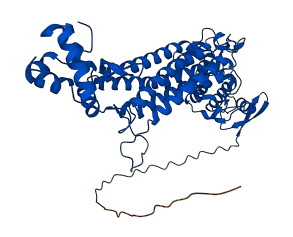
Descriptions
The autoinhibited protein was predicted that may have potential autoinhibitory elements via cis-regPred.
Autoinhibitory domains (AIDs)
Target domain |
|
Relief mechanism |
|
Assay |
cis-regPred |
Accessory elements
No accessory elements
Autoinhibited structure

Activated structure
1 structures for P14408
| Entry ID | Method | Resolution | Chain | Position | Source |
|---|---|---|---|---|---|
| AF-P14408-F1 | Predicted | AlphaFoldDB |
1 variants for P14408
| Variant ID(s) | Position | Change | Description | Diseaes Association | Provenance |
|---|---|---|---|---|---|
| rs8160983 | 481 | E>K | No | EVA |
No associated diseases with P14408
5 GO annotations of cellular component
| Name | Definition |
|---|---|
| chromosome | A structure composed of a very long molecule of DNA and associated proteins (e.g. histones) that carries hereditary information. |
| cytosol | The part of the cytoplasm that does not contain organelles but which does contain other particulate matter, such as protein complexes. |
| mitochondrion | A semiautonomous, self replicating organelle that occurs in varying numbers, shapes, and sizes in the cytoplasm of virtually all eukaryotic cells. It is notably the site of tissue respiration. |
| nucleus | A membrane-bounded organelle of eukaryotic cells in which chromosomes are housed and replicated. In most cells, the nucleus contains all of the cell's chromosomes except the organellar chromosomes, and is the site of RNA synthesis and processing. In some species, or in specialized cell types, RNA metabolism or DNA replication may be absent. |
| tricarboxylic acid cycle enzyme complex | Any of the heteromeric enzymes that act in the TCA cycle. |
1 GO annotations of molecular function
| Name | Definition |
|---|---|
| fumarate hydratase activity | Catalysis of the reaction: (S)-malate = fumarate + H(2)O. |
11 GO annotations of biological process
| Name | Definition |
|---|---|
| cellular response to DNA damage stimulus | Any process that results in a change in state or activity of a cell (in terms of movement, secretion, enzyme production, gene expression, etc.) as a result of a stimulus indicating damage to its DNA from environmental insults or errors during metabolism. |
| DNA repair | The process of restoring DNA after damage. Genomes are subject to damage by chemical and physical agents in the environment (e.g. UV and ionizing radiations, chemical mutagens, fungal and bacterial toxins, etc.) and by free radicals or alkylating agents endogenously generated in metabolism. DNA is also damaged because of errors during its replication. A variety of different DNA repair pathways have been reported that include direct reversal, base excision repair, nucleotide excision repair, photoreactivation, bypass, double-strand break repair pathway, and mismatch repair pathway. |
| fumarate metabolic process | The chemical reactions and pathways involving fumarate, the anion of trans-1,2-ethenedicarboxylic acid, the diastereoisomer of maleate. It is a key intermediate in metabolism and is formed in the TCA cycle from succinate and converted into malate. |
| homeostasis of number of cells within a tissue | Any biological process involved in the maintenance of the steady-state number of cells within a population of cells in a tissue. |
| malate metabolic process | The chemical reactions and pathways involving malate, the anion of hydroxybutanedioic acid, a chiral hydroxydicarboxylic acid. The (+) enantiomer is an important intermediate in metabolism as a component of both the TCA cycle and the glyoxylate cycle. |
| negative regulation of histone H3-K36 methylation | Any process that stops, prevents, or reduces the frequency, rate or extent of the covalent addition of a methyl group to the lysine at position 36 of histone H3. |
| positive regulation of cold-induced thermogenesis | Any process that activates or increases the frequency, rate or extent of cold-induced thermogenesis. |
| positive regulation of double-strand break repair via nonhomologous end joining | Any process that activates or increases the frequency, rate or extent of double-strand break repair via nonhomologous end joining. |
| regulation of arginine metabolic process | Any process that modulates the frequency, rate or extent of the chemical reactions and pathways involving arginine, 2-amino-5-(carbamimidamido)pentanoic acid. |
| tricarboxylic acid cycle | A nearly universal metabolic pathway in which the acetyl group of acetyl coenzyme A is effectively oxidized to two CO2 and four pairs of electrons are transferred to coenzymes. The acetyl group combines with oxaloacetate to form citrate, which undergoes successive transformations to isocitrate, 2-oxoglutarate, succinyl-CoA, succinate, fumarate, malate, and oxaloacetate again, thus completing the cycle. In eukaryotes the tricarboxylic acid is confined to the mitochondria. See also glyoxylate cycle. |
| urea cycle | The sequence of reactions by which arginine is synthesized from ornithine, then cleaved to yield urea and regenerate ornithine. The overall reaction equation is NH3 + CO2 + aspartate + 3 ATP + 2 H2O = urea + fumarate + 2 ADP + 2 phosphate + AMP + diphosphate. |
5 homologous proteins in AiPD
| UniProt AC | Gene Name | Protein Name | Species | Evidence Code |
|---|---|---|---|---|
| P07954 | FH | Fumarate hydratase, mitochondrial | Homo sapiens (Human) | PR |
| P97807 | Fh | Fumarate hydratase, mitochondrial | Mus musculus (Mouse) | PR |
| O17214 | fum-1 | Probable fumarate hydratase, mitochondrial | Caenorhabditis elegans | PR |
| Q9FI53 | FUM2 | Fumarate hydratase 2 | Arabidopsis thaliana (Mouse-ear cress) | PR |
| Q7SX99 | fh | Fumarate hydratase, mitochondrial | Danio rerio (Zebrafish) (Brachydanio rerio) | PR |
| 10 | 20 | 30 | 40 | 50 | 60 |
| MNRAFCLLAR | SRRFPRVPSA | GAVLSGEAAT | LPRCAPNVVR | MASQNSFRIE | YDTFGELKVP |
| 70 | 80 | 90 | 100 | 110 | 120 |
| TDKYYGAQTV | RSTMNFKIGG | ATERMPIPVI | KAFGILKRAA | AEVNQEYGLD | PKIASAIMKA |
| 130 | 140 | 150 | 160 | 170 | 180 |
| ADEVAEGKLN | DHFPLVVWQT | GSGTQTNMNV | NEVISNRAIE | MLGGELGSKK | PVHPNDHVNK |
| 190 | 200 | 210 | 220 | 230 | 240 |
| SQSSNDTFPT | AMHIAAALEV | HQVLLPGLQK | LHDALSAKSK | EFAQVIKIGR | THTQDAVPLT |
| 250 | 260 | 270 | 280 | 290 | 300 |
| LGQEFSGYVQ | QVQYAMERIK | AAMPRIYELA | AGGTAVGTGL | NTRIGFAEKV | AAKVAALTGL |
| 310 | 320 | 330 | 340 | 350 | 360 |
| PFVTAPNKFE | ALAAHDALVE | LSGAMNTTAC | SLMKIANDIR | FLGSGPRSGL | GELILPENEP |
| 370 | 380 | 390 | 400 | 410 | 420 |
| GSSIMPGKVN | PTQCEAMTMV | AAQVMGNHVA | VTVGGSNGHF | ELNVFKPMMI | KNVLHSARLL |
| 430 | 440 | 450 | 460 | 470 | 480 |
| GDASVSFTEN | CVVGIQANTE | RINKLMNESL | MLVTALNPHI | GYDKAAKIAK | TAHKNGSTLK |
| 490 | 500 | ||||
| ETAIELGYLT | AEQFDEWVKP | KDMLGPK |