P13596
Gene name |
Ncam1 (Ncam) |
Protein name |
Neural cell adhesion molecule 1 |
Names |
|
Species |
Rattus norvegicus (Rat) |
KEGG Pathway |
rno:24586 |
EC number |
|
Protein Class |
|
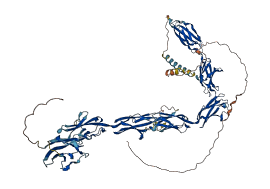
Descriptions
The autoinhibited protein was predicted that may have potential autoinhibitory elements via cis-regPred.
Autoinhibitory domains (AIDs)
Target domain |
|
Relief mechanism |
|
Assay |
cis-regPred |
Accessory elements
No accessory elements
Autoinhibited structure

Activated structure
4 structures for P13596
| Entry ID | Method | Resolution | Chain | Position | Source |
|---|---|---|---|---|---|
| 1EPF | X-ray | 185 A | A/B/C/D | 20-208 | PDB |
| 1LWR | NMR | - | A | 612-705 | PDB |
| 1QZ1 | X-ray | 200 A | A | 20-308 | PDB |
| AF-P13596-F1 | Predicted | AlphaFoldDB |
No variants for P13596
| Variant ID(s) | Position | Change | Description | Diseaes Association | Provenance |
|---|---|---|---|---|---|
| No variants for P13596 | |||||
No associated diseases with P13596
20 regional properties for P13596
| Type | Name | Position | InterPro Accession |
|---|---|---|---|
| domain | Immunoglobulin subtype 2 | 32 - 103 | IPR003598-1 |
| domain | Immunoglobulin subtype 2 | 130 - 196 | IPR003598-2 |
| domain | Immunoglobulin subtype 2 | 226 - 295 | IPR003598-3 |
| domain | Immunoglobulin subtype 2 | 321 - 403 | IPR003598-4 |
| domain | Immunoglobulin subtype 2 | 428 - 497 | IPR003598-5 |
| domain | Immunoglobulin subtype | 26 - 115 | IPR003599-1 |
| domain | Immunoglobulin subtype | 124 - 209 | IPR003599-2 |
| domain | Immunoglobulin subtype | 220 - 306 | IPR003599-3 |
| domain | Immunoglobulin subtype | 315 - 414 | IPR003599-4 |
| domain | Immunoglobulin subtype | 422 - 509 | IPR003599-5 |
| domain | Fibronectin type III | 509 - 609 | IPR003961-1 |
| domain | Fibronectin type III | 611 - 706 | IPR003961-2 |
| domain | Immunoglobulin-like domain | 20 - 111 | IPR007110-1 |
| domain | Immunoglobulin-like domain | 116 - 189 | IPR007110-2 |
| domain | Immunoglobulin-like domain | 212 - 302 | IPR007110-3 |
| domain | Immunoglobulin-like domain | 309 - 414 | IPR007110-4 |
| domain | Immunoglobulin-like domain | 417 - 502 | IPR007110-5 |
| domain | Immunoglobulin I-set | 21 - 114 | IPR013098-1 |
| domain | Immunoglobulin I-set | 217 - 305 | IPR013098-2 |
| domain | Immunoglobulin I-set | 424 - 503 | IPR013098-3 |
12 GO annotations of cellular component
| Name | Definition |
|---|---|
| axon | The long process of a neuron that conducts nerve impulses, usually away from the cell body to the terminals and varicosities, which are sites of storage and release of neurotransmitter. |
| cell surface | The external part of the cell wall and/or plasma membrane. |
| cell-cell junction | A cell junction that forms a connection between two or more cells of an organism; excludes direct cytoplasmic intercellular bridges, such as ring canals in insects. |
| external side of plasma membrane | The leaflet of the plasma membrane that faces away from the cytoplasm and any proteins embedded or anchored in it or attached to its surface. |
| glutamatergic synapse | A synapse that uses glutamate as a neurotransmitter. |
| growth cone | The migrating motile tip of a growing neuron projection, where actin accumulates, and the actin cytoskeleton is the most dynamic. |
| integral component of postsynaptic membrane | The component of the postsynaptic membrane consisting of the gene products and protein complexes having at least some part of their peptide sequence embedded in the hydrophobic region of the membrane. |
| integral component of presynaptic membrane | The component of the presynaptic membrane consisting of the gene products and protein complexes having at least some part of their peptide sequence embedded in the hydrophobic region of the membrane. |
| neuron projection | A prolongation or process extending from a nerve cell, e.g. an axon or dendrite. |
| neuronal cell body | The portion of a neuron that includes the nucleus, but excludes cell projections such as axons and dendrites. |
| plasma membrane | The membrane surrounding a cell that separates the cell from its external environment. It consists of a phospholipid bilayer and associated proteins. |
| Schaffer collateral - CA1 synapse | A synapse between the Schaffer collateral axon of a CA3 pyramidal cell and a CA1 pyramidal cell. |
5 GO annotations of molecular function
| Name | Definition |
|---|---|
| cytoskeletal protein binding | Binding to a protein component of a cytoskeleton (actin, microtubule, or intermediate filament cytoskeleton). |
| fibroblast growth factor receptor binding | Binding to a fibroblast growth factor receptor (FGFR). |
| heparin binding | Binding to heparin, a member of a group of glycosaminoglycans found mainly as an intracellular component of mast cells and which consist predominantly of alternating alpha-(1->4)-linked D-galactose and N-acetyl-D-glucosamine-6-sulfate residues. |
| LRR domain binding | Binding to a LRR domain (leucine rich repeats) of a protein. |
| phosphatase binding | Binding to a phosphatase. |
30 GO annotations of biological process
| Name | Definition |
|---|---|
| aging | A developmental process that is a deterioration and loss of function over time. Aging includes loss of functions such as resistance to disease, homeostasis, and fertility, as well as wear and tear. Aging includes cellular senescence, but is more inclusive. May precede death and may succeed developmental maturation (GO:0021700). |
| animal organ regeneration | The regrowth of a lost or destroyed animal organ. |
| axonal fasciculation | The collection of axons into a bundle of rods, known as a fascicle. |
| brain development | The process whose specific outcome is the progression of the brain over time, from its formation to the mature structure. Brain development begins with patterning events in the neural tube and ends with the mature structure that is the center of thought and emotion. The brain is responsible for the coordination and control of bodily activities and the interpretation of information from the senses (sight, hearing, smell, etc.). |
| calcium-independent cell-cell adhesion via plasma membrane cell-adhesion molecules | The attachment of one cell to another cell via adhesion molecules that do not require the presence of calcium for the interaction. |
| calcium-mediated signaling | Any intracellular signal transduction in which the signal is passed on within the cell via calcium ions. |
| cell adhesion | The attachment of a cell, either to another cell or to an underlying substrate such as the extracellular matrix, via cell adhesion molecules. |
| cell surface receptor signaling pathway | The series of molecular signals initiated by activation of a receptor on the surface of a cell. The pathway begins with binding of an extracellular ligand to a cell surface receptor, or for receptors that signal in the absence of a ligand, by ligand-withdrawal or the activity of a constitutively active receptor. The pathway ends with regulation of a downstream cellular process, e.g. transcription. |
| cellular response to inorganic substance | Any process that results in a change in state or activity of a cell (in terms of movement, secretion, enzyme production, gene expression, etc.) as a result of an inorganic substance stimulus. |
| cellular response to molecule of bacterial origin | Any process that results in a change in state or activity of a cell (in terms of movement, secretion, enzyme production, gene expression, etc.) as a result of a stimulus by molecules of bacterial origin such as peptides derived from bacterial flagellin. |
| commissural neuron axon guidance | The process in which the migration of an axon growth cone of a commissural neuron is directed to its target in the brain in response to a combination of attractive and repulsive cues. |
| homotypic cell-cell adhesion | The attachment of a cell to a second cell of the identical type via adhesion molecules. |
| learning or memory | The acquisition and processing of information and/or the storage and retrieval of this information over time. |
| modulation of chemical synaptic transmission | Any process that modulates the frequency or amplitude of synaptic transmission, the process of communication from a neuron to a target (neuron, muscle, or secretory cell) across a synapse. Amplitude, in this case, refers to the change in postsynaptic membrane potential due to a single instance of synaptic transmission. |
| multicellular organismal response to stress | Any process that results in a change in state or activity of a multicellular organism (in terms of movement, secretion, enzyme production, gene expression, etc.) as a result of a stimulus indicating the organism is under stress. The stress is usually, but not necessarily, exogenous (e.g. temperature, humidity, ionizing radiation). |
| negative regulation of cell death | Any process that decreases the rate or frequency of cell death. Cell death is the specific activation or halting of processes within a cell so that its vital functions markedly cease, rather than simply deteriorating gradually over time, which culminates in cell death. |
| neuron development | The process whose specific outcome is the progression of a neuron over time, from initial commitment of the cell to a specific fate, to the fully functional differentiated cell. |
| neuron projection development | The process whose specific outcome is the progression of a neuron projection over time, from its formation to the mature structure. A neuron projection is any process extending from a neural cell, such as axons or dendrites (collectively called neurites). |
| peripheral nervous system axon regeneration | The regrowth of axons outside the central nervous system (outside the brain and spinal cord) following an axonal injury. |
| positive regulation of calcium-mediated signaling | Any process that activates or increases the frequency, rate or extent of calcium-mediated signaling. |
| positive regulation of cardiac muscle cell proliferation | Any process that activates or increases the frequency, rate or extent of cardiac muscle cell proliferation. |
| regulation of exocyst assembly | Any process that modulates the frequency, rate or extent of exocyst assembly. |
| regulation of semaphorin-plexin signaling pathway | Any process that modulates the frequency, rate or extent of semaphorin-plexin signaling pathway. |
| regulation of sensory perception of pain | Any process that modulates the frequency, rate or extent of the sensory perception of pain, the series of events required for an organism to receive a painful stimulus, convert it to a molecular signal, and recognize and characterize the signal. |
| response to activity | Any process that results in a change in state or activity of a cell or an organism (in terms of movement, secretion, enzyme production, gene expression, etc.) as a result of an activity stimulus. |
| response to cocaine | Any process that results in a change in state or activity of a cell or an organism (in terms of movement, secretion, enzyme production, gene expression, etc.) as a result of a cocaine stimulus. Cocaine is a crystalline alkaloid obtained from the leaves of the coca plant. |
| response to inorganic substance | Any process that results in a change in state or activity of a cell or an organism (in terms of movement, secretion, enzyme production, gene expression, etc.) as a result of an inorganic substance stimulus. |
| response to lead ion | Any process that results in a change in state or activity of a cell or an organism (in terms of movement, secretion, enzyme production, gene expression, etc.) as a result of a lead ion stimulus. |
| response to xenobiotic stimulus | Any process that results in a change in state or activity of a cell or an organism (in terms of movement, secretion, enzyme production, gene expression, etc.) as a result of a stimulus from a xenobiotic, a compound foreign to the organim exposed to it. It may be synthesized by another organism (like ampicilin) or it can be a synthetic chemical. |
| thalamus development | The process in which the thalamus changes over time, from its initial formation to its mature state. |
5 homologous proteins in AiPD
| UniProt AC | Gene Name | Protein Name | Species | Evidence Code |
|---|---|---|---|---|
| Q9UPX0 | IGSF9B | Protein turtle homolog B | Homo sapiens (Human) | PR |
| Q05BQ1 | Igsf9 | Protein turtle homolog A | Mus musculus (Mouse) | PR |
| P13595 | Ncam1 | Neural cell adhesion molecule 1 | Mus musculus (Mouse) | PR |
| P0C5H6 | Igsf9 | Protein turtle homolog A | Rattus norvegicus (Rat) | PR |
| Q62682 | Cntn3 | Contactin-3 | Rattus norvegicus (Rat) | PR |
| 10 | 20 | 30 | 40 | 50 | 60 |
| MLRTKDLIWT | LFFLGTAVSL | QVDIVPSQGE | ISVGESKFFL | CQVAGDAKDK | DISWFSPNGE |
| 70 | 80 | 90 | 100 | 110 | 120 |
| KLSPNQQRIS | VVWNDDDSST | LTIYNANIDD | AGIYKCVVTA | EDGTQSEATV | NVKIFQKLMF |
| 130 | 140 | 150 | 160 | 170 | 180 |
| KNAPTPQEFK | EGEDAVIVCD | VVSSLPPTII | WKHKGRDVIL | KKDVRFIVLS | NNYLQIRGIK |
| 190 | 200 | 210 | 220 | 230 | 240 |
| KTDEGTYRCE | GRILARGEIN | FKDIQVIVNV | PPTVQARQSI | VNATANLGQS | VTLVCDADGF |
| 250 | 260 | 270 | 280 | 290 | 300 |
| PEPTMSWTKD | GEPIENEEED | DEKHIFSDDS | SELTIRNVDK | NDEAEYVCIA | ENKAGEQDAS |
| 310 | 320 | 330 | 340 | 350 | 360 |
| IHLKVFAKPK | ITYVENQTAM | ELEEQVTLTC | EASGDPIPSI | TWRTSTRNIS | SEEKASWTRP |
| 370 | 380 | 390 | 400 | 410 | 420 |
| EKQETLDGHM | VVRSHARVSS | LTLKSIQYTD | AGEYICTASN | TIGQDSQSMY | LEVQYAPKLQ |
| 430 | 440 | 450 | 460 | 470 | 480 |
| GPVAVYTWEG | NQVNITCEVF | AYPSATISWF | RDGQLLPSSN | YSNIKIYNTP | SASYLEVTPD |
| 490 | 500 | 510 | 520 | 530 | 540 |
| SENDFGNYNC | TAVNRIGQES | LEFILVQADT | PSSPSIDRVE | PYSSTAQVQF | DEPEATGGVP |
| 550 | 560 | 570 | 580 | 590 | 600 |
| ILKYKAEWKS | LGEEAWHSKW | YDAKEANMEG | IVTIMGLKPE | TRYAVRLAAL | NGKGLGEISA |
| 610 | 620 | 630 | 640 | 650 | 660 |
| ATEFKTQPVR | EPSAPKLEGQ | MGEDGNSIKV | NLIKQDDGGS | PIRHYLVKYR | ALASEWKPEI |
| 670 | 680 | 690 | 700 | 710 | 720 |
| RLPSGSDHVM | LKSLDWNAEY | EVYVVAENQQ | GKSKAAHFVF | RTSAQPTAIP | ANGSPTAGLS |
| 730 | 740 | 750 | 760 | 770 | 780 |
| TGAIVGILIV | IFVLLLVVMD | ITCYFLNKCG | LLMCIAVNLC | GKAGPGAKGK | DMEEGKAAFS |
| 790 | 800 | 810 | 820 | 830 | 840 |
| KDESKEPIVE | VRTEEERTPN | HDGGKHTEPN | ETTPLTEPEK | GPVETKSEPQ | ESEAKPAPTE |
| 850 | |||||
| VKTVPNEATQ | TKENESKA |