P13099
Gene name |
TOP3 (EDR1, YLR234W, L8083.3) |
Protein name |
DNA topoisomerase 3 |
Names |
DNA topoisomerase III |
Species |
Saccharomyces cerevisiae (strain ATCC 204508 / S288c) (Baker's yeast) |
KEGG Pathway |
sce:YLR234W |
EC number |
5.6.2.1: Enzymes altering nucleic acid conformation |
Protein Class |
|
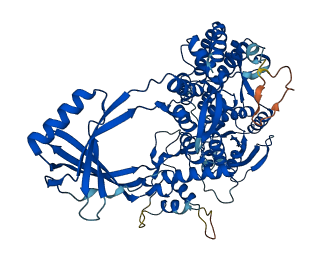
Descriptions
The autoinhibited protein was predicted that may have potential autoinhibitory elements via cis-regPred.
Autoinhibitory domains (AIDs)
Target domain |
|
Relief mechanism |
|
Assay |
cis-regPred |
Accessory elements
No accessory elements
Autoinhibited structure

Activated structure
1 structures for P13099
| Entry ID | Method | Resolution | Chain | Position | Source |
|---|---|---|---|---|---|
| AF-P13099-F1 | Predicted | AlphaFoldDB |
6 variants for P13099
| Variant ID(s) | Position | Change | Description | Diseaes Association | Provenance |
|---|---|---|---|---|---|
| s12-610217 | 145 | N>D | No | SGRP | |
| s12-610218 | 145 | N>S | No | SGRP | |
| s12-610680 | 299 | A>V | No | SGRP | |
| s12-610700 | 306 | V>I | No | SGRP | |
| s12-611181 | 466 | M>T | No | SGRP | |
| s12-611205 | 474 | V>A | No | SGRP |
No associated diseases with P13099
7 regional properties for P13099
| Type | Name | Position | InterPro Accession |
|---|---|---|---|
| domain | DNA topoisomerase, type IA, domain 2 | 147 - 259 | IPR003601 |
| domain | DNA topoisomerase, type IA, DNA-binding domain | 309 - 585 | IPR003602 |
| domain | TOPRIM domain | 2 - 156 | IPR006171 |
| domain | DNA topoisomerase, type IA, central | 115 - 128 | IPR013497-1 |
| domain | DNA topoisomerase, type IA, central | 171 - 635 | IPR013497-2 |
| active_site | DNA topoisomerase, type IA, active site | 346 - 360 | IPR023406 |
| domain | DNA topoisomerase 3-like, TOPRIM domain | 2 - 168 | IPR034144 |
Functions
| Description | ||
|---|---|---|
| EC Number | 5.6.2.1 | Enzymes altering nucleic acid conformation |
| Subcellular Localization |
|
|
| PANTHER Family | ||
| PANTHER Subfamily | ||
| PANTHER Protein Class | ||
| PANTHER Pathway Category | No pathway information available | |
2 GO annotations of cellular component
| Name | Definition |
|---|---|
| nucleus | A membrane-bounded organelle of eukaryotic cells in which chromosomes are housed and replicated. In most cells, the nucleus contains all of the cell's chromosomes except the organellar chromosomes, and is the site of RNA synthesis and processing. In some species, or in specialized cell types, RNA metabolism or DNA replication may be absent. |
| RecQ family helicase-topoisomerase III complex | A complex containing a RecQ family helicase and a topoisomerase III homologue (a member of the topoisomerase type IA subfamily); may also include one or more additional proteins; conserved from E. coli to human. |
3 GO annotations of molecular function
| Name | Definition |
|---|---|
| DNA binding | Any molecular function by which a gene product interacts selectively and non-covalently with DNA (deoxyribonucleic acid). |
| DNA topoisomerase activity | Catalysis of the transient cleavage and passage of individual DNA strands or double helices through one another, resulting a topological transformation in double-stranded DNA. |
| DNA topoisomerase type I (single strand cut, ATP-independent) activity | Catalysis of a DNA topological transformation by transiently cleaving one DNA strand at a time to allow passage of another strand; changes the linking number by +1 per catalytic cycle. |
6 GO annotations of biological process
| Name | Definition |
|---|---|
| DNA topological change | The process in which a transformation is induced in the topological structure of a double-stranded DNA helix, resulting in a change in linking number. |
| double-strand break repair via homologous recombination | The error-free repair of a double-strand break in DNA in which the broken DNA molecule is repaired using homologous sequences. A strand in the broken DNA searches for a homologous region in an intact chromosome to serve as the template for DNA synthesis. The restoration of two intact DNA molecules results in the exchange, reciprocal or nonreciprocal, of genetic material between the intact DNA molecule and the broken DNA molecule. |
| mitotic sister chromatid cohesion | The cell cycle process in which the sister chromatids of a replicated chromosome are joined along the entire length of the chromosome, from their formation in S phase through metaphase during a mitotic cell cycle. This cohesion cycle is critical for high fidelity chromosome transmission. |
| reciprocal meiotic recombination | The cell cycle process in which double strand breaks are formed and repaired through a single or double Holliday junction intermediate. This results in the equal exchange of genetic material between non-sister chromatids in a pair of homologous chromosomes. These reciprocal recombinant products ensure the proper segregation of homologous chromosomes during meiosis I and create genetic diversity. |
| regulation of DNA recombination | Any process that modulates the frequency, rate or extent of DNA recombination, a DNA metabolic process in which a new genotype is formed by reassortment of genes resulting in gene combinations different from those that were present in the parents. |
| telomere maintenance via telomerase | The maintenance of proper telomeric length by the addition of telomeric repeats by telomerase. |
4 homologous proteins in AiPD
| UniProt AC | Gene Name | Protein Name | Species | Evidence Code |
|---|---|---|---|---|
| Q13472 | TOP3A | DNA topoisomerase 3-alpha | Homo sapiens (Human) | PR |
| O70157 | Top3a | DNA topoisomerase 3-alpha | Mus musculus (Mouse) | PR |
| C7J0A2 | TOP3A | DNA topoisomerase 3-alpha | Oryza sativa subsp japonica (Rice) | PR |
| Q9LVP1 | TOP3A | DNA topoisomerase 3-alpha | Arabidopsis thaliana (Mouse-ear cress) | PR |
| 10 | 20 | 30 | 40 | 50 | 60 |
| MKVLCVAEKN | SIAKAVSQIL | GGGRSTSRDS | GYMYVKNYDF | MFSGFPFARN | GANCEVTMTS |
| 70 | 80 | 90 | 100 | 110 | 120 |
| VAGHLTGIDF | SHDSHGWGKC | AIQELFDAPL | NEIMNNNQKK | IASNIKREAR | NADYLMIWTD |
| 130 | 140 | 150 | 160 | 170 | 180 |
| CDREGEYIGW | EIWQEAKRGN | RLIQNDQVYR | AVFSHLERQH | ILNAARNPSR | LDMKSVHAVG |
| 190 | 200 | 210 | 220 | 230 | 240 |
| TRIEIDLRAG | VTFTRLLTET | LRNKLRNQAT | MTKDGAKHRG | GNKNDSQVVS | YGTCQFPTLG |
| 250 | 260 | 270 | 280 | 290 | 300 |
| FVVDRFERIR | NFVPEEFWYI | QLVVENKDNG | GTTTFQWDRG | HLFDRLSVLT | FYETCIETAG |
| 310 | 320 | 330 | 340 | 350 | 360 |
| NVAQVVDLKS | KPTTKYRPLP | LTTVELQKNC | ARYLRLNAKQ | SLDAAEKLYQ | KGFISYPRTE |
| 370 | 380 | 390 | 400 | 410 | 420 |
| TDTFPHAMDL | KSLVEKQAQL | DQLAAGGRTA | WASYAASLLQ | PENTSNNNKF | KFPRSGSHDD |
| 430 | 440 | 450 | 460 | 470 | 480 |
| KAHPPIHPIV | SLGPEANVSP | VERRVYEYVA | RHFLACCSED | AKGQSMTLVL | DWAVERFSAS |
| 490 | 500 | 510 | 520 | 530 | 540 |
| GLVVLERNFL | DVYPWARWET | TKQLPRLEMN | ALVDIAKAEM | KAGTTAPPKP | MTESELILLM |
| 550 | 560 | 570 | 580 | 590 | 600 |
| DTNGIGTDAT | IAEHIDKIQV | RNYVRSEKVG | KETYLQPTTL | GVSLVHGFEA | IGLEDSFAKP |
| 610 | 620 | 630 | 640 | 650 | |
| FQRREMEQDL | KKICEGHASK | TDVVKDIVEK | YRKYWHKTNA | CKNTLLQVYD | RVKASM |