P11928
Gene name |
Oas1a (Oias1) |
Protein name |
2'-5'-oligoadenylate synthase 1A |
Names |
(2-5')oligo(A) synthase 1A, 2-5A synthase 1A, p42 OAS |
Species |
Mus musculus (Mouse) |
KEGG Pathway |
mmu:246730 |
EC number |
2.7.7.84: Nucleotidyltransferases |
Protein Class |
|
Descriptions
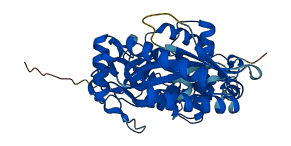
The autoinhibited protein was predicted that may have potential autoinhibitory elements via cis-regPred.
Autoinhibitory domains (AIDs)
Target domain |
|
Relief mechanism |
|
Assay |
cis-regPred |
Accessory elements
No accessory elements
Autoinhibited structure

Activated structure
1 structures for P11928
| Entry ID | Method | Resolution | Chain | Position | Source |
|---|---|---|---|---|---|
| AF-P11928-F1 | Predicted | AlphaFoldDB |
28 variants for P11928
| Variant ID(s) | Position | Change | Description | Diseaes Association | Provenance |
|---|---|---|---|---|---|
| rs226620248 | 41 | F>S | No | EVA | |
| rs579415641 | 49 | G>D | No | EVA | |
| rs578277683 | 90 | E>Q | No | EVA | |
| rs582773563 | 113 | E>K | No | EVA | |
| rs579241701 | 115 | R>H | No | EVA | |
| rs3388787334 | 169 | R>S | No | EVA | |
| rs3388794336 | 171 | Y>* | No | EVA | |
| rs3388788408 | 174 | L>F | No | EVA | |
| rs32177195 | 176 | E>G | No | EVA | |
| rs3396072679 | 178 | C>G | No | EVA | |
| rs3396167850 | 192 | T>R | No | EVA | |
| rs3395749152 | 193 | E>K | No | EVA | |
| rs3395743115 | 194 | L>F | No | EVA | |
| rs3388788250 | 217 | Y>F | No | EVA | |
| rs3388787422 | 227 | P>S | No | EVA | |
| rs3388787011 | 237 | L>H | No | EVA | |
| rs3388786988 | 238 | T>A | No | EVA | |
| rs214341435 | 249 | Y>H | No | EVA | |
| rs587415977 | 265 | I>M | No | EVA | |
| rs581608203 | 265 | I>T | No | EVA | |
| rs584731168 | 266 | N>K | No | EVA | |
| rs244997887 | 269 | H>Q | No | EVA | |
| rs3388781115 | 283 | Q>H | No | EVA | |
| rs386983365 | 329 | L>V | No | EVA | |
| rs3396072716 | 339 | G>V | No | EVA | |
| rs1131879077 | 341 | R>Q | No | EVA | |
| rs3388786941 | 359 | E>G | No | EVA | |
| rs1133170566 | 368 | L>C | No | EVA |
No associated diseases with P11928
5 regional properties for P11928
| Type | Name | Position | InterPro Accession |
|---|---|---|---|
| domain | Polymerase, nucleotidyl transferase domain | 39 - 134 | IPR002934 |
| domain | 2-5OAS/ClassI-CCAase, nucleotidyltransferase domain | 29 - 212 | IPR006116 |
| conserved_site | 2-5-oligoadenylate synthetase, C-terminal conserved site | 297 - 307 | IPR006117 |
| domain | 2'-5'-oligoadenylate synthetase 1, domain 2/C-terminal | 165 - 348 | IPR018952 |
| conserved_site | 2-5-oligoadenylate synthetase, N-terminal conserved site | 63 - 82 | IPR043518 |
Functions
| Description | ||
|---|---|---|
| EC Number | 2.7.7.84 | Nucleotidyltransferases |
| Subcellular Localization |
|
|
| PANTHER Family | ||
| PANTHER Subfamily | ||
| PANTHER Protein Class | ||
| PANTHER Pathway Category | No pathway information available | |
8 GO annotations of cellular component
| Name | Definition |
|---|---|
| cytoplasm | The contents of a cell excluding the plasma membrane and nucleus, but including other subcellular structures. |
| cytosol | The part of the cytoplasm that does not contain organelles but which does contain other particulate matter, such as protein complexes. |
| endoplasmic reticulum | The irregular network of unit membranes, visible only by electron microscopy, that occurs in the cytoplasm of many eukaryotic cells. The membranes form a complex meshwork of tubular channels, which are often expanded into slitlike cavities called cisternae. The ER takes two forms, rough (or granular), with ribosomes adhering to the outer surface, and smooth (with no ribosomes attached). |
| membrane | A lipid bilayer along with all the proteins and protein complexes embedded in it an attached to it. |
| mitochondrion | A semiautonomous, self replicating organelle that occurs in varying numbers, shapes, and sizes in the cytoplasm of virtually all eukaryotic cells. It is notably the site of tissue respiration. |
| nucleoplasm | That part of the nuclear content other than the chromosomes or the nucleolus. |
| nucleus | A membrane-bounded organelle of eukaryotic cells in which chromosomes are housed and replicated. In most cells, the nucleus contains all of the cell's chromosomes except the organellar chromosomes, and is the site of RNA synthesis and processing. In some species, or in specialized cell types, RNA metabolism or DNA replication may be absent. |
| ribosome | An intracellular organelle, about 200 A in diameter, consisting of RNA and protein. It is the site of protein biosynthesis resulting from translation of messenger RNA (mRNA). It consists of two subunits, one large and one small, each containing only protein and RNA. Both the ribosome and its subunits are characterized by their sedimentation coefficients, expressed in Svedberg units (symbol: S). Hence, the prokaryotic ribosome (70S) comprises a large (50S) subunit and a small (30S) subunit, while the eukaryotic ribosome (80S) comprises a large (60S) subunit and a small (40S) subunit. Two sites on the ribosomal large subunit are involved in translation, namely the aminoacyl site (A site) and peptidyl site (P site). Ribosomes from prokaryotes, eukaryotes, mitochondria, and chloroplasts have characteristically distinct ribosomal proteins. |
4 GO annotations of molecular function
| Name | Definition |
|---|---|
| 2'-5'-oligoadenylate synthetase activity | Catalysis of the reaction: ATP = pppA(2'p5'A)n oligomers. This reaction requires the binding of double-stranded RNA. |
| ATP binding | Binding to ATP, adenosine 5'-triphosphate, a universally important coenzyme and enzyme regulator. |
| double-stranded RNA binding | Binding to double-stranded RNA. |
| metal ion binding | Binding to a metal ion. |
23 GO annotations of biological process
| Name | Definition |
|---|---|
| cellular response to interferon-alpha | Any process that results in a change in state or activity of a cell (in terms of movement, secretion, enzyme production, gene expression, etc.) as a result of an interferon-alpha stimulus. Interferon-alpha is a type I interferon. |
| cellular response to interferon-beta | Any process that results in a change in state or activity of a cell (in terms of movement, secretion, enzyme production, gene expression, etc.) as a result of an interferon-beta stimulus. Interferon-beta is a type I interferon. |
| defense response to bacterium | Reactions triggered in response to the presence of a bacterium that act to protect the cell or organism. |
| defense response to virus | Reactions triggered in response to the presence of a virus that act to protect the cell or organism. |
| glucose homeostasis | Any process involved in the maintenance of an internal steady state of glucose within an organism or cell. |
| glucose metabolic process | The chemical reactions and pathways involving glucose, the aldohexose gluco-hexose. D-glucose is dextrorotatory and is sometimes known as dextrose; it is an important source of energy for living organisms and is found free as well as combined in homo- and hetero-oligosaccharides and polysaccharides. |
| negative regulation of chemokine (C-X-C motif) ligand 2 production | Any process that stops, prevents or reduces the frequency, rate or extent of chemokine (C-X-C motif) ligand 2 production. |
| negative regulation of IP-10 production | Any process that stops, prevents, or reduces the frequency, rate, or extent of production of IP-10. |
| negative regulation of type I interferon-mediated signaling pathway | Any process that decreases the rate, frequency or extent of a type I interferon-mediated signaling pathway. |
| negative regulation of viral genome replication | Any process that stops, prevents, or reduces the frequency, rate or extent of viral genome replication. |
| negative regulation of viral process | Any process that stops, prevents, or reduces the frequency, rate or extent of a multi-organism process in which a virus is a participant. |
| positive regulation of cellular respiration | Any process that activates or increases the frequency, rate or extent of cellular respiration. |
| positive regulation of interferon-beta production | Any process that activates or increases the frequency, rate, or extent of interferon-beta production. |
| positive regulation of monocyte chemotactic protein-1 production | Any process that activates or increases the frequency, rate, or extent of production of monocyte chemotactic protein-1. |
| positive regulation of tumor necrosis factor production | Any process that activates or increases the frequency, rate or extent of tumor necrosis factor production. |
| protein complex oligomerization | The process of creating protein oligomers, compounds composed of a small number, usually between three and ten, of component monomers; protein oligomers may be composed of different or identical monomers. Oligomers may be formed by the polymerization of a number of monomers or the depolymerization of a large protein polymer. |
| purine nucleotide biosynthetic process | The chemical reactions and pathways resulting in the formation of a purine nucleotide, a compound consisting of nucleoside (a purine base linked to a deoxyribose or ribose sugar) esterified with a phosphate group at either the 3' or 5'-hydroxyl group of the sugar. |
| regulation of ribonuclease activity | Any process that modulates the rate, frequency, or extent of ribonuclease activity, catalysis of the hydrolysis of phosphodiester bonds in chains of RNA. |
| response to virus | Any process that results in a change in state or activity of a cell or an organism (in terms of movement, secretion, enzyme production, gene expression, etc.) as a result of a stimulus from a virus. |
| surfactant homeostasis | Any process involved in the maintenance of a steady-state level of the surface-active lipoprotein mixture which coats the alveoli. |
| toll-like receptor 3 signaling pathway | The series of molecular signals initiated by a ligand binding to toll-like receptor 3. |
| toll-like receptor 4 signaling pathway | The series of molecular signals initiated by a ligand binding to toll-like receptor 4. |
| type I interferon signaling pathway | The series of molecular signals initiated by type I interferon binding to its receptor on the surface of a target cell, and ending with the regulation of a downstream cellular process, e.g. transcription. Type I interferons include the interferon-alpha, beta, delta, episilon, zeta, kappa, tau, and omega gene families. |
5 homologous proteins in AiPD
| UniProt AC | Gene Name | Protein Name | Species | Evidence Code |
|---|---|---|---|---|
| Q2T9Q2 | UBL4B | Ubiquitin-like protein 4B | Bos taurus (Bovine) | PR |
| P11441 | UBL4A | Ubiquitin-like protein 4A | Homo sapiens (Human) | PR |
| Q9CQ84 | Ubl4b | Ubiquitin-like protein 4B | Mus musculus (Mouse) | PR |
| Q9Z2F2 | Oasl2 | 2'-5'-oligoadenylate synthase-like protein 2 | Mus musculus (Mouse) | PR |
| Q5MYT9 | Oasl2 | 2'-5'-oligoadenylate synthase-like protein 2 | Rattus norvegicus (Rat) | PR |
| 10 | 20 | 30 | 40 | 50 | 60 |
| MEHGLRSIPA | WTLDKFIEDY | LLPDTTFGAD | VKSAVNVVCD | FLKERCFQGA | AHPVRVSKVV |
| 70 | 80 | 90 | 100 | 110 | 120 |
| KGGSSGKGTT | LKGKSDADLV | VFLNNLTSFE | DQLNRRGEFI | KEIKKQLYEV | QHERRFRVKF |
| 130 | 140 | 150 | 160 | 170 | 180 |
| EVQSSWWPNA | RSLSFKLSAP | HLHQEVEFDV | LPAFDVLGHV | NTSSKPDPRI | YAILIEECTS |
| 190 | 200 | 210 | 220 | 230 | 240 |
| LGKDGEFSTC | FTELQRNFLK | QRPTKLKSLI | RLVKHWYQLC | KEKLGKPLPP | QYALELLTVF |
| 250 | 260 | 270 | 280 | 290 | 300 |
| AWEQGNGCYE | FNTAQGFRTV | LELVINYQHL | RIYWTKYYDF | QHQEVSKYLH | RQLRKARPVI |
| 310 | 320 | 330 | 340 | 350 | 360 |
| LDPADPTGNV | AGGNPEGWRR | LAEEADVWLW | YPCFIKKDGS | RVSSWDVPTV | VPVPFEQVEE |
| NWTCILL |