P11441
Gene name |
UBL4A |
Protein name |
Ubiquitin-like protein 4A |
Names |
Ubiquitin-like protein GDX |
Species |
Homo sapiens (Human) |
KEGG Pathway |
hsa:8266 |
EC number |
|
Protein Class |
|
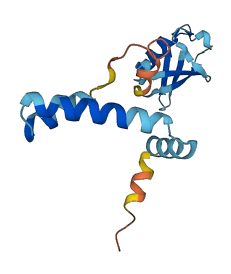
Descriptions
The autoinhibited protein was predicted that may have potential autoinhibitory elements via cis-regPred.
Autoinhibitory domains (AIDs)
Target domain |
|
Relief mechanism |
|
Assay |
cis-regPred |
Accessory elements
No accessory elements
Autoinhibited structure

Activated structure
84 variants for P11441
| Variant ID(s) | Position | Change | Description | Diseaes Association | Provenance |
|---|---|---|---|---|---|
|
rs1557212992 CA415202099 |
4 | T>M | No |
ClinGen gnomAD |
|
|
CA415202017 rs1557212987 |
8 | L>P | No |
ClinGen gnomAD |
|
|
rs1557212984 CA415201940 |
12 | E>* | No |
ClinGen Ensembl |
|
|
CA415201860 rs1382005748 |
14 | S>R | No |
ClinGen TOPMed gnomAD |
|
|
rs1557212921 CA415201743 |
17 | V>L | No |
ClinGen gnomAD |
|
|
CA415201701 rs1557212915 |
19 | E>K | No |
ClinGen TOPMed |
|
|
CA10565465 rs782165041 |
24 | S>Y | No |
ClinGen ExAC gnomAD |
|
|
rs1557212912 CA415201456 |
28 | Q>H | No |
ClinGen gnomAD |
|
|
rs1238393189 CA415201434 |
29 | L>Q | No |
ClinGen TOPMed |
|
|
CA10565464 rs782024019 |
33 | K>N | No |
ClinGen ExAC TOPMed gnomAD |
|
|
rs1557212911 CA415201376 |
33 | K>R | No |
ClinGen gnomAD |
|
|
CA10565462 rs782254388 |
39 | R>C | No |
ClinGen ExAC gnomAD |
|
|
rs1557212901 CA415201173 |
40 | Q>H | No |
ClinGen gnomAD |
|
| TCGA novel | 45 | F>L | Variant assessed as Somatic; impact. [NCI-TCGA] | No | NCI-TCGA |
|
rs1603397391 CA415201090 |
45 | F>V | No |
ClinGen Ensembl |
|
|
rs370563061 CA337293683 |
53 | G>E | No |
ClinGen ESP TOPMed gnomAD |
|
|
rs1401707201 CA415200740 |
56 | L>F | No |
ClinGen TOPMed |
|
|
rs782531758 CA10565428 COSM1118072 |
57 | S>L | Variant assessed as Somatic; 0.0 impact. endometrium [NCI-TCGA, Cosmic] | No |
ClinGen cosmic curated ExAC NCI-TCGA gnomAD |
|
rs1354344061 CA415200611 |
61 | I>V | No |
ClinGen TOPMed |
|
|
CA10565426 rs782758096 |
62 | G>E | No |
ClinGen ExAC gnomAD |
|
|
CA415200586 rs1412366328 |
62 | G>R | No |
ClinGen TOPMed |
|
|
rs1557212765 CA415200476 |
65 | S>Y | No |
ClinGen gnomAD |
|
|
CA415200453 rs1285641732 |
66 | K>R | No |
ClinGen TOPMed gnomAD |
|
|
rs1285641732 CA415200455 |
66 | K>T | No |
ClinGen TOPMed gnomAD |
|
|
rs1356573812 CA415200357 |
70 | V>L | No |
ClinGen TOPMed |
|
|
rs782495618 CA10565425 |
71 | V>I | No |
ClinGen ExAC gnomAD |
|
|
rs913973365 CA337293629 |
73 | P>S | No |
ClinGen Ensembl |
|
|
rs374503557 CA10565420 |
82 | G>D | No |
ClinGen ESP ExAC gnomAD |
|
|
CA415200186 rs1603397299 |
82 | G>S | No |
ClinGen Ensembl |
|
|
CA415200176 rs782359606 |
83 | E>K | Variant assessed as Somatic; 0.0 impact. [NCI-TCGA] | No |
ClinGen ExAC NCI-TCGA TOPMed gnomAD |
|
CA10565417 rs782359606 |
83 | E>Q | No |
ClinGen ExAC TOPMed gnomAD |
|
|
rs782215116 CA10565416 |
85 | Q>* | No |
ClinGen ExAC gnomAD |
|
|
CA415200156 rs1557212746 |
85 | Q>R | No |
ClinGen gnomAD |
|
| TCGA novel | 86 | R>S | Variant assessed as Somatic; impact. [NCI-TCGA] | No | NCI-TCGA |
|
rs781921631 CA10565415 |
88 | A>P | No |
ClinGen ExAC TOPMed gnomAD |
|
|
rs781921631 CA337293546 |
88 | A>T | No |
ClinGen ExAC TOPMed gnomAD |
|
|
rs782643777 CA10565412 |
89 | D>A | No |
ClinGen ExAC gnomAD |
|
|
CA10565413 rs782283486 COSM1118070 |
89 | D>N | Variant assessed as Somatic; 0.0 impact. endometrium [NCI-TCGA, Cosmic] | No |
ClinGen cosmic curated ExAC NCI-TCGA TOPMed gnomAD |
|
rs782517386 CA10565411 |
90 | S>P | No |
ClinGen ExAC gnomAD |
|
|
rs782230135 CA10565410 |
91 | P>L | No |
ClinGen ExAC gnomAD |
|
|
CA10565407 rs781782880 |
93 | P>A | No |
ClinGen ExAC TOPMed gnomAD |
|
|
rs782174250 CA10565406 |
93 | P>L | No |
ClinGen 1000Genomes ExAC gnomAD |
|
| TCGA novel | 93 | P>R | Variant assessed as Somatic; impact. [NCI-TCGA] | No | NCI-TCGA |
|
CA10565408 rs781782880 |
93 | P>S | No |
ClinGen ExAC TOPMed gnomAD |
|
|
rs1557212734 CA415200085 |
94 | Q>R | No |
ClinGen gnomAD |
|
|
CA415200051 rs1557212726 |
98 | L>V | No |
ClinGen gnomAD |
|
|
CA415200020 rs1557212718 |
101 | K>E | No |
ClinGen gnomAD |
|
|
CA415200022 rs1557212718 |
101 | K>Q | No |
ClinGen gnomAD |
|
|
rs781866836 CA10565404 |
102 | V>I | No |
ClinGen ExAC gnomAD |
|
|
rs377663564 CA10565402 |
104 | A>P | No |
ClinGen ESP ExAC TOPMed gnomAD |
|
|
rs377663564 CA10565403 |
104 | A>T | No |
ClinGen ESP ExAC TOPMed gnomAD |
|
|
rs150392222 CA10565401 |
105 | R>G | No |
ClinGen ESP ExAC TOPMed gnomAD |
|
|
rs782405603 CA10565399 |
108 | S>T | No |
ClinGen 1000Genomes ExAC TOPMed gnomAD |
|
|
rs782395991 CA10565397 COSM1118068 |
109 | A>V | Variant assessed as Somatic; 0.0 impact. endometrium [NCI-TCGA, Cosmic] | No |
ClinGen cosmic curated ExAC NCI-TCGA gnomAD |
|
rs1374745394 CA415199887 |
110 | A>V | No |
ClinGen TOPMed |
|
|
rs1557212699 CA415199876 |
111 | D>H | No |
ClinGen gnomAD |
|
|
COSM1118067 rs1557212699 CA415199874 |
111 | D>Y | Variant assessed as Somatic; 0.0 impact. endometrium [NCI-TCGA, Cosmic] | No |
ClinGen cosmic curated NCI-TCGA gnomAD |
|
rs782247131 CA337293490 |
112 | A>V | No |
ClinGen 1000Genomes |
|
|
rs1557212697 CA415199841 |
113 | S>G | No |
ClinGen gnomAD |
|
|
rs1569554977 CA415199598 |
122 | D>V | No |
ClinGen Ensembl |
|
|
rs781895687 CA415199568 |
124 | E>K | Variant assessed as Somatic; 0.0 impact. [NCI-TCGA] | No |
ClinGen ExAC NCI-TCGA gnomAD |
|
rs781895687 CA10565359 |
124 | E>Q | No |
ClinGen ExAC gnomAD |
|
|
rs372299383 CA337293253 |
126 | S>Y | No |
ClinGen ESP gnomAD |
|
|
CA415199487 rs1557212620 |
129 | R>C | No |
ClinGen gnomAD |
|
|
CA10565357 rs782123473 |
129 | R>H | Variant assessed as Somatic; 0.0 impact. [NCI-TCGA] | No |
ClinGen ExAC NCI-TCGA gnomAD |
| TCGA novel | 130 | L>P | Variant assessed as Somatic; impact. [NCI-TCGA] | No | NCI-TCGA |
|
rs781978076 CA10565356 |
131 | T>M | No |
ClinGen ExAC gnomAD |
|
|
CA10565354 rs782387958 |
132 | L>M | No |
ClinGen ExAC TOPMed gnomAD |
|
|
rs782305376 CA10565351 |
134 | D>N | No |
ClinGen ExAC gnomAD |
|
|
CA415199401 rs1394297342 |
136 | E>* | No |
ClinGen TOPMed |
|
|
rs1385439085 CA415199377 |
137 | R>L | No |
ClinGen TOPMed gnomAD |
|
|
rs1385439085 CA415199379 |
137 | R>Q | No |
ClinGen TOPMed gnomAD |
|
|
CA10565349 rs141549549 |
141 | R>H | No |
ClinGen ESP ExAC TOPMed gnomAD |
|
|
CA337293201 rs202239760 |
143 | L>V | No |
ClinGen 1000Genomes |
|
|
rs782371138 CA10565348 |
145 | P>L | No |
ClinGen ExAC |
|
|
rs976111106 CA337293192 |
148 | T>I | No |
ClinGen Ensembl |
|
|
CA415199147 rs1276330802 |
151 | M>T | No |
ClinGen TOPMed |
|
|
rs782604846 CA10565346 |
151 | M>V | No |
ClinGen ExAC gnomAD |
|
|
rs782191064 CA415199097 |
154 | G>C | No |
ClinGen ExAC gnomAD |
|
|
rs782191064 CA10565344 |
154 | G>S | No |
ClinGen ExAC gnomAD |
|
|
CA10565343 rs782682012 |
156 | S>F | No |
ClinGen ExAC gnomAD |
|
|
rs782819598 CA415199025 |
157 | K>R | No |
ClinGen 1000Genomes TOPMed gnomAD |
|
|
rs782819598 CA337293188 |
157 | K>T | No |
ClinGen 1000Genomes TOPMed gnomAD |
|
| TCGA novel | 158 | K>Y | Variant assessed as Somatic; impact. [NCI-TCGA] | No | NCI-TCGA |
No associated diseases with P11441
7 regional properties for P11441
| Type | Name | Position | InterPro Accession |
|---|---|---|---|
| domain | Ubiquitin-like domain | 1 - 73 | IPR000626 |
| conserved_site | Ubiquitin conserved site | 27 - 52 | IPR019954 |
| domain | Ubiquitin domain | 11 - 31 | IPR019956-1 |
| domain | Ubiquitin domain | 32 - 52 | IPR019956-2 |
| domain | Ubiquitin domain | 53 - 74 | IPR019956-3 |
| domain | Ubl4, C-terminal TUGS domain | 96 - 142 | IPR041421 |
| domain | UBL4A-like, ubiquitin-like domain | 1 - 72 | IPR044724 |
6 GO annotations of cellular component
| Name | Definition |
|---|---|
| BAT3 complex | A protein complex found in mammals that transfers tail-anchored (TA) proteins from SGTA to GET3 (ASNA1/TRC4) for targeting to the endoplasmic reticulum membrane. Also chaperones polypeptides from the endoplasmic reticulum retrotranslocation machinery to the proteasome, maintaining the solubility of substrates to improve ER-associated protein degradation (ERAD). Consists of BAG6 (BAT3) and its cofactors GET4 (TRC35) and UBL4A. |
| cytoplasm | The contents of a cell excluding the plasma membrane and nucleus, but including other subcellular structures. |
| cytosol | The part of the cytoplasm that does not contain organelles but which does contain other particulate matter, such as protein complexes. |
| membrane | A lipid bilayer along with all the proteins and protein complexes embedded in it an attached to it. |
| nucleoplasm | That part of the nuclear content other than the chromosomes or the nucleolus. |
| nucleus | A membrane-bounded organelle of eukaryotic cells in which chromosomes are housed and replicated. In most cells, the nucleus contains all of the cell's chromosomes except the organellar chromosomes, and is the site of RNA synthesis and processing. In some species, or in specialized cell types, RNA metabolism or DNA replication may be absent. |
2 GO annotations of molecular function
| Name | Definition |
|---|---|
| chaperone binding | Binding to a chaperone protein, a class of proteins that bind to nascent or unfolded polypeptides and ensure correct folding or transport. |
| ubiquitin-like protein transferase activity | Catalysis of the transfer of a ubiquitin-like from one protein to another via the reaction X-ULP + Y --> Y-ULP + X, where both X-ULP and Y-ULP are covalent linkages. ULP represents a ubiquitin-like protein. |
5 GO annotations of biological process
| Name | Definition |
|---|---|
| post-translational protein targeting to endoplasmic reticulum membrane | The targeting of proteins to a membrane that occurs after their translation. Some secretory proteins exhibit posttranslational transport into the endoplasmic reticulum (ER) lumen: they are synthesized in their entirety on free cytosolic ribosomes and then released into the cytosol, where they are bound by chaperones which keep them in an unfolded state, and subsequently are translocated across the ER membrane. |
| protein modification process | The covalent alteration of one or more amino acids occurring in proteins, peptides and nascent polypeptides (co-translational, post-translational modifications). Includes the modification of charged tRNAs that are destined to occur in a protein (pre-translation modification). |
| regulation of protein stability | Any process that affects the structure and integrity of a protein, altering the likelihood of its degradation or aggregation. |
| tail-anchored membrane protein insertion into ER membrane | A process of protein insertion into the endoplasmic reticulum (ER) membrane in which a tail-anchored (TA) transmembrane protein is incorporated into an endoplasmic reticulum (ER) membrane. TA transmembrane protein, also named type II transmembrane proteins, contain a single C- terminal transmembrane region. |
| ubiquitin-dependent protein catabolic process | The chemical reactions and pathways resulting in the breakdown of a protein or peptide by hydrolysis of its peptide bonds, initiated by the covalent attachment of a ubiquitin group, or multiple ubiquitin groups, to the protein. |
5 homologous proteins in AiPD
| UniProt AC | Gene Name | Protein Name | Species | Evidence Code |
|---|---|---|---|---|
| Q2T9Q2 | UBL4B | Ubiquitin-like protein 4B | Bos taurus (Bovine) | PR |
| Q9Z2F2 | Oasl2 | 2'-5'-oligoadenylate synthase-like protein 2 | Mus musculus (Mouse) | PR |
| P11928 | Oas1a | 2'-5'-oligoadenylate synthase 1A | Mus musculus (Mouse) | PR |
| Q9CQ84 | Ubl4b | Ubiquitin-like protein 4B | Mus musculus (Mouse) | PR |
| Q5MYT9 | Oasl2 | 2'-5'-oligoadenylate synthase-like protein 2 | Rattus norvegicus (Rat) | PR |
| 10 | 20 | 30 | 40 | 50 | 60 |
| MQLTVKALQG | RECSLQVPED | ELVSTLKQLV | SEKLNVPVRQ | QRLLFKGKAL | ADGKRLSDYS |
| 70 | 80 | 90 | 100 | 110 | 120 |
| IGPNSKLNLV | VKPLEKVLLE | EGEAQRLADS | PPPQVWQLIS | KVLARHFSAA | DASRVLEQLQ |
| 130 | 140 | 150 | |||
| RDYERSLSRL | TLDDIERLAS | RFLHPEVTET | MEKGFSK |