P08466
Gene name |
NUC1 (YJL208C, HRE329, J0310) |
Protein name |
Mitochondrial nuclease |
Names |
|
Species |
Saccharomyces cerevisiae (strain ATCC 204508 / S288c) (Baker's yeast) |
KEGG Pathway |
sce:YJL208C |
EC number |
|
Protein Class |
|
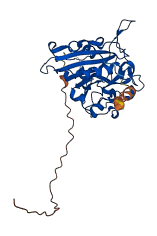
Descriptions
The autoinhibited protein was predicted that may have potential autoinhibitory elements via cis-regPred.
Autoinhibitory domains (AIDs)
Target domain |
|
Relief mechanism |
|
Assay |
cis-regPred |
Accessory elements
No accessory elements
Autoinhibited structure

Activated structure
1 structures for P08466
| Entry ID | Method | Resolution | Chain | Position | Source |
|---|---|---|---|---|---|
| AF-P08466-F1 | Predicted | AlphaFoldDB |
2 variants for P08466
| Variant ID(s) | Position | Change | Description | Diseaes Association | Provenance |
|---|---|---|---|---|---|
| s10-41107 | 26 | K>R | No | SGRP | |
| s10-40254 | 310 | N>K | No | SGRP |
No associated diseases with P08466
4 GO annotations of cellular component
| Name | Definition |
|---|---|
| cytosol | The part of the cytoplasm that does not contain organelles but which does contain other particulate matter, such as protein complexes. |
| mitochondrial inner membrane | The inner, i.e. lumen-facing, lipid bilayer of the mitochondrial envelope. It is highly folded to form cristae. |
| mitochondrion | A semiautonomous, self replicating organelle that occurs in varying numbers, shapes, and sizes in the cytoplasm of virtually all eukaryotic cells. It is notably the site of tissue respiration. |
| nucleus | A membrane-bounded organelle of eukaryotic cells in which chromosomes are housed and replicated. In most cells, the nucleus contains all of the cell's chromosomes except the organellar chromosomes, and is the site of RNA synthesis and processing. In some species, or in specialized cell types, RNA metabolism or DNA replication may be absent. |
8 GO annotations of molecular function
| Name | Definition |
|---|---|
| endodeoxyribonuclease activity | Catalysis of the hydrolysis of ester linkages within deoxyribonucleic acid by creating internal breaks. |
| endonuclease activity | Catalysis of the hydrolysis of ester linkages within nucleic acids by creating internal breaks. |
| endoribonuclease activity | Catalysis of the hydrolysis of ester linkages within ribonucleic acid by creating internal breaks. |
| exodeoxyribonuclease activity | Catalysis of the sequential cleavage of mononucleotides from a free 5' or 3' terminus of a DNA molecule. |
| metal ion binding | Binding to a metal ion. |
| nucleic acid binding | Binding to a nucleic acid. |
| ribonuclease activity | Catalysis of the hydrolysis of phosphodiester bonds in chains of RNA. |
| single-stranded DNA endodeoxyribonuclease activity | Catalysis of the hydrolysis of ester linkages within a single-stranded deoxyribonucleic acid molecule by creating internal breaks. |
6 GO annotations of biological process
| Name | Definition |
|---|---|
| apoptotic DNA fragmentation | The cleavage of DNA during apoptosis, which usually occurs in two stages: cleavage into fragments of about 50 kbp followed by cleavage between nucleosomes to yield 200 bp fragments. |
| apoptotic process | A programmed cell death process which begins when a cell receives an internal (e.g. DNA damage) or external signal (e.g. an extracellular death ligand), and proceeds through a series of biochemical events (signaling pathway phase) which trigger an execution phase. The execution phase is the last step of an apoptotic process, and is typically characterized by rounding-up of the cell, retraction of pseudopodes, reduction of cellular volume (pyknosis), chromatin condensation, nuclear fragmentation (karyorrhexis), plasma membrane blebbing and fragmentation of the cell into apoptotic bodies. When the execution phase is completed, the cell has died. |
| defense response to virus | Reactions triggered in response to the presence of a virus that act to protect the cell or organism. |
| DNA catabolic process | The cellular DNA metabolic process resulting in the breakdown of DNA, deoxyribonucleic acid, one of the two main types of nucleic acid, consisting of a long unbranched macromolecule formed from one or two strands of linked deoxyribonucleotides, the 3'-phosphate group of each constituent deoxyribonucleotide being joined in 3',5'-phosphodiester linkage to the 5'-hydroxyl group of the deoxyribose moiety of the next one. |
| DNA recombination | Any process in which a new genotype is formed by reassortment of genes resulting in gene combinations different from those that were present in the parents. In eukaryotes genetic recombination can occur by chromosome assortment, intrachromosomal recombination, or nonreciprocal interchromosomal recombination. Interchromosomal recombination occurs by crossing over. In bacteria it may occur by genetic transformation, conjugation, transduction, or F-duction. |
| RNA catabolic process | The chemical reactions and pathways resulting in the breakdown of RNA, ribonucleic acid, one of the two main type of nucleic acid, consisting of a long, unbranched macromolecule formed from ribonucleotides joined in 3',5'-phosphodiester linkage. |
| 10 | 20 | 30 | 40 | 50 | 60 |
| MCSRILLSGL | VGLGAGTGLT | YLLLNKHSPT | QIIETPYPPT | QKPNSNIQSH | SFNVDPSGFF |
| 70 | 80 | 90 | 100 | 110 | 120 |
| KYGFPGPIHD | LQNREEFISC | YNRQTQNPYW | VLEHITPESL | AARNADRKNS | FFKEDEVIPE |
| 130 | 140 | 150 | 160 | 170 | 180 |
| KFRGKLRDYF | RSGYDRGHQA | PAADAKFSQQ | AMDDTFYLSN | MCPQVGEGFN | RDYWAHLEYF |
| 190 | 200 | 210 | 220 | 230 | 240 |
| CRGLTKKYKS | VRIVTGPLYL | PKKDPIDNKF | RVNYEVIGNP | PSIAVPTHFF | KLIVAEAPTA |
| 250 | 260 | 270 | 280 | 290 | 300 |
| NPAREDIAVA | AFVLPNEPIS | NETKLTDFEV | PIDALERSTG | LELLQKVPPS | KKKALCKEVN |
| 310 | 320 | ||||
| CQIVVRDFSN | AAIKQSKDVK | LLPPPKKRN |