P08424
Gene name |
Ren1 (Ren) |
Protein name |
Renin |
Names |
Angiotensinogenase |
Species |
Rattus norvegicus (Rat) |
KEGG Pathway |
rno:24715 |
EC number |
3.4.23.15: Aspartic endopeptidases |
Protein Class |
|
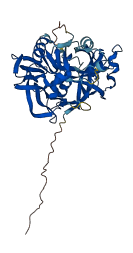
Descriptions
The autoinhibited protein was predicted that may have potential autoinhibitory elements via cis-regPred.
Autoinhibitory domains (AIDs)
Target domain |
|
Relief mechanism |
|
Assay |
cis-regPred |
Accessory elements
No accessory elements
Autoinhibited structure

Activated structure
2 structures for P08424
| Entry ID | Method | Resolution | Chain | Position | Source |
|---|---|---|---|---|---|
| 5MLG | X-ray | 260 A | A | 22-402 | PDB |
| AF-P08424-F1 | Predicted | AlphaFoldDB |
No variants for P08424
| Variant ID(s) | Position | Change | Description | Diseaes Association | Provenance |
|---|---|---|---|---|---|
| No variants for P08424 | |||||
No associated diseases with P08424
Functions
| Description | ||
|---|---|---|
| EC Number | 3.4.23.15 | Aspartic endopeptidases |
| Subcellular Localization |
|
|
| PANTHER Family | ||
| PANTHER Subfamily | ||
| PANTHER Protein Class | ||
| PANTHER Pathway Category | No pathway information available | |
4 GO annotations of cellular component
| Name | Definition |
|---|---|
| apical part of cell | The region of a polarized cell that forms a tip or is distal to a base. For example, in a polarized epithelial cell, the apical region has an exposed surface and lies opposite to the basal lamina that separates the epithelium from other tissue. |
| cytoplasm | The contents of a cell excluding the plasma membrane and nucleus, but including other subcellular structures. |
| extracellular space | That part of a multicellular organism outside the cells proper, usually taken to be outside the plasma membranes, and occupied by fluid. |
| membrane | A lipid bilayer along with all the proteins and protein complexes embedded in it an attached to it. |
5 GO annotations of molecular function
| Name | Definition |
|---|---|
| aspartic-type endopeptidase activity | Catalysis of the hydrolysis of internal, alpha-peptide bonds in a polypeptide chain by a mechanism in which a water molecule bound by the side chains of aspartic residues at the active center acts as a nucleophile. |
| endopeptidase activity | Catalysis of the hydrolysis of internal, alpha-peptide bonds in a polypeptide chain. |
| insulin-like growth factor receptor binding | Binding to an insulin-like growth factor receptor. |
| peptidase activity | Catalysis of the hydrolysis of a peptide bond. A peptide bond is a covalent bond formed when the carbon atom from the carboxyl group of one amino acid shares electrons with the nitrogen atom from the amino group of a second amino acid. |
| signaling receptor binding | Binding to one or more specific sites on a receptor molecule, a macromolecule that undergoes combination with a hormone, neurotransmitter, drug or intracellular messenger to initiate a change in cell function. |
20 GO annotations of biological process
| Name | Definition |
|---|---|
| amyloid-beta metabolic process | The chemical reactions and pathways involving amyloid-beta, a glycoprotein associated with Alzheimer's disease, and its precursor, amyloid precursor protein (APP). |
| angiotensin maturation | The process leading to the attainment of the full functional capacity of angiotensin by conversion of angiotensinogen into mature angiotensin in the blood. |
| cell maturation | A developmental process, independent of morphogenetic (shape) change, that is required for a cell to attain its fully functional state. |
| cellular response to xenobiotic stimulus | Any process that results in a change in state or activity of a cell (in terms of movement, secretion, enzyme production, gene expression, etc.) as a result of a stimulus from a xenobiotic, a compound foreign to the organism exposed to it. It may be synthesized by another organism (like ampicilin) or it can be a synthetic chemical. |
| drinking behavior | The specific behavior of an organism relating to the intake of liquids, especially water. |
| hormone-mediated signaling pathway | The series of molecular signals mediated by the detection of a hormone. |
| kidney development | The process whose specific outcome is the progression of the kidney over time, from its formation to the mature structure. The kidney is an organ that filters the blood and/or excretes the end products of body metabolism in the form of urine. |
| male gonad development | The process whose specific outcome is the progression of the male gonad over time, from its formation to the mature structure. |
| mesonephros development | The process whose specific outcome is the progression of the mesonephros over time, from its formation to the mature structure. In mammals, the mesonephros is the second of the three embryonic kidneys to be established and exists only transiently. In lower vertebrates such as fish and amphibia, the mesonephros will form the mature kidney. |
| proteolysis | The hydrolysis of proteins into smaller polypeptides and/or amino acids by cleavage of their peptide bonds. |
| regulation of blood pressure | Any process that modulates the force with which blood travels through the circulatory system. The process is controlled by a balance of processes that increase pressure and decrease pressure. |
| regulation of blood volume by renin-angiotensin | The process in which the renin-angiotensin system controls the rate of fluid intake and output into the blood. |
| regulation of MAPK cascade | Any process that modulates the frequency, rate or extent of signal transduction mediated by the MAP kinase (MAPK) cascade. |
| renin-angiotensin regulation of aldosterone production | The process in which an increase in active angiotensin stimulates the adrenal cortices to secrete aldosterone. |
| response to cAMP | Any process that results in a change in state or activity of a cell or an organism (in terms of movement, secretion, enzyme production, gene expression, etc.) as a result of a cAMP (cyclic AMP, adenosine 3',5'-cyclophosphate) stimulus. |
| response to cGMP | Any process that results in a change in state or activity of a cell or an organism (in terms of movement, secretion, enzyme production, gene expression, etc.) as a result of a cGMP (cyclic GMP, guanosine 3',5'-cyclophosphate) stimulus. |
| response to immobilization stress | Any process that results in a change in state or activity of a cell or an organism (in terms of movement, secretion, enzyme production, gene expression, etc.) as a result of being rendered immobile. |
| response to lipopolysaccharide | Any process that results in a change in state or activity of an organism (in terms of movement, secretion, enzyme production, gene expression, etc.) as a result of a lipopolysaccharide stimulus; lipopolysaccharide is a major component of the cell wall of gram-negative bacteria. |
| response to organic substance | Any process that results in a change in state or activity of a cell or an organism (in terms of movement, secretion, enzyme production, gene expression, etc.) as a result of an organic substance stimulus. |
| response to xenobiotic stimulus | Any process that results in a change in state or activity of a cell or an organism (in terms of movement, secretion, enzyme production, gene expression, etc.) as a result of a stimulus from a xenobiotic, a compound foreign to the organim exposed to it. It may be synthesized by another organism (like ampicilin) or it can be a synthetic chemical. |
| 10 | 20 | 30 | 40 | 50 | 60 |
| MGGRRMPLWA | LLLLWTSCSF | SLPTDTASFG | RILLKKMPSV | REILEERGVD | MTRISAEWGE |
| 70 | 80 | 90 | 100 | 110 | 120 |
| FIKKSSFTNV | TSPVVLTNYL | DTQYYGEIGI | GTPSQTFKVI | FDTGSANLWV | PSTKCGPLYT |
| 130 | 140 | 150 | 160 | 170 | 180 |
| ACEIHNLYDS | SESSSYMENG | TEFTIHYGSG | KVKGFLSQDV | VTVGGIIVTQ | TFGEVTELPL |
| 190 | 200 | 210 | 220 | 230 | 240 |
| IPFMLAKFDG | VLGMGFPAQA | VDGVIPVFDH | ILSQRVLKEE | VFSVYYSRES | HLLGGEVVLG |
| 250 | 260 | 270 | 280 | 290 | 300 |
| GSDPQHYQGN | FHYVSISKAG | SWQITMKGVS | VGPATLLCEE | GCMAVVDTGT | SYISGPTSSL |
| 310 | 320 | 330 | 340 | 350 | 360 |
| QLIMQALGVK | EKRANNYVVN | CSQVPTLPDI | SFYLGGRTYT | LSNMDYVQKN | PFRNDDLCIL |
| 370 | 380 | 390 | 400 | ||
| ALQGLDIPPP | TGPVWVLGAT | FIRKFYTEFD | RHNNRIGFAL | AR |