O88444
Gene name |
Adcy1 |
Protein name |
Adenylate cyclase type 1 |
Names |
ATP pyrophosphate-lyase 1, Adenylate cyclase type I, Adenylyl cyclase 1, Ca(2+)/calmodulin-activated adenylyl cyclase |
Species |
Mus musculus (Mouse) |
KEGG Pathway |
mmu:432530 |
EC number |
4.6.1.1: Phosphorus-oxygen lyases |
Protein Class |
|
Descriptions
The autoinhibited protein was predicted that may have potential autoinhibitory elements via cis-regPred.
Autoinhibitory domains (AIDs)
Target domain |
|
Relief mechanism |
|
Assay |
cis-regPred |
Accessory elements
No accessory elements
Autoinhibited structure

Activated structure
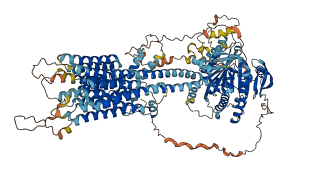
1 structures for O88444
| Entry ID | Method | Resolution | Chain | Position | Source |
|---|---|---|---|---|---|
| AF-O88444-F1 | Predicted | AlphaFoldDB |
47 variants for O88444
| Variant ID(s) | Position | Change | Description | Diseaes Association | Provenance |
|---|---|---|---|---|---|
| rs239790277 | 32 | F>V | No | EVA | |
| rs3401965576 | 160 | Q>R | No | EVA | |
| rs26928486 | 214 | G>V | No | EVA | |
| rs3389130579 | 215 | A>V | No | EVA | |
| rs3389148887 | 221 | F>C | No | EVA | |
| rs3389153202 | 275 | A>T | No | EVA | |
| rs3401719364 | 313 | G>APGLCTGTPDL* | No | EVA | |
| rs3389082521 | 327 | L>I | No | EVA | |
| rs3389148886 | 344 | R>P | No | EVA | |
| rs3389082497 | 404 | L>I | No | EVA | |
| rs3389145005 | 440 | T>A | No | EVA | |
| rs3389141249 | 450 | D>E | No | EVA | |
| rs3389144962 | 464 | F>I | No | EVA | |
| rs3389130600 | 504 | C>S | No | EVA | |
| rs3389130568 | 509 | Q>E | No | EVA | |
| rs3401902188 | 535 | R>W | No | EVA | |
| rs3401815787 | 537 | A>E | No | EVA | |
| rs3401815782 | 538 | L>* | No | EVA | |
| rs3389082500 | 553 | T>I | No | EVA | |
| rs3401966439 | 571 | L>H | No | EVA | |
| rs3401600404 | 574 | A>G | No | EVA | |
| rs3400619654 | 575 | R>G | No | EVA | |
| rs3389130556 | 575 | R>L | No | EVA | |
| rs3389118529 | 620 | A>T | No | EVA | |
| rs3389153147 | 634 | V>E | No | EVA | |
| rs3389114353 | 641 | V>A | No | EVA | |
| rs3389130618 | 642 | F>L | No | EVA | |
| rs3410333679 | 664 | G>W | No | EVA | |
| rs3389138357 | 692 | G>D | No | EVA | |
| rs3389153726 | 724 | E>D | No | EVA | |
| rs3389144774 | 761 | S>P | No | EVA | |
| rs3412972167 | 767 | E>T | No | EVA | |
| rs245511604 | 777 | G>S | No | EVA | |
| rs3400619642 | 780 | S>F | No | EVA | |
| rs26913279 | 796 | T>M | No | EVA | |
| rs3389153144 | 829 | K>E | No | EVA | |
| rs3389141247 | 839 | L>F | No | EVA | |
| rs3389153172 | 840 | L>M | No | EVA | |
| rs3389136052 | 885 | G>D | No | EVA | |
| rs3389141233 | 902 | D>G | No | EVA | |
| rs3389148898 | 920 | T>I | No | EVA | |
| rs3389082479 | 935 | A>T | No | EVA | |
| rs3389136098 | 948 | C>R | No | EVA | |
| rs3389136053 | 956 | D>E | No | EVA | |
| rs3389141059 | 964 | I>F | No | EVA | |
| rs3389153772 | 989 | G>D | No | EVA | |
| rs3389114383 | 1016 | R>G | No | EVA |
No associated diseases with O88444
Functions
| Description | ||
|---|---|---|
| EC Number | 4.6.1.1 | Phosphorus-oxygen lyases |
| Subcellular Localization |
|
|
| PANTHER Family | ||
| PANTHER Subfamily | ||
| PANTHER Protein Class | ||
| PANTHER Pathway Category | No pathway information available | |
10 GO annotations of cellular component
| Name | Definition |
|---|---|
| cytoplasm | The contents of a cell excluding the plasma membrane and nucleus, but including other subcellular structures. |
| glutamatergic synapse | A synapse that uses glutamate as a neurotransmitter. |
| hippocampal mossy fiber to CA3 synapse | One of the giant synapses that form between the mossy fiber axons of dentate gyrus granule cells and the large complex spines of CA3 pyramidal cells. It consists of a giant bouton known as the mossy fiber expansion, synapsed to the complex, multiheaded spine (thorny excresence) of a CA3 pyramidal cell. |
| integral component of plasma membrane | The component of the plasma membrane consisting of the gene products and protein complexes having at least some part of their peptide sequence embedded in the hydrophobic region of the membrane. |
| integral component of postsynaptic density membrane | The component of the postsynaptic density membrane consisting of the gene products and protein complexes having at least some part of their peptide sequence embedded in the hydrophobic region of the membrane. |
| membrane raft | Any of the small (10-200 nm), heterogeneous, highly dynamic, sterol- and sphingolipid-enriched membrane domains that compartmentalize cellular processes. Small rafts can sometimes be stabilized to form larger platforms through protein-protein and protein-lipid interactions. |
| nucleus | A membrane-bounded organelle of eukaryotic cells in which chromosomes are housed and replicated. In most cells, the nucleus contains all of the cell's chromosomes except the organellar chromosomes, and is the site of RNA synthesis and processing. In some species, or in specialized cell types, RNA metabolism or DNA replication may be absent. |
| plasma membrane | The membrane surrounding a cell that separates the cell from its external environment. It consists of a phospholipid bilayer and associated proteins. |
| postsynaptic density | An electron dense network of proteins within and adjacent to the postsynaptic membrane of an asymmetric, neuron-neuron synapse. Its major components include neurotransmitter receptors and the proteins that spatially and functionally organize them such as anchoring and scaffolding molecules, signaling enzymes and cytoskeletal components. |
| Schaffer collateral - CA1 synapse | A synapse between the Schaffer collateral axon of a CA3 pyramidal cell and a CA1 pyramidal cell. |
5 GO annotations of molecular function
| Name | Definition |
|---|---|
| adenylate cyclase activity | Catalysis of the reaction: ATP = 3',5'-cyclic AMP + diphosphate. |
| ATP binding | Binding to ATP, adenosine 5'-triphosphate, a universally important coenzyme and enzyme regulator. |
| calcium- and calmodulin-responsive adenylate cyclase activity | Catalysis of the reaction: ATP = 3',5'-cyclic AMP + diphosphate, stimulated by calcium-bound calmodulin. |
| calmodulin binding | Binding to calmodulin, a calcium-binding protein with many roles, both in the calcium-bound and calcium-free states. |
| metal ion binding | Binding to a metal ion. |
18 GO annotations of biological process
| Name | Definition |
|---|---|
| activation of adenylate cyclase activity | Any process that initiates the activity of the inactive enzyme adenylate cyclase. |
| adenylate cyclase-activating G protein-coupled receptor signaling pathway | A G protein-coupled receptor signaling pathway in which the signal is transmitted via the activation of adenylyl cyclase activity and a subsequent increase in the intracellular concentration of cyclic AMP (cAMP). |
| axonogenesis | De novo generation of a long process of a neuron, including the terminal branched region. Refers to the morphogenesis or creation of shape or form of the developing axon, which carries efferent (outgoing) action potentials from the cell body towards target cells. |
| brain development | The process whose specific outcome is the progression of the brain over time, from its formation to the mature structure. Brain development begins with patterning events in the neural tube and ends with the mature structure that is the center of thought and emotion. The brain is responsible for the coordination and control of bodily activities and the interpretation of information from the senses (sight, hearing, smell, etc.). |
| cAMP biosynthetic process | The chemical reactions and pathways resulting in the formation of the nucleotide cAMP (cyclic AMP, adenosine 3',5'-cyclophosphate). |
| cAMP-mediated signaling | Any intracellular signal transduction in which the signal is passed on within the cell via cyclic AMP (cAMP). Includes production of cAMP, and downstream effectors that further transmit the signal within the cell. |
| cellular response to calcium ion | Any process that results in a change in state or activity of a cell (in terms of movement, secretion, enzyme production, gene expression, etc.) as a result of a calcium ion stimulus. |
| cellular response to forskolin | Any process that results in a change in state or activity of a cell (in terms of movement, secretion, enzyme production, gene expression, etc.) as a result of a forskolin stimulus. |
| circadian rhythm | Any biological process in an organism that recurs with a regularity of approximately 24 hours. |
| long-term memory | The memory process that deals with the storage, retrieval and modification of information a long time (typically weeks, months or years) after receiving that information. This type of memory is typically dependent on gene transcription regulated by second messenger activation. |
| modulation of chemical synaptic transmission | Any process that modulates the frequency or amplitude of synaptic transmission, the process of communication from a neuron to a target (neuron, muscle, or secretory cell) across a synapse. Amplitude, in this case, refers to the change in postsynaptic membrane potential due to a single instance of synaptic transmission. |
| neuroinflammatory response | The immediate defensive reaction by neural vertebrate tissue to infection or injury caused by chemical or physical agents. |
| positive regulation of CREB transcription factor activity | Any process that activates or increases the frequency, rate or extent of activity of the transcription factor CREB. |
| positive regulation of long-term synaptic potentiation | Any process that activates or increases the frequency, rate or extent of long-term synaptic potentiation. |
| regulation of circadian rhythm | Any process that modulates the frequency, rate or extent of a circadian rhythm. A circadian rhythm is a biological process in an organism that recurs with a regularity of approximately 24 hours. |
| regulation of synaptic vesicle exocytosis | Any process that modulates the frequency, rate or extent of synaptic vesicle exocytosis. |
| response to lithium ion | Any process that results in a change in state or activity of a cell or an organism (in terms of movement, secretion, enzyme production, gene expression, etc.) as a result of a lithium (Li+) ion stimulus. |
| response to xenobiotic stimulus | Any process that results in a change in state or activity of a cell or an organism (in terms of movement, secretion, enzyme production, gene expression, etc.) as a result of a stimulus from a xenobiotic, a compound foreign to the organim exposed to it. It may be synthesized by another organism (like ampicilin) or it can be a synthetic chemical. |
6 homologous proteins in AiPD
| UniProt AC | Gene Name | Protein Name | Species | Evidence Code |
|---|---|---|---|---|
| P40145 | ADCY8 | Adenylate cyclase type 8 | Homo sapiens (Human) | PR |
| P97490 | Adcy8 | Adenylate cyclase type 8 | Mus musculus (Mouse) | PR |
| Q8VHH7 | Adcy3 | Adenylate cyclase type 3 | Mus musculus (Mouse) | PR |
| P51830 | Adcy9 | Adenylate cyclase type 9 | Mus musculus (Mouse) | PR |
| P21932 | Adcy3 | Adenylate cyclase type 3 | Rattus norvegicus (Rat) | PR |
| P40146 | Adcy8 | Adenylate cyclase type 8 | Rattus norvegicus (Rat) | PR |
| 10 | 20 | 30 | 40 | 50 | 60 |
| MAGAPRGQGG | GGGAGEPGGA | ERAAGPGGRR | GFRACGEEFA | CPELEALFRG | YTLRLEQAAT |
| 70 | 80 | 90 | 100 | 110 | 120 |
| LKALAVLSLL | AGALALAELL | GAPGPAPGLA | KGSHPVHCIL | FLALFVVTNV | RSLQVSQLQQ |
| 130 | 140 | 150 | 160 | 170 | 180 |
| VGQLALFFSL | TFALLCCPFA | LGGPARSSAG | GAMGSTVAEQ | GVWQLLLVTF | VSYALLPVRS |
| 190 | 200 | 210 | 220 | 230 | 240 |
| LLAIGFGLVV | AASHLLVTAA | LVPAKRPRLW | RTLGANALLF | FGVNMYGVFV | RILTERSQRK |
| 250 | 260 | 270 | 280 | 290 | 300 |
| AFLQARNCIE | DRLRLEDENE | KQERLLMSLL | PRNVAMEMKE | DFLKPPERIF | HKIYIQRHDN |
| 310 | 320 | 330 | 340 | 350 | 360 |
| VSILFADIVG | FTGLASQCTA | QELVKLLNEL | FGKFDELATE | NHCRRIKILG | DCYYCVSGLT |
| 370 | 380 | 390 | 400 | 410 | 420 |
| QPKTDHAHCC | VEMGLDMIDT | ITSVAEATEV | DLNMRVGLHT | GRVLCGVLGL | RKWQYDVWSN |
| 430 | 440 | 450 | 460 | 470 | 480 |
| DVTLANVMEA | AGLPGKVHIT | KTTLACLNGD | YEVEPGHGHE | RNTFLRTHNI | ETFFIVPSHR |
| 490 | 500 | 510 | 520 | 530 | 540 |
| RKIFPGLILS | DIKPAKRMKF | KTVCYLLVQL | MHCRKMFKAE | IPFSNVMTCE | DDDKRRALRT |
| 550 | 560 | 570 | 580 | 590 | 600 |
| ASEKLRNRSS | FSTNVVYTTP | GTRVNRYISR | LLEARQTELE | MADLNFFTLK | YKHVEREQKY |
| 610 | 620 | 630 | 640 | 650 | 660 |
| HQLQDEYFTS | AVVLALILAA | LFGLIYLLVI | PQSVAVLLLL | VFSICFLVAC | TLYLHITRVQ |
| 670 | 680 | 690 | 700 | 710 | 720 |
| CFPGCLTIQI | RTALCVFIVV | LIYSVAQGCV | VGCLPWAWSS | QSNSSLVVLA | AGGRRTVLPA |
| 730 | 740 | 750 | 760 | 770 | 780 |
| LPCESAHHAL | LCCLVGTLPL | AIFLRVSSLP | KMILLSGLTT | SYILVLELSG | YTKVGGGALS |
| 790 | 800 | 810 | 820 | 830 | 840 |
| GRSYEPIMAI | LLFSCTLALH | ARQVDVRLRL | DYLWAAQAEE | ERDDMERVKL | DNKRILFNLL |
| 850 | 860 | 870 | 880 | 890 | 900 |
| PAHVAQHFLM | SNPRNMDLYY | QSYSQVGVMF | ASIPNFNDFY | IELDGNNMGV | ECLRLLNEII |
| 910 | 920 | 930 | 940 | 950 | 960 |
| ADFDELMDKD | FYKDLEKIKT | IGSTYMAAVG | LAPTAGTRAK | KSISSHLCTL | ADFAIDMFDV |
| 970 | 980 | 990 | 1000 | 1010 | 1020 |
| LDEINYQSYN | DFVLRVGINV | GPVVAGVIGA | RRPQYDIWGN | TVNVASRMDS | TGVQGRIQVT |
| 1030 | 1040 | 1050 | 1060 | 1070 | 1080 |
| EEVHRLLKRC | SYQFVCRGKV | SVKGKGEMLT | YFLEGRTDGN | SSHGRTFRLE | RRMCPYGRGG |
| 1090 | 1100 | 1110 | |||
| GQARRPPLCP | AAGPPVRPGL | PPAPTSQYLS | STAAGKEA |