P21932
Gene name |
Adcy3 |
Protein name |
Adenylate cyclase type 3 |
Names |
ATP pyrophosphate-lyase 3, Adenylate cyclase type III, AC-III, Adenylate cyclase, olfactive type, Adenylyl cyclase 3, AC3 |
Species |
Rattus norvegicus (Rat) |
KEGG Pathway |
rno:64508 |
EC number |
4.6.1.1: Phosphorus-oxygen lyases |
Protein Class |
|
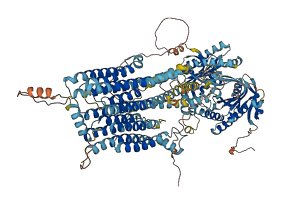
Descriptions
The autoinhibited protein was predicted that may have potential autoinhibitory elements via cis-regPred.
Autoinhibitory domains (AIDs)
Target domain |
|
Relief mechanism |
|
Assay |
cis-regPred |
Accessory elements
No accessory elements
Autoinhibited structure

Activated structure
1 structures for P21932
| Entry ID | Method | Resolution | Chain | Position | Source |
|---|---|---|---|---|---|
| AF-P21932-F1 | Predicted | AlphaFoldDB |
No variants for P21932
| Variant ID(s) | Position | Change | Description | Diseaes Association | Provenance |
|---|---|---|---|---|---|
| No variants for P21932 | |||||
No associated diseases with P21932
5 regional properties for P21932
| Type | Name | Position | InterPro Accession |
|---|---|---|---|
| domain | Adenylyl cyclase class-3/4/guanylyl cyclase | 270 - 472 | IPR001054-1 |
| domain | Adenylyl cyclase class-3/4/guanylyl cyclase | 883 - 1121 | IPR001054-2 |
| conserved_site | Adenylyl cyclase class-4/guanylyl cyclase, conserved site | 423 - 446 | IPR018297-1 |
| conserved_site | Adenylyl cyclase class-4/guanylyl cyclase, conserved site | 1052 - 1075 | IPR018297-2 |
| domain | Adenylate cyclase, N-terminal | 42 - 297 | IPR032628 |
Functions
| Description | ||
|---|---|---|
| EC Number | 4.6.1.1 | Phosphorus-oxygen lyases |
| Subcellular Localization |
|
|
| PANTHER Family | ||
| PANTHER Subfamily | ||
| PANTHER Protein Class | ||
| PANTHER Pathway Category | No pathway information available | |
10 GO annotations of cellular component
| Name | Definition |
|---|---|
| ciliary membrane | The portion of the plasma membrane surrounding a cilium. |
| cilium | A specialized eukaryotic organelle that consists of a filiform extrusion of the cell surface and of some cytoplasmic parts. Each cilium is largely bounded by an extrusion of the cytoplasmic (plasma) membrane, and contains a regular longitudinal array of microtubules, anchored to a basal body. |
| cytoplasm | The contents of a cell excluding the plasma membrane and nucleus, but including other subcellular structures. |
| Golgi apparatus | A membrane-bound cytoplasmic organelle of the endomembrane system that further processes the core oligosaccharides (e.g. N-glycans) added to proteins in the endoplasmic reticulum and packages them into membrane-bound vesicles. The Golgi apparatus operates at the intersection of the secretory, lysosomal, and endocytic pathways. |
| integral component of membrane | The component of a membrane consisting of the gene products and protein complexes having at least some part of their peptide sequence embedded in the hydrophobic region of the membrane. |
| integral component of plasma membrane | The component of the plasma membrane consisting of the gene products and protein complexes having at least some part of their peptide sequence embedded in the hydrophobic region of the membrane. |
| membrane | A lipid bilayer along with all the proteins and protein complexes embedded in it an attached to it. |
| membrane raft | Any of the small (10-200 nm), heterogeneous, highly dynamic, sterol- and sphingolipid-enriched membrane domains that compartmentalize cellular processes. Small rafts can sometimes be stabilized to form larger platforms through protein-protein and protein-lipid interactions. |
| nucleus | A membrane-bounded organelle of eukaryotic cells in which chromosomes are housed and replicated. In most cells, the nucleus contains all of the cell's chromosomes except the organellar chromosomes, and is the site of RNA synthesis and processing. In some species, or in specialized cell types, RNA metabolism or DNA replication may be absent. |
| plasma membrane | The membrane surrounding a cell that separates the cell from its external environment. It consists of a phospholipid bilayer and associated proteins. |
5 GO annotations of molecular function
| Name | Definition |
|---|---|
| adenylate cyclase activity | Catalysis of the reaction: ATP = 3',5'-cyclic AMP + diphosphate. |
| ATP binding | Binding to ATP, adenosine 5'-triphosphate, a universally important coenzyme and enzyme regulator. |
| calcium- and calmodulin-responsive adenylate cyclase activity | Catalysis of the reaction: ATP = 3',5'-cyclic AMP + diphosphate, stimulated by calcium-bound calmodulin. |
| calmodulin binding | Binding to calmodulin, a calcium-binding protein with many roles, both in the calcium-bound and calcium-free states. |
| metal ion binding | Binding to a metal ion. |
9 GO annotations of biological process
| Name | Definition |
|---|---|
| acrosome reaction | The discharge, by sperm, of a single, anterior secretory granule following the sperm's attachment to the zona pellucida of the oocyte. The process begins with the fusion of the outer acrosomal membrane with the sperm plasma membrane and ends with the exocytosis of the acrosomal contents into the zona pellucida. |
| adenylate cyclase-activating G protein-coupled receptor signaling pathway | A G protein-coupled receptor signaling pathway in which the signal is transmitted via the activation of adenylyl cyclase activity and a subsequent increase in the intracellular concentration of cyclic AMP (cAMP). |
| cAMP biosynthetic process | The chemical reactions and pathways resulting in the formation of the nucleotide cAMP (cyclic AMP, adenosine 3',5'-cyclophosphate). |
| cellular response to forskolin | Any process that results in a change in state or activity of a cell (in terms of movement, secretion, enzyme production, gene expression, etc.) as a result of a forskolin stimulus. |
| flagellated sperm motility | The directed, self-propelled movement of a cilium (aka flagellum) that contributes to the movement of a flagellated sperm. |
| intracellular signal transduction | The process in which a signal is passed on to downstream components within the cell, which become activated themselves to further propagate the signal and finally trigger a change in the function or state of the cell. |
| olfactory learning | Any process in an organism in which a relatively long-lasting adaptive behavioral change occurs in response to (repeated) exposure to an olfactory cue. |
| sensory perception of smell | The series of events required for an organism to receive an olfactory stimulus, convert it to a molecular signal, and recognize and characterize the signal. Olfaction involves the detection of chemical composition of an organism's ambient medium by chemoreceptors. This is a neurological process. |
| single fertilization | The union of male and female gametes to form a zygote. |
5 homologous proteins in AiPD
| UniProt AC | Gene Name | Protein Name | Species | Evidence Code |
|---|---|---|---|---|
| P40145 | ADCY8 | Adenylate cyclase type 8 | Homo sapiens (Human) | PR |
| O88444 | Adcy1 | Adenylate cyclase type 1 | Mus musculus (Mouse) | PR |
| P97490 | Adcy8 | Adenylate cyclase type 8 | Mus musculus (Mouse) | PR |
| Q8VHH7 | Adcy3 | Adenylate cyclase type 3 | Mus musculus (Mouse) | PR |
| P40146 | Adcy8 | Adenylate cyclase type 8 | Rattus norvegicus (Rat) | PR |
| 10 | 20 | 30 | 40 | 50 | 60 |
| MTEDQGFSDP | EYSAEYSAEY | SVSLPSDPDR | GVGRTHEISV | RNSGSCLCLP | RFMRLTFVPE |
| 70 | 80 | 90 | 100 | 110 | 120 |
| SLENLYQTYF | KRQRHETLLV | LVVFAALFDC | YVVVMCAVVF | SSDKLAPLMV | AGVGLVLDII |
| 130 | 140 | 150 | 160 | 170 | 180 |
| LFVLCKKGLL | PDRVSRKVVP | YLLWLLITAQ | IFSYLGLNFS | RAHAASDTVG | WQAFFVFSFF |
| 190 | 200 | 210 | 220 | 230 | 240 |
| ITLPLSLSPI | VIISVVSCVV | HTLVLGVTVA | QQQQDELEGM | QLLREILANV | FLYLCAIIVG |
| 250 | 260 | 270 | 280 | 290 | 300 |
| IMSYYMADRK | HRKAFLEARQ | SLEVKMNLEE | QSQQQENLML | SILPKHVADE | MLKDMKKDES |
| 310 | 320 | 330 | 340 | 350 | 360 |
| QKDQQQFNTM | YMYRHENVSI | LFADIVGFTQ | LSSACSAQEL | VKLLNELFAR | FDKLAAKYHQ |
| 370 | 380 | 390 | 400 | 410 | 420 |
| LRIKILGDCY | YCICGLPDYR | EDHAVCSILM | GLAMVEAISY | VREKTKTGVD | MRVGVHTGTV |
| 430 | 440 | 450 | 460 | 470 | 480 |
| LGGVLGQKRW | QYDVWSTDVT | VANKMEAGGI | PGRVHISQST | MDCLKGEFDV | EPGDGGSRCD |
| 490 | 500 | 510 | 520 | 530 | 540 |
| YLDEKGIETY | LIIASKPEVK | KTAQNGLNGS | ALPNGAPASK | PSSPALIETK | EPNGSAHASG |
| 550 | 560 | 570 | 580 | 590 | 600 |
| STSEEAEEQE | AQADNPSFPN | PRRRLRLQDL | ADRVVDASED | EHELNQLLNE | ALLERESAQV |
| 610 | 620 | 630 | 640 | 650 | 660 |
| VKKRNTFLLT | MRFMDPEMET | RYSVEKEKQS | GAAFSCSCVV | LFCTAMVEIL | IDPWLMTNYV |
| 670 | 680 | 690 | 700 | 710 | 720 |
| TFVVGEVLLL | ILTICSMAAI | FPRAFPKKLV | AFSSWIDRTR | WARNTWAMLA | IFILVMANVV |
| 730 | 740 | 750 | 760 | 770 | 780 |
| DMLSCLQYYM | GPYNVTTGIE | LDGGCMENPK | YYNYVAVLSL | IATIMLVQVS | HMVKLTLMLL |
| 790 | 800 | 810 | 820 | 830 | 840 |
| VTGAVTAINL | YAWCPVFDEY | DHKRFQEKDS | PMVALEKMQV | LSTPGLNGTD | SRLPLVPSKY |
| 850 | 860 | 870 | 880 | 890 | 900 |
| SMTVMMFVMM | LSFYYFSRHV | EKLARTLFLW | KIEVHDQKER | VYEMRRWNEA | LVTNMLPEHV |
| 910 | 920 | 930 | 940 | 950 | 960 |
| ARHFLGSKKR | DEELYSQSYD | EIGVMFASLP | NFADFYTEES | INNGGIECLR | FLNEIISDFD |
| 970 | 980 | 990 | 1000 | 1010 | 1020 |
| SLLDNPKFRV | ITKIKTIGST | YMAASGVTPD | VNTNGFTSSS | KEEKSDKERW | QHLADLADFA |
| 1030 | 1040 | 1050 | 1060 | 1070 | 1080 |
| LAMKDTLTNI | NNQSFNNFML | RIGMNKGGVL | AGVIGARKPH | YDIWGNTVNV | ASRMESTGVM |
| 1090 | 1100 | 1110 | 1120 | 1130 | 1140 |
| GNIQVVEETQ | VILREYGFRF | VRRGPIFVKG | KGELLTFFLK | GRDRPAAFPN | GSSVTLPHQV |
| VDNP |