O82266
Gene name |
SWA1 |
Protein name |
Protein SLOW WALKER 1 |
Names |
Protein EMBRYO SAC DEVELOPMENT ARREST 13, Protein EMBRYO SAC DEVELOPMENT ARREST 19 |
Species |
Arabidopsis thaliana (Mouse-ear cress) |
KEGG Pathway |
ath:AT2G47990 |
EC number |
|
Protein Class |
|
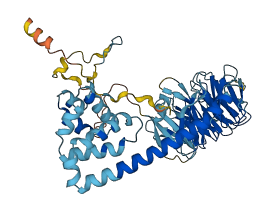
Descriptions
The autoinhibited protein was predicted that may have potential autoinhibitory elements via cis-regPred.
Autoinhibitory domains (AIDs)
Target domain |
|
Relief mechanism |
|
Assay |
cis-regPred |
Accessory elements
No accessory elements
Autoinhibited structure

Activated structure
1 structures for O82266
| Entry ID | Method | Resolution | Chain | Position | Source |
|---|---|---|---|---|---|
| AF-O82266-F1 | Predicted | AlphaFoldDB |
38 variants for O82266
| Variant ID(s) | Position | Change | Description | Diseaes Association | Provenance |
|---|---|---|---|---|---|
| tmp_2_19638594_T_G | 3 | E>D | No | 1000Genomes | |
| tmp_2_19638532_G_A | 24 | S>L | No | 1000Genomes | |
| tmp_2_19638508_G_A | 32 | S>L | No | 1000Genomes | |
| tmp_2_19638460_G_T | 48 | T>K | No | 1000Genomes | |
| ENSVATH13672477 | 58 | L>S | No | 1000Genomes | |
| ENSVATH05737385 | 59 | A>S | No | 1000Genomes | |
| tmp_2_19638388_T_G | 72 | H>P | No | 1000Genomes | |
| ENSVATH02000427 | 83 | S>L | No | 1000Genomes | |
| tmp_2_19638320_C_T | 95 | V>I | No | 1000Genomes | |
| tmp_2_19638196_G_A | 136 | A>V | No | 1000Genomes | |
| ENSVATH05737383 | 149 | L>V | No | 1000Genomes | |
| ENSVATH05737382 | 161 | K>N | No | 1000Genomes | |
| ENSVATH14625936 | 192 | S>L | No | 1000Genomes | |
| ENSVATH13672475 | 210 | V>G | No | 1000Genomes | |
| tmp_2_19637968_G_A | 212 | T>M | No | 1000Genomes | |
| ENSVATH02000426 | 214 | N>K | No | 1000Genomes | |
| ENSVATH02000425 | 235 | G>A | No | 1000Genomes | |
| ENSVATH02000424 | 236 | L>M | No | 1000Genomes | |
| ENSVATH02000424 | 236 | L>V | No | 1000Genomes | |
| ENSVATH05737380 | 247 | V>L | No | 1000Genomes | |
| ENSVATH05737379 | 254 | G>E | No | 1000Genomes | |
| tmp_2_19637835_C_A | 256 | M>I | No | 1000Genomes | |
| tmp_2_19637833_A_C | 257 | V>G | No | 1000Genomes | |
| tmp_2_19637831_A_G | 258 | C>R | No | 1000Genomes | |
| tmp_2_19637803_A_G | 267 | V>A | No | 1000Genomes | |
| ENSVATH00801947 | 271 | R>H | No | 1000Genomes | |
| tmp_2_19637780_T_C | 275 | M>V | No | 1000Genomes | |
| tmp_2_19637581_T_G | 341 | D>A | No | 1000Genomes | |
| ENSVATH02000423 | 349 | S>N | No | 1000Genomes | |
| ENSVATH14625934 | 350 | L>S | No | 1000Genomes | |
| tmp_2_19637431_T_A | 391 | K>M | No | 1000Genomes | |
| tmp_2_19637276_C_T | 443 | V>M | No | 1000Genomes | |
| tmp_2_19637248_C_T | 452 | G>E | No | 1000Genomes | |
| tmp_2_19637224_C_G | 460 | R>T | No | 1000Genomes | |
| tmp_2_19637162_T_C | 481 | T>A | No | 1000Genomes | |
| ENSVATH02000420 | 499 | L>F | No | 1000Genomes | |
| ENSVATH13672467 | 521 | A>T | No | 1000Genomes | |
| tmp_2_19637027_T_C | 526 | I>V | No | 1000Genomes |
No associated diseases with O82266
2 GO annotations of cellular component
| Name | Definition |
|---|---|
| Cul4-RING E3 ubiquitin ligase complex | A ubiquitin ligase complex in which a cullin from the Cul4 family and a RING domain protein form the catalytic core; substrate specificity is conferred by an adaptor protein. |
| nucleolus | A small, dense body one or more of which are present in the nucleus of eukaryotic cells. It is rich in RNA and protein, is not bounded by a limiting membrane, and is not seen during mitosis. Its prime function is the transcription of the nucleolar DNA into 45S ribosomal-precursor RNA, the processing of this RNA into 5.8S, 18S, and 28S components of ribosomal RNA, and the association of these components with 5S RNA and proteins synthesized outside the nucleolus. This association results in the formation of ribonucleoprotein precursors; these pass into the cytoplasm and mature into the 40S and 60S subunits of the ribosome. |
1 GO annotations of molecular function
| Name | Definition |
|---|---|
| mRNA binding | Binding to messenger RNA (mRNA), an intermediate molecule between DNA and protein. mRNA includes UTR and coding sequences, but does not contain introns. |
6 GO annotations of biological process
| Name | Definition |
|---|---|
| cell cycle | The progression of biochemical and morphological phases and events that occur in a cell during successive cell replication or nuclear replication events. Canonically, the cell cycle comprises the replication and segregation of genetic material followed by the division of the cell, but in endocycles or syncytial cells nuclear replication or nuclear division may not be followed by cell division. |
| cell division | The process resulting in division and partitioning of components of a cell to form more cells; may or may not be accompanied by the physical separation of a cell into distinct, individually membrane-bounded daughter cells. |
| embryo sac development | The process whose specific outcome is the progression of the embryo sac over time, from its formation to the mature structure. The process begins with the meiosis of the megasporocyte to form four haploid megaspores. Three of the megaspores disintegrate, and the fourth undergoes mitosis giving rise to a binucleate syncytial embryo sac. The two haploid nuclei migrate to the opposite poles of the embryo sac and then undergo two rounds of mitosis generating four haploid nuclei at each pole. One nucleus from each set of four migrates to the center of the cell. Cellularization occurs, resulting in an eight-nucleate seven-celled structure. This structure contains two synergid cells and an egg cell at the micropylar end, and three antipodal cells at the other end. A binucleate endosperm mother cell is formed at the center. The two polar nuclei fuse resulting in a mononucleate diploid endosperm mother cell. The three antipodal cells degenerate. |
| megagametogenesis | The process whose specific outcome is the progression of the embryo sac over time, from its formation as the megaspore to the mature structure. The process begins when three of the four haploid megaspores disintegrate, and the fourth undergoes mitosis giving rise to a binucleate syncytial embryo sac. The two haploid nuclei migrate to the opposite poles of the embryo sac and then undergo two rounds of mitosis generating four haploid nuclei at each pole. One nucleus from each set of four migrates to the center of the cell. Cellularization occurs, resulting in an eight-nucleate seven-celled structure. This structure contains two synergid cells and an egg cell at the micropylar end, and three antipodal cells at the other end. A binucleate endosperm mother cell is formed at the center. |
| positive regulation of transcription by RNA polymerase I | Any process that activates or increases the frequency, rate or extent of transcription mediated by RNA polymerase I. |
| rRNA processing | Any process involved in the conversion of a primary ribosomal RNA (rRNA) transcript into one or more mature rRNA molecules. |
3 homologous proteins in AiPD
| UniProt AC | Gene Name | Protein Name | Species | Evidence Code |
|---|---|---|---|---|
| Q04305 | UTP15 | U3 small nucleolar RNA-associated protein 15 | Saccharomyces cerevisiae (strain ATCC 204508 / S288c) (Baker's yeast) | PR |
| Q8C7V3 | Utp15 | U3 small nucleolar RNA-associated protein 15 homolog | Mus musculus (Mouse) | PR |
| A2RRU3 | Utp15 | U3 small nucleolar RNA-associated protein 15 homolog | Rattus norvegicus (Rat) | PR |
| 10 | 20 | 30 | 40 | 50 | 60 |
| MEEELRVRLN | DHQVSKVFPV | KPKSTAKPVS | ESETPESRYW | SSFKNHSTPN | LVSSVAALAF |
| 70 | 80 | 90 | 100 | 110 | 120 |
| SPVHPHSLAV | AHSATVSLFS | SQSLSSSRRF | SFRDVVSSVC | FRSDGALFAA | CDLSGVVQVF |
| 130 | 140 | 150 | 160 | 170 | 180 |
| DIKERMALRT | LRSHSAPARF | VKYPVQDKLH | LVSGGDDGVV | KYWDVAGATV | ISDLLGHKDY |
| 190 | 200 | 210 | 220 | 230 | 240 |
| VRCGDCSPVN | DSMLVTGSYD | HTVKVWDARV | HTSNWIAEIN | HGLPVEDVVY | LPSGGLIATA |
| 250 | 260 | 270 | 280 | 290 | 300 |
| GGNSVKVWDL | IGGGKMVCSM | ESHNKTVTSL | RVARMESAES | RLVSVALDGY | MKVFDYGRAK |
| 310 | 320 | 330 | 340 | 350 | 360 |
| VTYSMRFPAP | LMSLGLSPDG | STRVIGGSNG | MVFAGKKKVR | DVVGGQKKSL | NLWSLISDVD |
| 370 | 380 | 390 | 400 | 410 | 420 |
| ESRRRALRPT | YFRYFQRGQS | EKPSKDDYLV | KEKKGLKLTR | HDKLLKKFRH | KEALVSVLEE |
| 430 | 440 | 450 | 460 | 470 | 480 |
| KKPANVVAVM | EELVARRKLM | KCVSNMEEGE | LGMLLGFLQR | YCTVQRYSGL | LMGLTKKVLE |
| 490 | 500 | 510 | 520 | ||
| TRAEDIKGKN | EFKGLLRNLK | REVNQEIRIQ | QSLLEIQGVI | APLMRIAGRS |