O54724
Gene name |
Cavin1 (Ptrf) |
Protein name |
Caveolae-associated protein 1 |
Names |
Cav-p60, Cavin-1, Polymerase I and transcript release factor |
Species |
Mus musculus (Mouse) |
KEGG Pathway |
mmu:19285 |
EC number |
|
Protein Class |
|
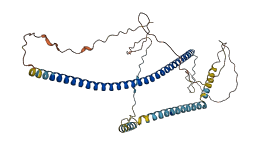
Descriptions
The autoinhibited protein was predicted that may have potential autoinhibitory elements via cis-regPred.
Autoinhibitory domains (AIDs)
Target domain |
|
Relief mechanism |
|
Assay |
cis-regPred |
Accessory elements
No accessory elements
Autoinhibited structure

Activated structure
2 structures for O54724
| Entry ID | Method | Resolution | Chain | Position | Source |
|---|---|---|---|---|---|
| 4QKV | X-ray | 300 A | A/B/C | 45-155 | PDB |
| AF-O54724-F1 | Predicted | AlphaFoldDB |
11 variants for O54724
| Variant ID(s) | Position | Change | Description | Diseaes Association | Provenance |
|---|---|---|---|---|---|
| rs3389214050 | 15 | G>R | No | EVA | |
| rs3389138175 | 79 | E>* | No | EVA | |
| rs3389197067 | 127 | R>C | No | EVA | |
| rs3389200500 | 133 | Q>H | No | EVA | |
| rs3389207186 | 195 | E>D | No | EVA | |
| rs3389190953 | 233 | D>Y | No | EVA | |
| rs3389164278 | 250 | T>M | No | EVA | |
| rs3389138196 | 267 | K>M | No | EVA | |
| rs3389200508 | 320 | V>M | No | EVA | |
| rs3403002217 | 354 | G>A | No | EVA | |
| rs3389164330 | 371 | V>M | No | EVA |
No associated diseases with O54724
No regional properties for O54724
| Type | Name | Position | InterPro Accession |
|---|---|---|---|
| No domain, repeats, and functional sites for O54724 | |||
Functions
10 GO annotations of cellular component
| Name | Definition |
|---|---|
| caveola | A membrane raft that forms small pit, depression, or invagination that communicates with the outside of a cell and extends inward, indenting the cytoplasm and the cell membrane. Examples include flask-shaped invaginations of the plasma membrane in adipocytes associated with caveolin proteins, and minute pits or incuppings of the cell membrane formed during pinocytosis. Caveolae may be pinched off to form free vesicles within the cytoplasm. |
| cytoplasm | The contents of a cell excluding the plasma membrane and nucleus, but including other subcellular structures. |
| cytosol | The part of the cytoplasm that does not contain organelles but which does contain other particulate matter, such as protein complexes. |
| endoplasmic reticulum | The irregular network of unit membranes, visible only by electron microscopy, that occurs in the cytoplasm of many eukaryotic cells. The membranes form a complex meshwork of tubular channels, which are often expanded into slitlike cavities called cisternae. The ER takes two forms, rough (or granular), with ribosomes adhering to the outer surface, and smooth (with no ribosomes attached). |
| intracellular membrane-bounded organelle | Organized structure of distinctive morphology and function, bounded by a single or double lipid bilayer membrane and occurring within the cell. Includes the nucleus, mitochondria, plastids, vacuoles, and vesicles. Excludes the plasma membrane. |
| membrane raft | Any of the small (10-200 nm), heterogeneous, highly dynamic, sterol- and sphingolipid-enriched membrane domains that compartmentalize cellular processes. Small rafts can sometimes be stabilized to form larger platforms through protein-protein and protein-lipid interactions. |
| mitochondrion | A semiautonomous, self replicating organelle that occurs in varying numbers, shapes, and sizes in the cytoplasm of virtually all eukaryotic cells. It is notably the site of tissue respiration. |
| nucleus | A membrane-bounded organelle of eukaryotic cells in which chromosomes are housed and replicated. In most cells, the nucleus contains all of the cell's chromosomes except the organellar chromosomes, and is the site of RNA synthesis and processing. In some species, or in specialized cell types, RNA metabolism or DNA replication may be absent. |
| plasma membrane | The membrane surrounding a cell that separates the cell from its external environment. It consists of a phospholipid bilayer and associated proteins. |
| protein-containing complex | A stable assembly of two or more macromolecules, i.e. proteins, nucleic acids, carbohydrates or lipids, in which at least one component is a protein and the constituent parts function together. |
2 GO annotations of molecular function
| Name | Definition |
|---|---|
| identical protein binding | Binding to an identical protein or proteins. |
| rRNA primary transcript binding | Binding to an unprocessed ribosomal RNA transcript. |
5 GO annotations of biological process
| Name | Definition |
|---|---|
| positive regulation of cell motility | Any process that activates or increases the frequency, rate or extent of cell motility. |
| protein secretion | The controlled release of proteins from a cell. |
| rRNA transcription | The synthesis of ribosomal RNA (rRNA), any RNA that forms part of the ribosomal structure, from a DNA template. |
| termination of RNA polymerase I transcription | A transcription termination process that completes the production of a ribosomal RNA transcript. RNAP I termination requires binding of a terminator protein to specific sequences downstream of the transcription unit. |
| transcription initiation at RNA polymerase I promoter | A transcription initiation process that takes place at a RNA polymerase I gene promoter. Ribosomal RNAs (rRNA) genes are transcribed by RNA polymerase I. |
5 homologous proteins in AiPD
| UniProt AC | Gene Name | Protein Name | Species | Evidence Code |
|---|---|---|---|---|
| A5PJI6 | CAVIN4 | Caveolae-associated protein 4 | Bos taurus (Bovine) | PR |
| Q5BKX8 | CAVIN4 | Caveolae-associated protein 4 | Homo sapiens (Human) | PR |
| Q6NZI2 | CAVIN1 | Caveolae-associated protein 1 | Homo sapiens (Human) | PR |
| A2AMM0 | Cavin4 | Caveolae-associated protein 4 | Mus musculus (Mouse) | PR |
| B1PRL5 | Cavin4 | Caveolae-associated protein 4 | Rattus norvegicus (Rat) | PR |
| 10 | 20 | 30 | 40 | 50 | 60 |
| MEDVTLHIVE | RPYSGFPDAS | SEGPEPTQGE | ARATEEPSGT | GSDELIKSDQ | VNGVLVLSLL |
| 70 | 80 | 90 | 100 | 110 | 120 |
| DKIIGAVDQI | QLTQAQLEER | QAEMEGAVQS | IQGELSKLGK | AHATTSNTVS | KLLEKVRKVS |
| 130 | 140 | 150 | 160 | 170 | 180 |
| VNVKTVRGSL | ERQAGQIKKL | EVNEAELLRR | RNFKVMIYQD | EVKLPAKLSV | SKSLKESEAL |
| 190 | 200 | 210 | 220 | 230 | 240 |
| PEKEGDELGE | GERPEDDTAA | IELSSDEAVE | VEEVIEESRA | ERIKRSGLRR | VDDFKKAFSK |
| 250 | 260 | 270 | 280 | 290 | 300 |
| EKMEKTKVRT | RENLEKTRLK | TKENLEKTRH | TLEKRMNKLG | TRLVPVERRE | KLKTSRDKLR |
| 310 | 320 | 330 | 340 | 350 | 360 |
| KSFTPDHVVY | ARSKTAVYKV | PPFTFHVKKI | REGEVEVLKA | TEMVEVGPED | DEVGAERGEA |
| 370 | 380 | 390 | |||
| TDLLRGSSPD | VHTLLEITEE | SDAVLVDKSD | SD |