A2AMM0
Gene name |
Cavin4 (Murc) |
Protein name |
Caveolae-associated protein 4 |
Names |
Muscle-related coiled-coil protein, Muscle-restricted coiled-coil protein |
Species |
Mus musculus (Mouse) |
KEGG Pathway |
mmu:68016 |
EC number |
|
Protein Class |
|
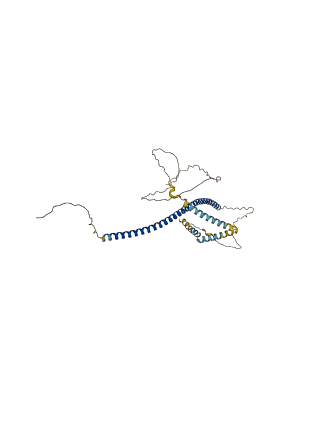
Descriptions
The autoinhibited protein was predicted that may have potential autoinhibitory elements via cis-regPred.
Autoinhibitory domains (AIDs)
Target domain |
|
Relief mechanism |
|
Assay |
cis-regPred |
Accessory elements
No accessory elements
Autoinhibited structure

Activated structure
1 structures for A2AMM0
| Entry ID | Method | Resolution | Chain | Position | Source |
|---|---|---|---|---|---|
| AF-A2AMM0-F1 | Predicted | AlphaFoldDB |
27 variants for A2AMM0
| Variant ID(s) | Position | Change | Description | Diseaes Association | Provenance |
|---|---|---|---|---|---|
| rs3388686000 | 19 | S>T | No | EVA | |
| rs27843433 | 20 | S>G | No | EVA | |
| rs3388684964 | 24 | D>H | No | EVA | |
| rs3410377037 | 71 | D>E | No | EVA | |
| rs3388682741 | 73 | L>V | No | EVA | |
| rs3388681375 | 117 | V>I | No | EVA | |
| rs3388685978 | 126 | K>R | No | EVA | |
| rs3394274497 | 129 | K>N | No | EVA | |
| rs256971285 | 133 | V>E | No | EVA | |
| rs3388688784 | 145 | L>M | No | EVA | |
| rs3388682373 | 155 | E>G | No | EVA | |
| rs3388684147 | 159 | E>* | No | EVA | |
| rs3388670384 | 183 | S>T | No | EVA | |
| rs27843359 | 212 | T>N | No | EVA | |
| rs3388677266 | 218 | S>I | No | EVA | |
| rs3388688734 | 246 | R>K | No | EVA | |
| rs3388663706 | 258 | I>N | No | EVA | |
| rs3388681406 | 268 | F>L | No | EVA | |
| rs246259679 | 282 | E>K | No | EVA | |
| rs3388670370 | 288 | R>S | No | EVA | |
| rs3388679324 | 300 | A>P | No | EVA | |
| rs3388682298 | 301 | L>M | No | EVA | |
| rs3388678951 | 335 | P>L | No | EVA | |
| rs3388681370 | 344 | P>H | No | EVA | |
| rs3388682369 | 344 | P>T | No | EVA | |
| rs3388682696 | 351 | D>N | No | EVA | |
| rs3388688745 | 352 | E>V | No | EVA |
No associated diseases with A2AMM0
No regional properties for A2AMM0
| Type | Name | Position | InterPro Accession |
|---|---|---|---|
| No domain, repeats, and functional sites for A2AMM0 | |||
Functions
7 GO annotations of cellular component
| Name | Definition |
|---|---|
| caveola | A membrane raft that forms small pit, depression, or invagination that communicates with the outside of a cell and extends inward, indenting the cytoplasm and the cell membrane. Examples include flask-shaped invaginations of the plasma membrane in adipocytes associated with caveolin proteins, and minute pits or incuppings of the cell membrane formed during pinocytosis. Caveolae may be pinched off to form free vesicles within the cytoplasm. |
| cytoplasm | The contents of a cell excluding the plasma membrane and nucleus, but including other subcellular structures. |
| cytosol | The part of the cytoplasm that does not contain organelles but which does contain other particulate matter, such as protein complexes. |
| plasma membrane | The membrane surrounding a cell that separates the cell from its external environment. It consists of a phospholipid bilayer and associated proteins. |
| sarcolemma | The outer membrane of a muscle cell, consisting of the plasma membrane, a covering basement membrane (about 100 nm thick and sometimes common to more than one fiber), and the associated loose network of collagen fibers. |
| sarcoplasm | The cytoplasm of a muscle cell; includes the sarcoplasmic reticulum. |
| Z disc | Platelike region of a muscle sarcomere to which the plus ends of actin filaments are attached. |
1 GO annotations of molecular function
| Name | Definition |
|---|---|
| GTPase activator activity | Binds to and increases the activity of a GTPase, an enzyme that catalyzes the hydrolysis of GTP. |
6 GO annotations of biological process
| Name | Definition |
|---|---|
| cardiac myofibril assembly | The process whose specific outcome is the progression of the cardiac myofibril over time, from its formation to the mature structure. A cardiac myofibril is a myofibril specific to cardiac muscle cells. |
| muscle organ development | The process whose specific outcome is the progression of the muscle over time, from its formation to the mature structure. The muscle is an organ consisting of a tissue made up of various elongated cells that are specialized to contract and thus to produce movement and mechanical work. |
| positive regulation of transcription by RNA polymerase II | Any process that activates or increases the frequency, rate or extent of transcription from an RNA polymerase II promoter. |
| regulation of gene expression | Any process that modulates the frequency, rate or extent of gene expression. Gene expression is the process in which a gene's coding sequence is converted into a mature gene product (protein or RNA). |
| regulation of Rho protein signal transduction | Any process that modulates the frequency, rate or extent of Rho protein signal transduction. |
| Rho protein signal transduction | The series of molecular signals within the cell that are mediated by a member of the Rho family of proteins switching to a GTP-bound active state. |
5 homologous proteins in AiPD
| UniProt AC | Gene Name | Protein Name | Species | Evidence Code |
|---|---|---|---|---|
| A5PJI6 | CAVIN4 | Caveolae-associated protein 4 | Bos taurus (Bovine) | PR |
| Q6NZI2 | CAVIN1 | Caveolae-associated protein 1 | Homo sapiens (Human) | PR |
| Q5BKX8 | CAVIN4 | Caveolae-associated protein 4 | Homo sapiens (Human) | PR |
| O54724 | Cavin1 | Caveolae-associated protein 1 | Mus musculus (Mouse) | PR |
| B1PRL5 | Cavin4 | Caveolae-associated protein 4 | Rattus norvegicus (Rat) | PR |
| 10 | 20 | 30 | 40 | 50 | 60 |
| MEHNGSASNA | GKIHQNRLSS | VTEDEDQDAA | LTIVTVLDRV | ASVVDSVQAS | QKRIEERHRE |
| 70 | 80 | 90 | 100 | 110 | 120 |
| MGNAIKSVQI | DLLKLSQSHS | NTGYVVNKLF | EKTRKVSAHI | KDVKARVEKQ | QVRVTKVETK |
| 130 | 140 | 150 | 160 | 170 | 180 |
| QEEIMKKNKF | RVVIFQEDIP | CPASLSVVKD | RSLPENQEEA | EEVFDPPIEL | SSDEEYYVEE |
| 190 | 200 | 210 | 220 | 230 | 240 |
| SRSARLRKSG | KEHIDHIKKA | FSRENMQKTR | QTLDKKVSGI | RTRIVTPERR | ERLRQSGERL |
| 250 | 260 | 270 | 280 | 290 | 300 |
| RQSGERLRQS | GERFKKSISS | AAPSKEAFKI | RSLRKAKDPK | AEGQEVDRGM | GVDIISGSLA |
| 310 | 320 | 330 | 340 | 350 | 360 |
| LGPIHEFHSD | EFSETEKEVT | KGGYSPQEGG | DPPTPEPLKV | TFKPQVRVED | DESLLLELKQ |
| SS |