F6PTN1
Gene name |
trabd2a (tiki1) |
Protein name |
Metalloprotease TIKI1 |
Names |
TRAB domain-containing protein 2A |
Species |
Xenopus tropicalis (Western clawed frog) (Silurana tropicalis) |
KEGG Pathway |
xtr:100491951 |
EC number |
|
Protein Class |
|
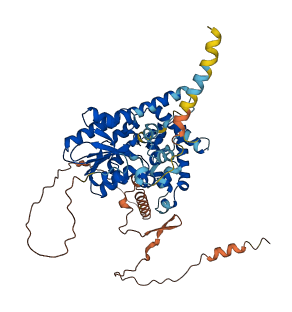
Descriptions
The autoinhibited protein was predicted that may have potential autoinhibitory elements via cis-regPred.
Autoinhibitory domains (AIDs)
Target domain |
|
Relief mechanism |
|
Assay |
cis-regPred |
Accessory elements
No accessory elements
Autoinhibited structure

Activated structure
1 structures for F6PTN1
| Entry ID | Method | Resolution | Chain | Position | Source |
|---|---|---|---|---|---|
| AF-F6PTN1-F1 | Predicted | AlphaFoldDB |
No variants for F6PTN1
| Variant ID(s) | Position | Change | Description | Diseaes Association | Provenance |
|---|---|---|---|---|---|
| No variants for F6PTN1 | |||||
No associated diseases with F6PTN1
No regional properties for F6PTN1
| Type | Name | Position | InterPro Accession |
|---|---|---|---|
| No domain, repeats, and functional sites for F6PTN1 | |||
2 GO annotations of cellular component
| Name | Definition |
|---|---|
| integral component of organelle membrane | The component of the organelle membrane consisting of the gene products having at least some part of their peptide sequence embedded in the hydrophobic region of the membrane. |
| integral component of plasma membrane | The component of the plasma membrane consisting of the gene products and protein complexes having at least some part of their peptide sequence embedded in the hydrophobic region of the membrane. |
3 GO annotations of molecular function
| Name | Definition |
|---|---|
| metal ion binding | Binding to a metal ion. |
| metalloendopeptidase activity | Catalysis of the hydrolysis of internal, alpha-peptide bonds in a polypeptide chain by a mechanism in which water acts as a nucleophile, one or two metal ions hold the water molecule in place, and charged amino acid side chains are ligands for the metal ions. |
| Wnt-protein binding | Binding to a Wnt-protein, a secreted growth factor involved in signaling. |
4 GO annotations of biological process
| Name | Definition |
|---|---|
| head development | The biological process whose specific outcome is the progression of a head from an initial condition to its mature state. The head is the anterior-most division of the body. |
| negative regulation of Wnt signaling pathway | Any process that stops, prevents, or reduces the frequency, rate or extent of the Wnt signaling pathway. |
| proteolysis | The hydrolysis of proteins into smaller polypeptides and/or amino acids by cleavage of their peptide bonds. |
| Wnt signaling pathway | The series of molecular signals initiated by binding of a Wnt protein to a frizzled family receptor on the surface of the target cell and ending with a change in cell state. |
5 homologous proteins in AiPD
| UniProt AC | Gene Name | Protein Name | Species | Evidence Code |
|---|---|---|---|---|
| A6NFA1 | TRABD2B | Metalloprotease TIKI2 | Homo sapiens (Human) | PR |
| Q86V40 | TRABD2A | Metalloprotease TIKI1 | Homo sapiens (Human) | PR |
| B1ATG9 | Trabd2b | Metalloprotease TIKI2 | Mus musculus (Mouse) | PR |
| E7F4V6 | trabd2b | Metalloprotease TIKI2 | Danio rerio (Zebrafish) (Brachydanio rerio) | PR |
| E7F6V0 | trabd2a | Metalloprotease TIKI1 | Danio rerio (Zebrafish) (Brachydanio rerio) | PR |
| 10 | 20 | 30 | 40 | 50 | 60 |
| MVIIWNIFLP | AFLLVLAKAS | LRSSRDSANC | KLNKKQSQLN | SFLWTIKRDP | PSYFFGTIHV |
| 70 | 80 | 90 | 100 | 110 | 120 |
| PYTRVWDFIP | ENSKTAFQQS | NIVYFELDLT | DPYTISALTS | CQMLPQGENL | QNVLPRDIYR |
| 130 | 140 | 150 | 160 | 170 | 180 |
| RLKRHLEYVK | LMMPSWMTPD | QRGKGLYADY | LFNAIAGNWE | RKRPVWVMLM | VNSLTEVDIK |
| 190 | 200 | 210 | 220 | 230 | 240 |
| SRGVPVLDLY | LAQEAERLKK | RTGAVEQVEE | QCHPLNGLNL | SQVIFALNQT | LLQQENLRAG |
| 250 | 260 | 270 | 280 | 290 | 300 |
| SVQVPYSTED | LIKHYNCGDL | NSIIFNHDSS | QVPNFINSTL | PPQERITAQE | IDNYFRQELI |
| 310 | 320 | 330 | 340 | 350 | 360 |
| YKRNERMGKR | VKDLLEQFPE | KSFFFAFGAG | HFLGNNTVID | VLKRYGYDVL | HTPAGRSIIN |
| 370 | 380 | 390 | 400 | 410 | 420 |
| NGKGKKNLLP | SKFSSSSLPV | GLSAPPCTVT | SRIKQSINSH | KDQESLPDIL | LDDDIDQLDK |
| 430 | 440 | 450 | 460 | 470 | 480 |
| DERKYKKRKQ | RKEKHRHFSD | LWVRIQESST | DTTPQIRIIN | GYITVEPHPR | EHGKDKYIKA |
| 490 | 500 | ||||
| AQSVSFSLSI | PSAFLLLAWC | FQQVAVLQ |