B4F769
Gene name |
Smarcal1 (Harp) |
Protein name |
SWI/SNF-related matrix-associated actin-dependent regulator of chromatin subfamily A-like protein 1 |
Names |
HepA-related protein, Sucrose nonfermenting protein 2-like 1 |
Species |
Rattus norvegicus (Rat) |
KEGG Pathway |
rno:316477 |
EC number |
|
Protein Class |
|
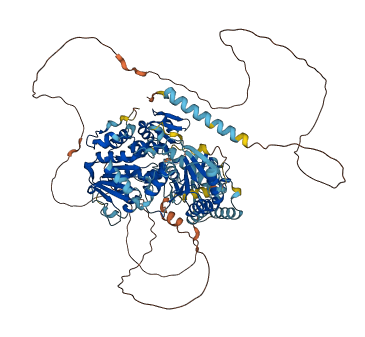
Descriptions
The autoinhibited protein was predicted that may have potential autoinhibitory elements via cis-regPred.
Autoinhibitory domains (AIDs)
Target domain |
|
Relief mechanism |
|
Assay |
cis-regPred |
Accessory elements
No accessory elements
Autoinhibited structure

Activated structure
1 structures for B4F769
| Entry ID | Method | Resolution | Chain | Position | Source |
|---|---|---|---|---|---|
| AF-B4F769-F1 | Predicted | AlphaFoldDB |
3 variants for B4F769
| Variant ID(s) | Position | Change | Description | Diseaes Association | Provenance |
|---|---|---|---|---|---|
| rs197864744 | 129 | S>C | No | EVA | |
| rs198986498 | 179 | E>G | No | EVA | |
| rs8173180 | 886 | A>D | No | EVA |
No associated diseases with B4F769
5 GO annotations of cellular component
| Name | Definition |
|---|---|
| DNA replication factor A complex | A conserved heterotrimeric complex that binds nonspecifically to single-stranded DNA and is required for multiple processes in eukaryotic DNA metabolism, including DNA replication, DNA repair, and recombination. In all eukaryotic organisms examined the complex is composed of subunits of approximately 70, 30, and 14 kDa. |
| nuclear replication fork | The Y-shaped region of a nuclear replicating DNA molecule, resulting from the separation of the DNA strands and in which the synthesis of new strands takes place. Also includes associated protein complexes. |
| nucleoplasm | That part of the nuclear content other than the chromosomes or the nucleolus. |
| nucleus | A membrane-bounded organelle of eukaryotic cells in which chromosomes are housed and replicated. In most cells, the nucleus contains all of the cell's chromosomes except the organellar chromosomes, and is the site of RNA synthesis and processing. In some species, or in specialized cell types, RNA metabolism or DNA replication may be absent. |
| site of double-strand break | A region of a chromosome at which a DNA double-strand break has occurred. DNA damage signaling and repair proteins accumulate at the lesion to respond to the damage and repair the DNA to form a continuous DNA helix. |
6 GO annotations of molecular function
| Name | Definition |
|---|---|
| ATP binding | Binding to ATP, adenosine 5'-triphosphate, a universally important coenzyme and enzyme regulator. |
| ATP-dependent activity, acting on DNA | Catalytic activity that acts to modify DNA, driven by ATP hydrolysis. |
| ATP-dependent chromatin remodeler activity | An activity, driven by ATP hydrolysis, that modulates the contacts between histones and DNA, resulting in a change in chromosome architecture within the nucleosomal array, leading to chromatin remodeling. |
| ATP-dependent DNA/DNA annealing activity | An ATP-dependent activity that facilitates the formation of a complementary double-stranded DNA molecule. |
| helicase activity | Catalysis of the reaction: ATP + H2O = ADP + phosphate, to drive the unwinding of a DNA or RNA helix. |
| hydrolase activity | Catalysis of the hydrolysis of various bonds, e.g. C-O, C-N, C-C, phosphoric anhydride bonds, etc. |
6 GO annotations of biological process
| Name | Definition |
|---|---|
| cellular response to DNA damage stimulus | Any process that results in a change in state or activity of a cell (in terms of movement, secretion, enzyme production, gene expression, etc.) as a result of a stimulus indicating damage to its DNA from environmental insults or errors during metabolism. |
| DNA repair | The process of restoring DNA after damage. Genomes are subject to damage by chemical and physical agents in the environment (e.g. UV and ionizing radiations, chemical mutagens, fungal and bacterial toxins, etc.) and by free radicals or alkylating agents endogenously generated in metabolism. DNA is also damaged because of errors during its replication. A variety of different DNA repair pathways have been reported that include direct reversal, base excision repair, nucleotide excision repair, photoreactivation, bypass, double-strand break repair pathway, and mismatch repair pathway. |
| double-strand break repair via nonhomologous end joining | The repair of a double-strand break in DNA in which the two broken ends are rejoined with little or no sequence complementarity. Information at the DNA ends may be lost due to the modification of broken DNA ends. This term covers instances of separate pathways, called classical (or canonical) and alternative nonhomologous end joining (C-NHEJ and A-NHEJ). These in turn may further branch into sub-pathways, but evidence is still unclear. |
| regulation of transcription by RNA polymerase II | Any process that modulates the frequency, rate or extent of transcription mediated by RNA polymerase II. |
| replication fork processing | The process in which a DNA replication fork that has stalled is restored to a functional state and replication is restarted. The stalling may be due to DNA damage, DNA secondary structure, bound proteins, dNTP shortage, or other causes. |
| replication fork protection | Any process that prevents the collapse of stalled replication forks. |
6 homologous proteins in AiPD
| UniProt AC | Gene Name | Protein Name | Species | Evidence Code |
|---|---|---|---|---|
| Q9TTA5 | SMARCAL1 | SWI/SNF-related matrix-associated actin-dependent regulator of chromatin subfamily A-like protein 1 | Bos taurus (Bovine) | PR |
| Q5FWF4 | ZRANB3 | DNA annealing helicase and endonuclease ZRANB3 | Homo sapiens (Human) | PR |
| Q9NZC9 | SMARCAL1 | SWI/SNF-related matrix-associated actin-dependent regulator of chromatin subfamily A-like protein 1 | Homo sapiens (Human) | PR |
| Q8BJL0 | Smarcal1 | SWI/SNF-related matrix-associated actin-dependent regulator of chromatin subfamily A-like protein 1 | Mus musculus (Mouse) | PR |
| Q8MNV7 | smrc-1 | SWI/SNF-related matrix-associated actin-dependent regulator of chromatin subfamily A-like protein 1 homolog | Caenorhabditis elegans | PR |
| B2ZFP3 | smarcal1 | SWI/SNF-related matrix-associated actin-dependent regulator of chromatin subfamily A-like protein 1 | Danio rerio (Zebrafish) (Brachydanio rerio) | PR |
| 10 | 20 | 30 | 40 | 50 | 60 |
| MSLPLTEEQR | KKIEENRQKA | LARRAEKLWA | EQPQSTASGS | SAARPSQCKQ | NSLLNLPAEP |
| 70 | 80 | 90 | 100 | 110 | 120 |
| SKPEGHATIS | KGQNLNNSLP | AAQRPHSSPC | FQPSTAEEAK | GLWKSEGKMS | AACPNPSPPE |
| 130 | 140 | 150 | 160 | 170 | 180 |
| VSNQQLLGSK | SSEGHPQATQ | DTAASCPRPF | PRDPKLEAKA | GRPSTSGQSI | SDTFYALGEK |
| 190 | 200 | 210 | 220 | 230 | 240 |
| TPKTDGRPAK | ALQTSPQKAS | CLRGMCLRTG | DRFRVKIGYN | KELIEVFKSL | PSRRYDSFTK |
| 250 | 260 | 270 | 280 | 290 | 300 |
| TWDFSMSDYR | ALMKAVERLS | TVSLQPLEEV | DGTGGQTSLP | SAPSLTFVTG | RCMLISRARF |
| 310 | 320 | 330 | 340 | 350 | 360 |
| EVDIGYSEVV | IALFKQMESR | NYDPKTRKWN | FLLEEHNKLI | ARSRELKQVQ | LDPLPKTLTL |
| 370 | 380 | 390 | 400 | 410 | 420 |
| AFASQLEKTS | LQSKADVPEA | DLSGVDAKLV | SNLMPFQREG | VSFAISKRGR | LLLADDMGLG |
| 430 | 440 | 450 | 460 | 470 | 480 |
| KTIQAICIAA | FYRKEWPLLV | VVPSSVRFTW | EQAFLRWLPS | LSPEDINVVV | TGKGRLTAGL |
| 490 | 500 | 510 | 520 | 530 | 540 |
| VNIVSFDLLS | KLEKQLKTPF | KVVIIDESHF | LKNIKTARCR | AAVPILKVAK | RVILLSGTPA |
| 550 | 560 | 570 | 580 | 590 | 600 |
| MSRPAELYTQ | IIAVKPTFFP | QFHAFGLRYC | DAKRLPWGWD | YSGSSNLGEL | KLLLEEAVML |
| 610 | 620 | 630 | 640 | 650 | 660 |
| RRLKSDVLSQ | LPAKQRKMVV | VNPGRISTRA | KAALDAAAKE | MTKDKTKQQQ | KEALLVFFNR |
| 670 | 680 | 690 | 700 | 710 | 720 |
| TAEAKIPCVI | EYILDLLESG | REKFLVFAHH | KVLLDAIAKE | LERKNVQHIR | IDGSTPSADR |
| 730 | 740 | 750 | 760 | 770 | 780 |
| EDLCQQFQLS | KGHTVAVLSI | TAANMGLTFS | SADLVVFAEL | FWNPGVLIQA | EDRVHRIGQT |
| 790 | 800 | 810 | 820 | 830 | 840 |
| NSVGIHYLVA | KGTADDYLWP | LIQEKIKVLG | EAGLSETNFS | EMTEATDYLY | KDPKQKTIYS |
| 850 | 860 | 870 | 880 | 890 | 900 |
| LFQQSFEDDG | NDMEFLEAAE | SFELGSTSGT | SGNSSQELGD | ITDENALADS | PPKKRRFEFF |
| DNWDSFTSPF |