A7YY97
Gene name |
cdc37l1 (zgc:171475) |
Protein name |
Hsp90 co-chaperone Cdc37-like 1 |
Names |
|
Species |
Danio rerio (Zebrafish) (Brachydanio rerio) |
KEGG Pathway |
dre:569357 |
EC number |
|
Protein Class |
|
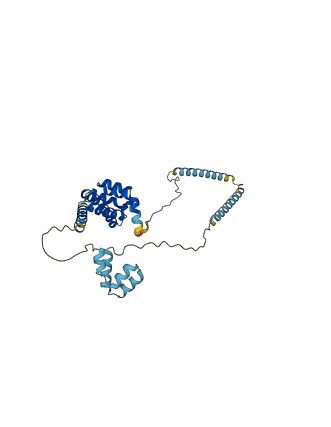
Descriptions
The autoinhibited protein was predicted that may have potential autoinhibitory elements via cis-regPred.
Autoinhibitory domains (AIDs)
Target domain |
|
Relief mechanism |
|
Assay |
cis-regPred |
Accessory elements
No accessory elements
Autoinhibited structure

Activated structure
1 structures for A7YY97
| Entry ID | Method | Resolution | Chain | Position | Source |
|---|---|---|---|---|---|
| AF-A7YY97-F1 | Predicted | AlphaFoldDB |
No variants for A7YY97
| Variant ID(s) | Position | Change | Description | Diseaes Association | Provenance |
|---|---|---|---|---|---|
| No variants for A7YY97 | |||||
1 associated diseases with A7YY97
[MIM: 615500]: Ciliary dyskinesia, primary, 26 (CILD26)
A disorder characterized by abnormalities of motile cilia. Respiratory infections leading to chronic inflammation and bronchiectasis are recurrent, due to defects in the respiratory cilia. Patients may exhibit randomization of left-right body asymmetry and situs inversus, due to dysfunction of monocilia at the embryonic node. Primary ciliary dyskinesia associated with situs inversus is referred to as Kartagener syndrome. {ECO:0000269|PubMed:24094744}. Note=The disease is caused by variants affecting the gene represented in this entry. Cilia in nasal epithelia show the absence of both outer and inner dynein-arm components and complete paralysis.
Without disease ID
- A disorder characterized by abnormalities of motile cilia. Respiratory infections leading to chronic inflammation and bronchiectasis are recurrent, due to defects in the respiratory cilia. Patients may exhibit randomization of left-right body asymmetry and situs inversus, due to dysfunction of monocilia at the embryonic node. Primary ciliary dyskinesia associated with situs inversus is referred to as Kartagener syndrome. {ECO:0000269|PubMed:24094744}. Note=The disease is caused by variants affecting the gene represented in this entry. Cilia in nasal epithelia show the absence of both outer and inner dynein-arm components and complete paralysis.
No regional properties for A7YY97
| Type | Name | Position | InterPro Accession |
|---|---|---|---|
| No domain, repeats, and functional sites for A7YY97 | |||
1 GO annotations of cellular component
| Name | Definition |
|---|---|
| cytoplasm | The contents of a cell excluding the plasma membrane and nucleus, but including other subcellular structures. |
3 GO annotations of molecular function
| Name | Definition |
|---|---|
| chaperone binding | Binding to a chaperone protein, a class of proteins that bind to nascent or unfolded polypeptides and ensure correct folding or transport. |
| heat shock protein binding | Binding to a heat shock protein, a protein synthesized or activated in response to heat shock. |
| unfolded protein binding | Binding to an unfolded protein. |
2 GO annotations of biological process
| Name | Definition |
|---|---|
| protein folding | The process of assisting in the covalent and noncovalent assembly of single chain polypeptides or multisubunit complexes into the correct tertiary structure. |
| protein stabilization | Any process involved in maintaining the structure and integrity of a protein and preventing it from degradation or aggregation. |
6 homologous proteins in AiPD
| UniProt AC | Gene Name | Protein Name | Species | Evidence Code |
|---|---|---|---|---|
| P06101 | CDC37 | Hsp90 co-chaperone Cdc37 | Saccharomyces cerevisiae (strain ATCC 204508 / S288c) (Baker's yeast) | PR |
| Q5EAC6 | CDC37 | Hsp90 co-chaperone Cdc37 | Bos taurus (Bovine) | PR |
| Q24276 | Cdc37 | Hsp90 co-chaperone Cdc37 | Drosophila melanogaster (Fruit fly) | PR |
| Q16543 | CDC37 | Hsp90 co-chaperone Cdc37 | Homo sapiens (Human) | PR |
| Q61081 | Cdc37 | Hsp90 co-chaperone Cdc37 | Mus musculus (Mouse) | PR |
| Q63692 | Cdc37 | Hsp90 co-chaperone Cdc37 | Rattus norvegicus (Rat) | PR |
| 10 | 20 | 30 | 40 | 50 | 60 |
| MASLCQRQQH | CVKASIASEW | QLAEAQDQLC | GLELHSSESV | EQERARALAS | STELSHTEHQ |
| 70 | 80 | 90 | 100 | 110 | 120 |
| WRLKERMLGT | LCPEANRDVF | DKSIINITQS | WPNESDPDKS | LNFVQRNEEL | LKHFGMLGRW |
| 130 | 140 | 150 | 160 | 170 | 180 |
| DDSQRFLAEY | HHLICEETAN | YLILWCFRLQ | AEKKEALMEQ | VAHQAVVMQF | ILEMARNTQQ |
| 190 | 200 | 210 | 220 | 230 | 240 |
| DPRGCFRHFF | QKAKAGQEGY | LDVFHTELQA | FKDRVKEYTM | KSTGETPKDT | VHQNTPPACC |
| 250 | 260 | 270 | 280 | 290 | 300 |
| LDPKEVFESL | PQELKTCIQM | QDMQILQNVL | SSMNPQVAEY | HVKRCLEAGL | WTNIPRTSKD |
| 310 | |||||
| ESSEVDEWKM | MET |