A6QQV6
Gene name |
PRMT7 |
Protein name |
Protein arginine N-methyltransferase 7 |
Names |
Histone-arginine N-methyltransferase PRMT7, [Myelin basic protein]-arginine N-methyltransferase PRMT7 |
Species |
Bos taurus (Bovine) |
KEGG Pathway |
bta:514202 |
EC number |
2.1.1.321: Methyltransferases |
Protein Class |
|
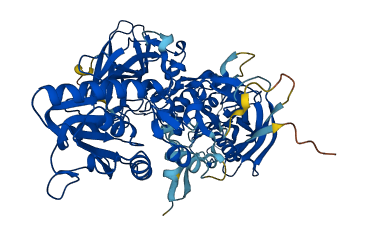
Descriptions
The autoinhibited protein was predicted that may have potential autoinhibitory elements via cis-regPred.
Autoinhibitory domains (AIDs)
Target domain |
|
Relief mechanism |
|
Assay |
cis-regPred |
Accessory elements
No accessory elements
Autoinhibited structure

Activated structure
1 structures for A6QQV6
| Entry ID | Method | Resolution | Chain | Position | Source |
|---|---|---|---|---|---|
| AF-A6QQV6-F1 | Predicted | AlphaFoldDB |
No variants for A6QQV6
| Variant ID(s) | Position | Change | Description | Diseaes Association | Provenance |
|---|---|---|---|---|---|
| No variants for A6QQV6 | |||||
No associated diseases with A6QQV6
Functions
| Description | ||
|---|---|---|
| EC Number | 2.1.1.321 | Methyltransferases |
| Subcellular Localization |
|
|
| PANTHER Family | ||
| PANTHER Subfamily | ||
| PANTHER Protein Class | ||
| PANTHER Pathway Category | No pathway information available | |
3 GO annotations of cellular component
| Name | Definition |
|---|---|
| cytosol | The part of the cytoplasm that does not contain organelles but which does contain other particulate matter, such as protein complexes. |
| nucleus | A membrane-bounded organelle of eukaryotic cells in which chromosomes are housed and replicated. In most cells, the nucleus contains all of the cell's chromosomes except the organellar chromosomes, and is the site of RNA synthesis and processing. In some species, or in specialized cell types, RNA metabolism or DNA replication may be absent. |
| plasma membrane | The membrane surrounding a cell that separates the cell from its external environment. It consists of a phospholipid bilayer and associated proteins. |
4 GO annotations of molecular function
| Name | Definition |
|---|---|
| histone methyltransferase activity (H4-R3 specific) | Catalysis of the reaction: S-adenosyl-L-methionine + (histone H4)-arginine (position 3) = S-adenosyl-L-homocysteine + (histone H4)-N-methyl-arginine (position 3). This reaction is the addition of a methyl group to arginine at position 3 of histone H4. |
| olfactory receptor activity | Combining with an odorant and transmitting the signal from one side of the membrane to the other to initiate a change in cell activity in response to detection of smell. |
| protein-arginine omega-N monomethyltransferase activity | Catalysis of the addition of a methyl group to either of the unmethylated terminal nitrogen atoms (also called omega nitrogen) in peptidyl-arginine to form an omega-N-G-monomethylated arginine residue. The reaction is S-adenosyl-L-methionine |
| protein-arginine omega-N symmetric methyltransferase activity | +Catalysis of the addition of a second methyl group to methylated peptidyl-arginine. Methylation is on the terminal nitrogen (omega nitrogen) residue that is not already methylated, resulting in symmetrical peptidyl-N(omega),N'(omega)-dimethyled arginine residues. |
6 GO annotations of biological process
| Name | Definition |
|---|---|
| cell differentiation | The process in which relatively unspecialized cells, e.g. embryonic or regenerative cells, acquire specialized structural and/or functional features that characterize the cells, tissues, or organs of the mature organism or some other relatively stable phase of the organism's life history. Differentiation includes the processes involved in commitment of a cell to a specific fate and its subsequent development to the mature state. |
| DNA methylation involved in gamete generation | The covalent transfer of a methyl group to C-5 of cytosine that contributes to the establishment of DNA methylation patterns in the gamete. |
| histone arginine methylation | The modification of a histone by addition of a methyl group to an arginine residue. |
| peptidyl-arginine methylation | The addition of a methyl group to an arginine residue in a protein. |
| regulation of gene expression by genomic imprinting | An epigenetic mechanism of regulation of gene expression in which epigenetic modifications (imprints) are established during gametogenesis. For a given gene to show parentally biased expression, the imprint are established exclusively in one of the two parental genomes, thus generating an asymmetry between the maternal and paternal alleles. |
| spliceosomal snRNP assembly | The aggregation, arrangement and bonding together of one or more snRNA and multiple protein components to form a ribonucleoprotein complex that is involved in formation of the spliceosome. |
8 homologous proteins in AiPD
| UniProt AC | Gene Name | Protein Name | Species | Evidence Code |
|---|---|---|---|---|
| Q5ZIB9 | PRMT7 | Protein arginine N-methyltransferase 7 | Gallus gallus (Chicken) | PR |
| Q9W1V1 | Art7 | Protein arginine N-methyltransferase 7 | Drosophila melanogaster (Fruit fly) | PR |
| Q6P2P2 | PRMT9 | Protein arginine N-methyltransferase 9 | Homo sapiens (Human) | PR |
| Q9NVM4 | PRMT7 | Protein arginine N-methyltransferase 7 | Homo sapiens (Human) | PR |
| Q3U3W5 | Prmt9 | Protein arginine N-methyltransferase 9 | Mus musculus (Mouse) | PR |
| Q922X9 | Prmt7 | Protein arginine N-methyltransferase 7 | Mus musculus (Mouse) | PR |
| Q5U4E8 | Prmt7 | Protein arginine N-methyltransferase 7 | Rattus norvegicus (Rat) | PR |
| A2AV36 | prmt7 | Protein arginine N-methyltransferase 7 | Danio rerio (Zebrafish) (Brachydanio rerio) | PR |
| 10 | 20 | 30 | 40 | 50 | 60 |
| MKVFCGRANP | TTGSVEWLEE | DEHYDYHQEI | ARSSYADMLH | DKDRNMKYYQ | GIRAAVSRVK |
| 70 | 80 | 90 | 100 | 110 | 120 |
| DRGQKALVLD | IGTGTGLLSM | MAVTAGADFC | YAIEVFKPMA | DAAVKIVEKN | GFSDKIKVIN |
| 130 | 140 | 150 | 160 | 170 | 180 |
| KHSTEVTVGP | DGDMPCRANI | LITELFDTEL | IGEGALPSYE | HAHRHLVQAN | CEAVPHRATV |
| 190 | 200 | 210 | 220 | 230 | 240 |
| YAQLVESRRM | WSWNKLFPIR | VQTSRGERVI | IPPLELERCP | GAPSVCDIQL | NQVSPADFTI |
| 250 | 260 | 270 | 280 | 290 | 300 |
| LSDVLPMFSV | DFSKQVSSSA | ACHSRQFEPL | VSGRAQVVLS | WWDIEMDPEG | KIKCTMAPSW |
| 310 | 320 | 330 | 340 | 350 | 360 |
| AHSDPEELQW | RDHWMQCVYF | LPQEEPVVQG | LALCLVAYHD | DYCVWYSLQK | TSPEKNGRVH |
| 370 | 380 | 390 | 400 | 410 | 420 |
| PVRPVCDCQA | HLLWNRPRFG | EINDRNRTDQ | YIQALRTVLK | PDSVCLCVSD | GSLLSMLAYH |
| 430 | 440 | 450 | 460 | 470 | 480 |
| LGVEQVFTIE | NSAVSHRLMK | KIFKANHLED | KINIIEKRPE | LLTPADLEGK | KVSLLLGEPF |
| 490 | 500 | 510 | 520 | 530 | 540 |
| FTTSLLPWHN | LYFWYVRTAV | DQHLGPGAVV | MPQAASLHVV | VVEFRDLWRI | RSPCGDCEGF |
| 550 | 560 | 570 | 580 | 590 | 600 |
| DVHIMDDMIK | RALDFRESKE | AEPHPLWEYP | CSSLSEPQQI | LTFDFRQPVP | LQPIHAEGTI |
| 610 | 620 | 630 | 640 | 650 | 660 |
| ELRRCGRSHG | AVLWMEYHLT | ADSTVSTGLL | KSAEDEGDCC | WNPHCKQAVY | FFNTTLDPRA |
| 670 | 680 | 690 | |||
| PPGSSQTVTY | TVEFHPHTGD | ITMDFTLSDA | LDSGC |