A2VDM0
Gene name |
TIFA |
Protein name |
TRAF-interacting protein with FHA domain-containing protein A |
Names |
|
Species |
Bos taurus (Bovine) |
KEGG Pathway |
bta:783855 |
EC number |
|
Protein Class |
|
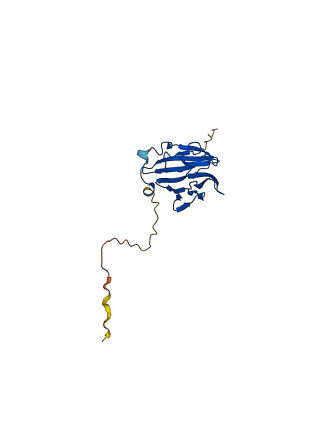
Descriptions
The autoinhibited protein was predicted that may have potential autoinhibitory elements via cis-regPred.
Autoinhibitory domains (AIDs)
Target domain |
|
Relief mechanism |
|
Assay |
cis-regPred |
Accessory elements
No accessory elements
Autoinhibited structure

Activated structure
1 structures for A2VDM0
| Entry ID | Method | Resolution | Chain | Position | Source |
|---|---|---|---|---|---|
| AF-A2VDM0-F1 | Predicted | AlphaFoldDB |
22 variants for A2VDM0
| Variant ID(s) | Position | Change | Description | Diseaes Association | Provenance |
|---|---|---|---|---|---|
| rs476075998 | 6 | D>A | No | EVA | |
| rs444731606 | 6 | D>E | No | EVA | |
| rs440090214 | 8 | D>E | No | EVA | |
| rs481099275 | 8 | D>H | No | EVA | |
| rs460280047 | 9 | T>K | No | EVA | |
| rs476990435 | 11 | E>V | No | EVA | |
| rs445770296 | 15 | C>S | No | EVA | |
| rs462604093 | 20 | L>F | No | EVA | |
| rs448375422 | 26 | Q>H | No | EVA | |
| rs467743165 | 28 | S>R | No | EVA | |
| rs380216384 | 32 | R>* | No | EVA | |
| rs522672506 | 32 | R>Q | No | EVA | |
| rs436422246 | 43 | P>T | No | EVA | |
| rs446889256 | 77 | K>I | No | EVA | |
| rs383011888 | 100 | D>N | No | EVA | |
| rs432468534 | 101 | N>D | No | EVA | |
| rs452683053 | 112 | L>P | No | EVA | |
| rs446804111 | 152 | E>* | No | EVA | |
| rs476010862 | 156 | L>V | No | EVA | |
| rs438274805 | 161 | I>M | No | EVA | |
| rs455270941 | 163 | E>V | No | EVA | |
| rs386114827 | 170 | C>S | No | EVA |
No associated diseases with A2VDM0
1 GO annotations of cellular component
| Name | Definition |
|---|---|
| cytoplasm | The contents of a cell excluding the plasma membrane and nucleus, but including other subcellular structures. |
No GO annotations of molecular function
| Name | Definition |
|---|---|
| No GO annotations for molecular function |
5 GO annotations of biological process
| Name | Definition |
|---|---|
| cytoplasmic pattern recognition receptor signaling pathway | The series of molecular signals initiated by a ligand binding to a cytoplasmic pattern recognition receptor (PRR). PRRs bind pathogen-associated molecular pattern (PAMPs), structures conserved among microbial species. |
| I-kappaB kinase/NF-kappaB signaling | The process in which a signal is passed on to downstream components within the cell through the I-kappaB-kinase (IKK)-dependent activation of NF-kappaB. The cascade begins with activation of a trimeric IKK complex (consisting of catalytic kinase subunits IKKalpha and/or IKKbeta, and the regulatory scaffold protein NEMO) and ends with the regulation of transcription of target genes by NF-kappaB. In a resting state, NF-kappaB dimers are bound to I-kappaB proteins, sequestering NF-kappaB in the cytoplasm. Phosphorylation of I-kappaB targets I-kappaB for ubiquitination and proteasomal degradation, thus releasing the NF-kappaB dimers, which can translocate to the nucleus to bind DNA and regulate transcription. |
| innate immune response | Innate immune responses are defense responses mediated by germline encoded components that directly recognize components of potential pathogens. |
| positive regulation of I-kappaB kinase/NF-kappaB signaling | Any process that activates or increases the frequency, rate or extent of I-kappaB kinase/NF-kappaB signaling. |
| protein homooligomerization | The process of creating protein oligomers, compounds composed of a small number, usually between three and ten, of identical component monomers. Oligomers may be formed by the polymerization of a number of monomers or the depolymerization of a large protein polymer. |
3 homologous proteins in AiPD
| UniProt AC | Gene Name | Protein Name | Species | Evidence Code |
|---|---|---|---|---|
| Q96CG3 | TIFA | TRAF-interacting protein with FHA domain-containing protein A | Homo sapiens (Human) | PR |
| Q793I8 | Tifa | TRAF-interacting protein with FHA domain-containing protein A | Mus musculus (Mouse) | PR |
| Q5XIB9 | Tifa | TRAF-interacting protein with FHA domain-containing protein A | Rattus norvegicus (Rat) | PR |
| 10 | 20 | 30 | 40 | 50 | 60 |
| MSSFEDADTE | EMVTCLQMTL | YHPGHQRSGI | FRSIKFFNRE | KLPTSEVVKF | GRNSHTCNYI |
| 70 | 80 | 90 | 100 | 110 | 120 |
| FQDKQVSRVQ | FSLQVFKKFN | SSVVSFEIKN | MSKKTSLLVD | NKELGYLNKM | DLPDKCMIRF |
| 130 | 140 | 150 | 160 | 170 | 180 |
| GDYQFLVEKE | DGESLEFFEI | QFSLSKKPLL | QENNWLSQEP | IPECGSYSSC | LTQNNSPMEV |
| GENEW |