Q9ZVL3
Gene name |
NFYC3 (At1g54830, F14C21.41, T22H22.22) |
Protein name |
Nuclear transcription factor Y subunit C-3 |
Names |
AtNF-YC-3 |
Species |
Arabidopsis thaliana (Mouse-ear cress) |
KEGG Pathway |
ath:AT1G54830 |
EC number |
|
Protein Class |
|
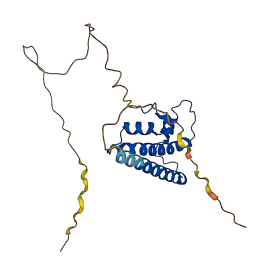
Descriptions
The autoinhibited protein was predicted that may have potential autoinhibitory elements via cis-regPred.
Autoinhibitory domains (AIDs)
Target domain |
|
Relief mechanism |
|
Assay |
cis-regPred |
Accessory elements
No accessory elements
Autoinhibited structure

Activated structure
12 variants for Q9ZVL3
| Variant ID(s) | Position | Change | Description | Diseaes Association | Provenance |
|---|---|---|---|---|---|
| tmp_1_20451679_A_G | 3 | Q>R | No | 1000Genomes | |
| tmp_1_20451750_A_G | 27 | T>A | No | 1000Genomes | |
| ENSVATH04963594 | 131 | A>T | No | 1000Genomes | |
| tmp_1_20452072_C_T | 134 | T>I | No | 1000Genomes | |
| tmp_1_20452146_G_C | 159 | V>L | No | 1000Genomes | |
| tmp_1_20452179_C_A | 170 | P>T | No | 1000Genomes | |
| ENSVATH04963596 | 176 | P>S | No | 1000Genomes | |
| ENSVATH04963597 | 188 | M>L | No | 1000Genomes | |
| tmp_1_20452234_T_G | 188 | M>R | No | 1000Genomes | |
| tmp_1_20452249_C_T | 193 | A>V | No | 1000Genomes | |
| tmp_1_20452255_C_T | 195 | P>L | No | 1000Genomes | |
| ENSVATH04963598 | 204 | M>I | No | 1000Genomes |
No associated diseases with Q9ZVL3
1 regional properties for Q9ZVL3
| Type | Name | Position | InterPro Accession |
|---|---|---|---|
| domain | Histone H2A/H2B/H3 | 32 - 133 | IPR007125 |
1 GO annotations of cellular component
| Name | Definition |
|---|---|
| nucleus | A membrane-bounded organelle of eukaryotic cells in which chromosomes are housed and replicated. In most cells, the nucleus contains all of the cell's chromosomes except the organellar chromosomes, and is the site of RNA synthesis and processing. In some species, or in specialized cell types, RNA metabolism or DNA replication may be absent. |
5 GO annotations of molecular function
| Name | Definition |
|---|---|
| DNA-binding transcription activator activity, RNA polymerase II-specific | A DNA-binding transcription factor activity that activates or increases transcription of specific gene sets transcribed by RNA polymerase II. |
| DNA-binding transcription factor activity | A transcription regulator activity that modulates transcription of gene sets via selective and non-covalent binding to a specific double-stranded genomic DNA sequence (sometimes referred to as a motif) within a cis-regulatory region. Regulatory regions include promoters (proximal and distal) and enhancers. Genes are transcriptional units, and include bacterial operons. |
| protein heterodimerization activity | Binding to a nonidentical protein to form a heterodimer. |
| transcription cis-regulatory region binding | Binding to a specific sequence of DNA that is part of a regulatory region that controls transcription of that section of the DNA. The transcribed region might be described as a gene, cistron, or operon. |
| transcription coregulator activity | A transcription regulator activity that modulates the transcription of specific gene sets via binding to a DNA-bound DNA-binding transcription factor, either on its own or as part of a complex. Coregulators often act by altering chromatin structure and modifications. For example, one class of transcription coregulators modifies chromatin structure through covalent modification of histones. A second class remodels the conformation of chromatin in an ATP-dependent fashion. A third class modulates interactions of DNA-bound DNA-binding transcription factors with other transcription coregulators. |
6 GO annotations of biological process
| Name | Definition |
|---|---|
| abscisic acid-activated signaling pathway | The series of molecular signals generated by the binding of the plant hormone abscisic acid (ABA) to a receptor, and ending with modulation of a cellular process, e.g. transcription. |
| gibberellic acid mediated signaling pathway | The series of molecular signals mediated by the detection of gibberellic acid. |
| long-day photoperiodism, flowering | A change from the vegetative to the reproductive phase as a result of detection of, or exposure to, a period of light that exceeds the critical day length. The critical day length varies between species. Although the term is long-day is used, most species actually respond to the duration of the night, so that the response will occur when a period of darkness falls short of the number of hours defined by 24 minus the critical day length. |
| positive regulation of photomorphogenesis | Any process that activates or increases the frequency, rate or extent of photomorphogenesis. |
| regulation of DNA-templated transcription | Any process that modulates the frequency, rate or extent of cellular DNA-templated transcription. |
| regulation of seed germination | Any process that modulates the frequency, rate or extent of seed germination. |
| 10 | 20 | 30 | 40 | 50 | 60 |
| MDQQGQSSAM | NYGSNPYQTN | AMTTTPTGSD | HPAYHQIHQQ | QQQQLTQQLQ | SFWETQFKEI |
| 70 | 80 | 90 | 100 | 110 | 120 |
| EKTTDFKNHS | LPLARIKKIM | KADEDVRMIS | AEAPVVFARA | CEMFILELTL | RSWNHTEENK |
| 130 | 140 | 150 | 160 | 170 | 180 |
| RRTLQKNDIA | AAVTRTDIFD | FLVDIVPRED | LRDEVLGGVG | AEAATAAGYP | YGYLPPGTAP |
| 190 | 200 | 210 | |||
| IGNPGMVMGN | PGAYPPNPYM | GQPMWQQPGP | EQQDPDN |