Q9WV31
Gene name |
Arc |
Protein name |
Activity-regulated cytoskeleton-associated protein |
Names |
mArc, Activity-regulated gene 3.1 protein, ARC/ARG3.1, Arg3.1 |
Species |
Mus musculus (Mouse) |
KEGG Pathway |
mmu:11838 |
EC number |
|
Protein Class |
|
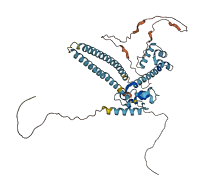
Descriptions
The autoinhibited protein was predicted that may have potential autoinhibitory elements via cis-regPred.
Autoinhibitory domains (AIDs)
Target domain |
|
Relief mechanism |
|
Assay |
cis-regPred |
Accessory elements
No accessory elements
Autoinhibited structure

Activated structure
1 structures for Q9WV31
| Entry ID | Method | Resolution | Chain | Position | Source |
|---|---|---|---|---|---|
| AF-Q9WV31-F1 | Predicted | AlphaFoldDB |
33 variants for Q9WV31
| Variant ID(s) | Position | Change | Description | Diseaes Association | Provenance |
|---|---|---|---|---|---|
| rs3406294525 | 20 | G>R | No | EVA | |
| rs3406315439 | 21 | P>R | No | EVA | |
| rs3405741007 | 24 | K>E | No | EVA | |
| rs3389360031 | 35 | R>Q | No | EVA | |
| rs3388456220 | 86 | R>C | No | EVA | |
| rs3388456591 | 87 | W>* | No | EVA | |
| rs3389356807 | 89 | K>* | No | EVA | |
| rs3389372163 | 92 | K>N | No | EVA | |
| rs3389372107 | 104 | N>D | No | EVA | |
| rs3406614465 | 113 | M>R | No | EVA | |
| rs3388456211 | 139 | V>G | No | EVA | |
| rs3389368089 | 169 | V>I | No | EVA | |
| rs3389376963 | 224 | L>V | No | EVA | |
| rs3389365554 | 239 | L>P | No | EVA | |
| rs3406614509 | 240 | S>A | No | EVA | |
| rs3389316597 | 260 | S>L | No | EVA | |
| rs3389286042 | 285 | Q>R | No | EVA | |
| rs3389346257 | 299 | D>E | No | EVA | |
| rs3389365552 | 306 | R>Q | No | EVA | |
| rs3389362271 | 317 | E>D | No | EVA | |
| rs1132717158 | 319 | E>D | No | EVA | |
| rs1135084249 | 319 | E>G | No | EVA | |
| rs1133840350 | 321 | I>T | No | EVA | |
| rs1132602964 | 321 | I>V | No | EVA | |
| rs1133274972 | 325 | V>G | No | EVA | |
| rs3389372108 | 326 | V>M | No | EVA | |
| rs3389368104 | 334 | K>* | No | EVA | |
| rs3388457402 | 338 | R>C | No | EVA | |
| rs3388457459 | 340 | P>S | No | EVA | |
| rs1132309038 | 345 | L>M | No | EVA | |
| rs3388456926 | 348 | L>F | No | EVA | |
| rs3389361216 | 349 | I>N | No | EVA | |
| rs3388457292 | 354 | E>G | No | EVA |
No associated diseases with Q9WV31
Functions
16 GO annotations of cellular component
| Name | Definition |
|---|---|
| acrosomal vesicle | A structure in the head of a spermatozoon that contains acid hydrolases, and is concerned with the breakdown of the outer membrane of the ovum during fertilization. It lies just beneath the plasma membrane and is derived from the lysosome. |
| actin cytoskeleton | The part of the cytoskeleton (the internal framework of a cell) composed of actin and associated proteins. Includes actin cytoskeleton-associated complexes. |
| anchoring junction | A cell junction that mechanically attaches a cell (and its cytoskeleton) to neighboring cells or to the extracellular matrix. |
| cell cortex | The region of a cell that lies just beneath the plasma membrane and often, but not always, contains a network of actin filaments and associated proteins. |
| cytoplasm | The contents of a cell excluding the plasma membrane and nucleus, but including other subcellular structures. |
| cytoskeleton | A cellular structure that forms the internal framework of eukaryotic and prokaryotic cells. The cytoskeleton includes intermediate filaments, microfilaments, microtubules, the microtrabecular lattice, and other structures characterized by a polymeric filamentous nature and long-range order within the cell. The various elements of the cytoskeleton not only serve in the maintenance of cellular shape but also have roles in other cellular functions, including cellular movement, cell division, endocytosis, and movement of organelles. |
| dendrite | A neuron projection that has a short, tapering, morphology. Dendrites receive and integrate signals from other neurons or from sensory stimuli, and conduct nerve impulses towards the axon or the cell body. In most neurons, the impulse is conveyed from dendrites to axon via the cell body, but in some types of unipolar neuron, the impulse does not travel via the cell body. |
| dendritic spine | A small, membranous protrusion from a dendrite that forms a postsynaptic compartment, typically receiving input from a single presynapse. They function as partially isolated biochemical and an electrical compartments. Spine morphology is variable:they can be thin, stubby, mushroom, or branched, with a continuum of intermediate morphologies. They typically terminate in a bulb shape, linked to the dendritic shaft by a restriction. Spine remodeling is though to be involved in synaptic plasticity. |
| early endosome membrane | The lipid bilayer surrounding an early endosome. |
| extracellular vesicle | Any vesicle that is part of the extracellular region. |
| glutamatergic synapse | A synapse that uses glutamate as a neurotransmitter. |
| membrane raft | Any of the small (10-200 nm), heterogeneous, highly dynamic, sterol- and sphingolipid-enriched membrane domains that compartmentalize cellular processes. Small rafts can sometimes be stabilized to form larger platforms through protein-protein and protein-lipid interactions. |
| neuronal ribonucleoprotein granule | A ribonucleoprotein complex that is found in the cytoplasm of axons and dendrites, and transports translationally silenced mRNAs to dendritic synapses, where they are released and translated in response to specific exogenous stimuli. |
| plasma membrane | The membrane surrounding a cell that separates the cell from its external environment. It consists of a phospholipid bilayer and associated proteins. |
| postsynaptic density membrane | The membrane component of the postsynaptic density. This is the region of the postsynaptic membrane in which the population of neurotransmitter receptors involved in synaptic transmission are concentrated. |
| postsynaptic endosome | An endosomal compartment that is part of the post-synapse. Only early and recycling endosomes are typically present in the postsynapse. |
2 GO annotations of molecular function
| Name | Definition |
|---|---|
| actin binding | Binding to monomeric or multimeric forms of actin, including actin filaments. |
| mRNA binding | Binding to messenger RNA (mRNA), an intermediate molecule between DNA and protein. mRNA includes UTR and coding sequences, but does not contain introns. |
18 GO annotations of biological process
| Name | Definition |
|---|---|
| anterior/posterior pattern specification | The regionalization process in which specific areas of cell differentiation are determined along the anterior-posterior axis. The anterior-posterior axis is defined by a line that runs from the head or mouth of an organism to the tail or opposite end of the organism. |
| cell migration | The controlled self-propelled movement of a cell from one site to a destination guided by molecular cues. Cell migration is a central process in the development and maintenance of multicellular organisms. |
| cytoskeleton organization | A process that is carried out at the cellular level which results in the assembly, arrangement of constituent parts, or disassembly of cytoskeletal structures. |
| endocytosis | A vesicle-mediated transport process in which cells take up external materials or membrane constituents by the invagination of a small region of the plasma membrane to form a new membrane-bounded vesicle. |
| endoderm development | The process whose specific outcome is the progression of the endoderm over time, from its formation to the mature structure. The endoderm is the innermost germ layer that develops into the gastrointestinal tract, the lungs and associated tissues. |
| learning | Any process in an organism in which a relatively long-lasting adaptive behavioral change occurs as the result of experience. |
| long-term memory | The memory process that deals with the storage, retrieval and modification of information a long time (typically weeks, months or years) after receiving that information. This type of memory is typically dependent on gene transcription regulated by second messenger activation. |
| modulation of chemical synaptic transmission | Any process that modulates the frequency or amplitude of synaptic transmission, the process of communication from a neuron to a target (neuron, muscle, or secretory cell) across a synapse. Amplitude, in this case, refers to the change in postsynaptic membrane potential due to a single instance of synaptic transmission. |
| mRNA transport | The directed movement of mRNA, messenger ribonucleic acid, into, out of or within a cell, or between cells, by means of some agent such as a transporter or pore. |
| positive regulation of AMPA receptor activity | Any process that activates or increases the frequency, rate or extent of AMPA selective glutamate receptor activity. |
| protein homooligomerization | The process of creating protein oligomers, compounds composed of a small number, usually between three and ten, of identical component monomers. Oligomers may be formed by the polymerization of a number of monomers or the depolymerization of a large protein polymer. |
| regulation of cell morphogenesis | Any process that modulates the frequency, rate or extent of cell morphogenesis. Cell morphogenesis is the developmental process in which the shape of a cell is generated and organized. |
| regulation of dendritic spine morphogenesis | Any process that modulates the rate, frequency, or extent of dendritic spine morphogenesis, the process in which the anatomical structures of a dendritic spine are generated and organized. A dendritic spine is a protrusion from a dendrite and a specialized subcellular compartment involved in synaptic transmission. |
| regulation of long-term synaptic depression | Any process that modulates the frequency, rate or extent of long term synaptic depression. |
| regulation of long-term synaptic potentiation | Any process that modulates the frequency, rate or extent of long-term synaptic potentiation. |
| regulation of neuronal synaptic plasticity | A process that modulates neuronal synaptic plasticity, the ability of neuronal synapses to change as circumstances require. They may alter function, such as increasing or decreasing their sensitivity, or they may increase or decrease in actual numbers. |
| regulation of postsynaptic neurotransmitter receptor internalization | Any process that modulates the frequency, rate or extent of endocytosis of neurotransmitter receptor at the postsynapse. |
| vesicle-mediated intercellular transport | A cellular transport process in which transported substances are moved in extracellular vesicles between cells; transported substances are enclosed in the vesicle lumen or located in the extracellular vesicle membrane. |
3 homologous proteins in AiPD
| UniProt AC | Gene Name | Protein Name | Species | Evidence Code |
|---|---|---|---|---|
| Q8AWC3 | ARC | Activity-regulated cytoskeleton-associated protein | Gallus gallus (Chicken) | PR |
| Q7LC44 | ARC | Activity-regulated cytoskeleton-associated protein | Homo sapiens (Human) | PR |
| Q63053 | Arc | Activity-regulated cytoskeleton-associated protein | Rattus norvegicus (Rat) | PR |
| 10 | 20 | 30 | 40 | 50 | 60 |
| MELDHMTTGG | LHAYPAPRGG | PAAKPNVILQ | IGKCRAEMLE | HVRRTHRHLL | TEVSKQVERE |
| 70 | 80 | 90 | 100 | 110 | 120 |
| LKGLHRSVGK | LENNLDGYVP | TGDSQRWKKS | IKACLCRCQE | TIANLERWVK | REMHVWREVF |
| 130 | 140 | 150 | 160 | 170 | 180 |
| YRLERWADRL | ESMGGKYPVG | SEPARHTVSV | GVGGPEPYCQ | EADGYDYTVS | PYAITPPPAA |
| 190 | 200 | 210 | 220 | 230 | 240 |
| GELPEQESVE | AQQYQSWGPG | EDGQPSPGVD | TQIFEDPREF | LSHLEEYLRQ | VGGSEEYWLS |
| 250 | 260 | 270 | 280 | 290 | 300 |
| QIQNHMNGPA | KKWWEFKQGS | VKNWVEFKKE | FLQYSEGTLS | REAIQRELEL | PQKQGEPLDQ |
| 310 | 320 | 330 | 340 | 350 | 360 |
| FLWRKRDLYQ | TLYVDAEEEE | IIQYVVGTLQ | PKLKRFLRHP | LPKTLEQLIQ | RGMEVQDGLE |
| 370 | 380 | 390 | |||
| QAAEPSGTPL | PTEDETEALT | PALTSESVAS | DRTQPE |