Q9UIV1
Gene name |
CNOT7 (CAF1) |
Protein name |
CCR4-NOT transcription complex subunit 7 |
Names |
BTG1-binding factor 1, CCR4-associated factor 1, CAF-1, Caf1a |
Species |
Homo sapiens (Human) |
KEGG Pathway |
hsa:29883 |
EC number |
3.1.13.4: Exoribonucleases producing 5'-phosphomonoesters |
Protein Class |
|
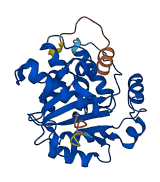
Descriptions
The autoinhibited protein was predicted that may have potential autoinhibitory elements via cis-regPred.
Autoinhibitory domains (AIDs)
Target domain |
|
Relief mechanism |
|
Assay |
cis-regPred |
Accessory elements
No accessory elements
Autoinhibited structure

Activated structure
5 structures for Q9UIV1
| Entry ID | Method | Resolution | Chain | Position | Source |
|---|---|---|---|---|---|
| 2D5R | X-ray | 250 A | A | 11-262 | PDB |
| 4GMJ | X-ray | 270 A | B/D/F | 1-285 | PDB |
| 7AX1 | X-ray | 330 A | B | 2-285 | PDB |
| 7VOI | X-ray | 438 A | B | 1-285 | PDB |
| AF-Q9UIV1-F1 | Predicted | AlphaFoldDB |
128 variants for Q9UIV1
| Variant ID(s) | Position | Change | Description | Diseaes Association | Provenance |
|---|---|---|---|---|---|
|
CA4643051 rs767567772 |
3 | A>V | No |
ClinGen ExAC TOPMed gnomAD |
|
|
CA4643049 rs751586478 |
5 | T>A | No |
ClinGen ExAC gnomAD |
|
|
rs766330962 CA4643048 |
5 | T>I | No |
ClinGen ExAC TOPMed gnomAD |
|
|
CA370403126 rs766330962 |
5 | T>S | No |
ClinGen ExAC TOPMed gnomAD |
|
|
CA370403115 rs1334555593 |
7 | D>G | Variant assessed as Somatic; impact. [NCI-TCGA] | No |
ClinGen NCI-TCGA TOPMed |
|
COSM1496863 CA4643047 rs762916263 |
9 | S>R | kidney [Cosmic] | No |
ClinGen cosmic curated ExAC gnomAD |
|
CA370403096 rs1563214981 |
9 | S>T | No |
ClinGen Ensembl |
|
|
rs1405230418 CA370403090 |
10 | Q>E | No |
ClinGen gnomAD |
|
|
rs1358368834 CA370403067 |
11 | R>I | Variant assessed as Somatic; impact. [NCI-TCGA] | No |
ClinGen NCI-TCGA TOPMed |
| TCGA novel | 11 | R>S | Variant assessed as Somatic; impact. [NCI-TCGA] | No | NCI-TCGA |
|
CA172947177 rs970479963 |
13 | C>R | No |
ClinGen TOPMed |
|
|
CA370402990 rs1418125981 |
17 | A>G | No |
ClinGen gnomAD |
|
|
CA172947174 rs930242144 |
17 | A>S | No |
ClinGen gnomAD |
|
|
CA4643044 rs142912321 |
19 | N>S | No |
ClinGen ESP ExAC TOPMed gnomAD |
|
|
rs142912321 CA370402965 |
19 | N>T | No |
ClinGen ESP ExAC TOPMed gnomAD |
|
|
CA4643042 rs768140191 |
21 | D>G | No |
ClinGen ExAC gnomAD |
|
|
CA4643043 rs776354768 |
21 | D>H | No |
ClinGen ExAC gnomAD |
|
|
CA370402933 rs1198098277 |
22 | E>K | No |
ClinGen gnomAD |
|
|
CA4643038 rs200983574 |
24 | M>I | No |
ClinGen 1000Genomes ExAC TOPMed gnomAD |
|
|
CA4643040 rs369445114 |
24 | M>L | No |
ClinGen ESP ExAC TOPMed gnomAD |
|
|
CA4643039 rs369445114 |
24 | M>V | No |
ClinGen ESP ExAC TOPMed gnomAD |
|
|
CA370402890 rs1487779225 |
25 | K>E | No |
ClinGen gnomAD |
|
|
rs1219452358 CA370402880 |
25 | K>N | No |
ClinGen TOPMed |
|
|
CA4643037 rs778137902 |
28 | R>H | No |
ClinGen ExAC TOPMed gnomAD |
|
|
CA370402837 rs1201029345 |
29 | Q>K | No |
ClinGen TOPMed |
|
|
rs375278542 COSM2873028 CA4643036 |
32 | R>Q | large_intestine [Cosmic] | No |
ClinGen cosmic curated ESP ExAC TOPMed gnomAD |
|
rs781083959 CA4643035 |
34 | Y>C | No |
ClinGen ExAC gnomAD |
|
| TCGA novel | 35 | N>D | Variant assessed as Somatic; impact. [NCI-TCGA] | No | NCI-TCGA |
|
rs148569654 CA4643034 |
37 | V>I | No |
ClinGen ESP ExAC TOPMed gnomAD |
|
| TCGA novel | 40 | D>= | Variant assessed as Somatic; impact. [NCI-TCGA] | No | NCI-TCGA |
|
rs1188071244 CA370402430 |
48 | A>V | No |
ClinGen TOPMed |
|
|
rs1178806345 CA370402409 |
51 | I>T | No |
ClinGen gnomAD |
|
|
CA4642997 rs367872876 |
61 | Q>R | No |
ClinGen ESP ExAC |
|
| TCGA novel | 76 | Q>* | Variant assessed as Somatic; impact. [NCI-TCGA] | No | NCI-TCGA |
|
CA172946180 rs370779310 |
79 | L>V | No |
ClinGen gnomAD |
|
|
rs778900473 CA4642991 |
80 | T>I | No |
ClinGen ExAC gnomAD |
|
|
CA4642990 rs757339677 |
82 | M>V | No |
ClinGen ExAC gnomAD |
|
|
rs753778888 CA4642989 |
83 | N>H | No |
ClinGen ExAC gnomAD |
|
|
CA370402179 rs1315840022 |
84 | E>G | No |
ClinGen gnomAD |
|
|
CA4642988 rs777784414 |
85 | Q>K | No |
ClinGen ExAC TOPMed gnomAD |
|
|
CA4642987 rs755985486 |
86 | G>A | No |
ClinGen ExAC |
|
|
CA4642986 rs188113569 |
87 | E>Q | No |
ClinGen 1000Genomes ExAC TOPMed gnomAD |
|
|
rs767309108 CA4642985 |
87 | E>V | No |
ClinGen ExAC |
|
|
CA4642984 rs754622526 |
88 | Y>H | No |
ClinGen ExAC gnomAD |
|
|
rs1446456914 CA370402144 |
89 | P>L | No |
ClinGen gnomAD |
|
|
CA370402138 rs1406070868 |
90 | P>L | No |
ClinGen gnomAD |
|
|
CA370402133 rs1267476160 |
91 | G>A | No |
ClinGen TOPMed gnomAD |
|
|
rs762517857 CA370401967 |
104 | T>K | No |
ClinGen ExAC gnomAD |
|
|
CA4642981 rs762517857 |
104 | T>M | No |
ClinGen ExAC gnomAD |
|
|
rs201352145 CA172936521 |
105 | E>K | No |
ClinGen 1000Genomes |
|
|
rs764621462 CA4642955 |
107 | M>T | No |
ClinGen ExAC gnomAD |
|
|
CA370401045 rs1563198871 |
113 | I>V | No |
ClinGen Ensembl |
|
| TCGA novel | 114 | E>D | Variant assessed as Somatic; impact. [NCI-TCGA] | No | NCI-TCGA |
|
CA370400984 rs759942846 |
122 | Q>H | No |
ClinGen ExAC |
|
|
rs1294944378 CA370400963 |
125 | K>T | No |
ClinGen TOPMed gnomAD |
|
|
rs774447300 CA4642950 |
126 | H>L | No |
ClinGen ExAC gnomAD |
|
|
rs915272393 CA172936508 |
126 | H>Q | No |
ClinGen TOPMed gnomAD |
|
| TCGA novel | 126 | H>T | Variant assessed as Somatic; impact. [NCI-TCGA] | No | NCI-TCGA |
|
CA4642948 rs749409263 |
128 | E>D | No |
ClinGen ExAC TOPMed gnomAD |
|
|
rs773648799 CA172936499 |
129 | E>G | No |
ClinGen Ensembl |
|
|
CA4642946 rs769967825 |
131 | I>V | No |
ClinGen ExAC gnomAD |
|
|
rs781268765 CA370400913 |
132 | E>D | No |
ClinGen ExAC TOPMed gnomAD |
|
|
rs748150992 CA4642945 |
132 | E>K | No |
ClinGen ExAC gnomAD |
|
|
rs1198764115 CA370400904 |
134 | Q>* | No |
ClinGen TOPMed |
|
|
CA370400899 rs1199498530 |
134 | Q>H | No |
ClinGen gnomAD |
|
|
rs768542225 CA172936482 |
135 | Y>C | No |
ClinGen Ensembl |
|
|
CA370400895 rs1400074762 |
135 | Y>D | No |
ClinGen gnomAD |
|
|
CA172936476 rs17850178 |
142 | T>I | No |
ClinGen Ensembl |
|
|
CA370400832 rs1473009991 |
144 | G>A | No |
ClinGen TOPMed |
|
|
rs746944412 CA4642940 |
149 | E>D | No |
ClinGen ExAC TOPMed gnomAD |
|
|
CA4642941 rs779598549 |
149 | E>K | No |
ClinGen ExAC TOPMed gnomAD |
|
|
rs1471513111 CA370400795 |
150 | G>E | No |
ClinGen TOPMed |
|
|
rs1234630840 CA370400798 |
150 | G>R | No |
ClinGen gnomAD |
|
|
rs1314283160 CA370400790 |
151 | V>F | No |
ClinGen gnomAD |
|
|
rs548128564 CA4642939 |
152 | K>R | No |
ClinGen 1000Genomes ExAC gnomAD |
|
| rs766824900 | 158 | S>= | Variant assessed as Somatic; 0.0 impact. [NCI-TCGA] | No | NCI-TCGA |
|
CA4642909 rs562363899 |
159 | G>S | No |
ClinGen ExAC TOPMed gnomAD |
|
|
rs79465220 CA172935046 |
163 | G>C | No |
ClinGen Ensembl |
|
| TCGA novel | 164 | Y>C | Variant assessed as Somatic; impact. [NCI-TCGA] | No | NCI-TCGA |
|
rs1257252552 CA370400505 |
166 | I>V | No |
ClinGen gnomAD |
|
|
rs765495514 CA4642907 |
168 | I>M | No |
ClinGen ExAC gnomAD |
|
|
CA4642906 rs759521873 |
169 | L>V | No |
ClinGen ExAC gnomAD |
|
|
CA370400476 rs1476469058 |
170 | T>I | No |
ClinGen TOPMed |
|
|
CA370400478 rs1476469058 |
170 | T>N | No |
ClinGen TOPMed |
|
|
rs775280548 CA4642902 |
171 | N>D | No |
ClinGen ExAC gnomAD |
|
|
CA370400464 rs1413135775 |
172 | S>C | No |
ClinGen TOPMed |
|
|
rs1284844296 CA370400455 |
173 | N>K | No |
ClinGen gnomAD |
|
| TCGA novel | 175 | P>L | Variant assessed as Somatic; impact. [NCI-TCGA] | No | NCI-TCGA |
|
rs771925219 CA4642901 |
175 | P>S | No |
ClinGen ExAC gnomAD |
|
| TCGA novel | 178 | E>missing | Variant assessed as Somatic; impact. [NCI-TCGA] | No | NCI-TCGA |
|
CA370400417 rs1422081084 |
179 | L>V | No |
ClinGen TOPMed |
|
|
CA4642899 rs774008173 |
180 | D>N | No |
ClinGen ExAC |
|
|
rs1314228146 CA370400404 |
181 | F>L | No |
ClinGen gnomAD |
|
|
CA370400382 rs1199187510 |
183 | E>D | No |
ClinGen gnomAD |
|
|
rs770529090 CA4642898 |
184 | I>V | No |
ClinGen ExAC gnomAD |
|
|
rs1402157230 COSM1097454 CA370400365 |
186 | R>Q | Variant assessed as Somatic; 0.0 impact. large_intestine endometrium [NCI-TCGA, Cosmic] | No |
ClinGen cosmic curated NCI-TCGA gnomAD |
|
CA370400336 rs1390932291 |
190 | P>L | Variant assessed as Somatic; 0.0 impact. [NCI-TCGA] | No |
ClinGen NCI-TCGA gnomAD |
|
CA370400337 rs1390932291 |
190 | P>R | No |
ClinGen gnomAD |
|
| TCGA novel | 192 | I>M | Variant assessed as Somatic; impact. [NCI-TCGA] | No | NCI-TCGA |
|
CA370400286 rs1554475435 |
197 | Y>* | No |
ClinGen Ensembl |
|
|
CA4642895 rs755562076 |
200 | K>R | No |
ClinGen ExAC TOPMed gnomAD |
|
|
rs780357311 CA4642893 |
206 | K>R | No |
ClinGen ExAC gnomAD |
|
|
rs1346903614 CA370399886 |
207 | G>D | No |
ClinGen TOPMed |
|
|
rs1214946785 CA370399816 |
213 | A>S | No |
ClinGen gnomAD |
|
|
COSM750212 CA370399769 rs1453783166 |
217 | E>Q | lung Variant assessed as Somatic; impact. central_nervous_system [Cosmic, NCI-TCGA] | No |
ClinGen cosmic curated NCI-TCGA TOPMed |
|
CA370399721 rs1443002137 |
224 | Q>R | No |
ClinGen gnomAD |
|
| TCGA novel | 226 | Q>* | Variant assessed as Somatic; impact. [NCI-TCGA] | No | NCI-TCGA |
| TCGA novel | 228 | G>* | Variant assessed as Somatic; impact. [NCI-TCGA] | No | NCI-TCGA |
|
rs201539670 CA172933719 |
232 | L>S | No |
ClinGen 1000Genomes |
|
|
CA172933713 rs181822276 |
239 | F>I | No |
ClinGen 1000Genomes |
|
|
CA4642854 rs371008461 |
243 | E>G | No |
ClinGen ESP ExAC TOPMed gnomAD |
|
|
rs1180209120 CA370399313 |
247 | E>* | No |
ClinGen gnomAD |
|
|
CA370399276 rs1585772211 |
249 | H>Q | No |
ClinGen Ensembl |
|
|
rs760199118 CA4642829 |
249 | H>R | No |
ClinGen ExAC gnomAD |
|
|
CA4642828 rs775016646 |
252 | D>G | No |
ClinGen ExAC gnomAD |
|
|
rs1382786685 CA370399204 |
257 | G>A | No |
ClinGen gnomAD |
|
|
CA370399207 rs1339119719 |
257 | G>R | No |
ClinGen TOPMed gnomAD |
|
|
CA370399206 rs1339119719 |
257 | G>S | No |
ClinGen TOPMed gnomAD |
|
| TCGA novel | 258 | H>N | Variant assessed as Somatic; impact. [NCI-TCGA] | No | NCI-TCGA |
|
CA370399199 rs1554473647 |
258 | H>Y | No |
ClinGen Ensembl |
|
|
rs1334061263 CA370399183 |
260 | Y>F | No |
ClinGen TOPMed gnomAD |
|
|
rs1393440071 CA370399185 |
260 | Y>H | No |
ClinGen gnomAD |
|
|
rs1044327623 CA172932542 |
261 | G>S | No |
ClinGen Ensembl |
|
| TCGA novel | 264 | S>Y | Variant assessed as Somatic; impact. [NCI-TCGA] | No | NCI-TCGA |
|
CA4642824 rs770178762 |
266 | S>L | No |
ClinGen ExAC gnomAD |
|
|
rs149444121 CA4642823 |
268 | Y>C | No |
ClinGen ESP ExAC TOPMed gnomAD |
|
|
CA370399035 rs1161828066 |
282 | N>S | No |
ClinGen gnomAD |
|
|
CA370399007 rs1419185662 |
286 | S>G | No |
ClinGen gnomAD |
No associated diseases with Q9UIV1
No regional properties for Q9UIV1
| Type | Name | Position | InterPro Accession |
|---|---|---|---|
| No domain, repeats, and functional sites for Q9UIV1 | |||
Functions
| Description | ||
|---|---|---|
| EC Number | 3.1.13.4 | Exoribonucleases producing 5'-phosphomonoesters |
| Subcellular Localization |
|
|
| PANTHER Family | ||
| PANTHER Subfamily | ||
| PANTHER Protein Class | ||
| PANTHER Pathway Category | No pathway information available | |
9 GO annotations of cellular component
| Name | Definition |
|---|---|
| CCR4-NOT complex | The Ccr4-Not complex is an eukaryotically conserved deadenylase that can initiate cytoplasmic mRNA decay, and reduce translation by releasing poly(A)-binding protein (Pab1/PABPC1). Ccr4-Not contains seven core subunits, including two poly(A)-specific exonucleases, Ccr4/CNOT6/CNOT6L and Caf1/Pop2/CNOT7/CNOT8. |
| CCR4-NOT core complex | The core of the CCR4-NOT complex. In Saccharomyces the CCR4-NOT core complex comprises Ccr4p, Caf1p, Caf40p, Caf130p, Not1p, Not2p, Not3p, Not4p, and Not5p. |
| cytoplasm | The contents of a cell excluding the plasma membrane and nucleus, but including other subcellular structures. |
| cytosol | The part of the cytoplasm that does not contain organelles but which does contain other particulate matter, such as protein complexes. |
| membrane | A lipid bilayer along with all the proteins and protein complexes embedded in it an attached to it. |
| nuclear body | Extra-nucleolar nuclear domains usually visualized by confocal microscopy and fluorescent antibodies to specific proteins. |
| nuclear speck | A discrete extra-nucleolar subnuclear domain, 20-50 in number, in which splicing factors are seen to be localized by immunofluorescence microscopy. |
| nucleus | A membrane-bounded organelle of eukaryotic cells in which chromosomes are housed and replicated. In most cells, the nucleus contains all of the cell's chromosomes except the organellar chromosomes, and is the site of RNA synthesis and processing. In some species, or in specialized cell types, RNA metabolism or DNA replication may be absent. |
| P-body | A focus in the cytoplasm where mRNAs may become inactivated by decapping or some other mechanism. Protein and RNA localized to these foci are involved in mRNA degradation, nonsense-mediated mRNA decay (NMD), translational repression, and RNA-mediated gene silencing. |
7 GO annotations of molecular function
| Name | Definition |
|---|---|
| 3'-5'-exoribonuclease activity | Catalysis of the sequential cleavage of mononucleotides from a free 3' terminus of an RNA molecule. |
| DNA-binding transcription factor binding | Binding to a DNA-binding transcription factor, a protein that interacts with a specific DNA sequence (sometimes referred to as a motif) within the regulatory region of a gene to modulate transcription. |
| exoribonuclease activity | Catalysis of the sequential cleavage of mononucleotides from a free 5' or 3' terminus of an RNA molecule. |
| metal ion binding | Binding to a metal ion. |
| poly(A)-specific ribonuclease activity | Catalysis of the exonucleolytic cleavage of poly(A) to 5'-AMP. |
| RNA binding | Binding to an RNA molecule or a portion thereof. |
| transcription corepressor activity | A transcription coregulator activity that represses or decreases the transcription of specific gene sets via binding to a DNA-bound DNA-binding transcription factor, either on its own or as part of a complex. Corepressors often act by altering chromatin structure and modifications. For example, one class of transcription corepressors modifies chromatin structure through covalent modification of histones. A second class remodels the conformation of chromatin in an ATP-dependent fashion. A third class modulates interactions of DNA-bound DNA-binding transcription factors with other transcription coregulators. |
18 GO annotations of biological process
| Name | Definition |
|---|---|
| deadenylation-dependent decapping of nuclear-transcribed mRNA | Cleavage of the 5'-cap of a nuclear mRNA triggered by shortening of the poly(A) tail to below a minimum functional length. |
| defense response to virus | Reactions triggered in response to the presence of a virus that act to protect the cell or organism. |
| exonucleolytic catabolism of deadenylated mRNA | The chemical reactions and pathways resulting in the breakdown of the transcript body of a nuclear-transcribed mRNA that occurs when the ends are not protected by the 3'-poly(A) tail. |
| gene silencing by RNA | A process in which an RNA molecule reduces expression of target genes. This can occur pre-transcriptionally by assembly of heterochromatin and prevention of transcription or co- or post-transcriptionally by targeting RNAs for degradation or by interfering with splicing or translation. This process starts once the inhibitory RNA molecule has been transcribed, and includes processing of the RNA such as cleavage, modifications, transport from the nucleus to the cytoplasm, loading onto the RISC complex, and the effect on transcription or translation. |
| miRNA-mediated gene silencing | A post-transcriptional gene silencing pathway in which regulatory microRNAs (miRNAs) elicit silencing of specific target genes. miRNAs are endogenous 21-24 nucleotide small RNAs processed from stem-loop RNA precursors (pre-miRNAs). Once incorporated into a RNA-induced silencing complex (RISC), miRNAs can downregulate gene expression by either of two posttranscriptional mechanisms: endonucleolytic cleavage of the RNA (often mRNA) or mRNA translational repression, usually accompanied by poly-A tail shortening and subsequent degradation of the mRNA. miRNAs are present in all the animals and in plants, whereas siRNAs are present in lower animals and in plants. |
| negative regulation of cell population proliferation | Any process that stops, prevents or reduces the rate or extent of cell proliferation. |
| negative regulation of DNA-templated transcription | Any process that stops, prevents, or reduces the frequency, rate or extent of cellular DNA-templated transcription. |
| negative regulation of gene expression | Any process that decreases the frequency, rate or extent of gene expression. Gene expression is the process in which a gene's coding sequence is converted into a mature gene product (protein or RNA). |
| negative regulation of type I interferon-mediated signaling pathway | Any process that decreases the rate, frequency or extent of a type I interferon-mediated signaling pathway. |
| nuclear-transcribed mRNA poly(A) tail shortening | Shortening of the poly(A) tail of a nuclear-transcribed mRNA from full length to an oligo(A) length. |
| P-body assembly | The aggregation, arrangement and bonding together of proteins and RNA molecules to form a cytoplasmic mRNA processing body. |
| positive regulation of cell population proliferation | Any process that activates or increases the rate or extent of cell proliferation. |
| positive regulation of mRNA catabolic process | Any process that increases the rate, frequency, or extent of a mRNA catabolic process, the chemical reactions and pathways resulting in the breakdown of RNA, ribonucleic acid, one of the two main type of nucleic acid, consisting of a long, unbranched macromolecule formed from ribonucleotides joined in 3',5'-phosphodiester linkage. |
| positive regulation of nuclear-transcribed mRNA catabolic process, deadenylation-dependent decay | Any process that activates or increases the frequency, rate or extent of nuclear-transcribed mRNA catabolic process, deadenylation-dependent decay. |
| positive regulation of nuclear-transcribed mRNA poly(A) tail shortening | Any process that increases the frequency, rate or extent of poly(A) tail shortening of a nuclear-transcribed mRNA. Poly(A) tail shortening is the decrease in length of the poly(A) tail of an mRNA from full length to an oligo(A) length. |
| positive regulation of transcription by RNA polymerase II | Any process that activates or increases the frequency, rate or extent of transcription from an RNA polymerase II promoter. |
| positive regulation of viral genome replication | Any process that activates or increases the frequency, rate or extent of viral genome replication. |
| regulation of tyrosine phosphorylation of STAT protein | Any process that modulates the frequency, rate or extent of the introduction of a phosphate group to a tyrosine residue of a STAT (Signal Transducer and Activator of Transcription) protein. |
4 homologous proteins in AiPD
| UniProt AC | Gene Name | Protein Name | Species | Evidence Code |
|---|---|---|---|---|
| Q3ZC01 | CNOT7 | CCR4-NOT transcription complex subunit 7 | Bos taurus (Bovine) | PR |
| Q5ZJV9 | CNOT7 | CCR4-NOT transcription complex subunit 7 | Gallus gallus (Chicken) | PR |
| Q60809 | Cnot7 | CCR4-NOT transcription complex subunit 7 | Mus musculus (Mouse) | PR |
| A4II96 | cnot7 | CCR4-NOT transcription complex subunit 7 | Xenopus tropicalis (Western clawed frog) (Silurana tropicalis) | PR |
| 10 | 20 | 30 | 40 | 50 | 60 |
| MPAATVDHSQ | RICEVWACNL | DEEMKKIRQV | IRKYNYVAMD | TEFPGVVARP | IGEFRSNADY |
| 70 | 80 | 90 | 100 | 110 | 120 |
| QYQLLRCNVD | LLKIIQLGLT | FMNEQGEYPP | GTSTWQFNFK | FNLTEDMYAQ | DSIELLTTSG |
| 130 | 140 | 150 | 160 | 170 | 180 |
| IQFKKHEEEG | IETQYFAELL | MTSGVVLCEG | VKWLSFHSGY | DFGYLIKILT | NSNLPEEELD |
| 190 | 200 | 210 | 220 | 230 | 240 |
| FFEILRLFFP | VIYDVKYLMK | SCKNLKGGLQ | EVAEQLELER | IGPQHQAGSD | SLLTGMAFFK |
| 250 | 260 | 270 | 280 | ||
| MREMFFEDHI | DDAKYCGHLY | GLGSGSSYVQ | NGTGNAYEEE | ANKQS |