Q3ZC01
Gene name |
CNOT7 (CAF1) |
Protein name |
CCR4-NOT transcription complex subunit 7 |
Names |
CCR4-associated factor 1, CAF-1 |
Species |
Bos taurus (Bovine) |
KEGG Pathway |
bta:508055 |
EC number |
3.1.13.4: Exoribonucleases producing 5'-phosphomonoesters |
Protein Class |
|
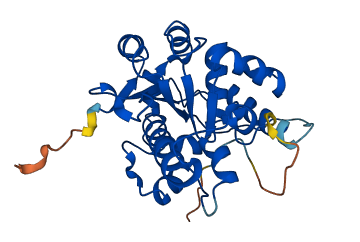
Descriptions
The autoinhibited protein was predicted that may have potential autoinhibitory elements via cis-regPred.
Autoinhibitory domains (AIDs)
Target domain |
|
Relief mechanism |
|
Assay |
cis-regPred |
Accessory elements
No accessory elements
Autoinhibited structure

Activated structure
1 structures for Q3ZC01
| Entry ID | Method | Resolution | Chain | Position | Source |
|---|---|---|---|---|---|
| AF-Q3ZC01-F1 | Predicted | AlphaFoldDB |
38 variants for Q3ZC01
| Variant ID(s) | Position | Change | Description | Diseaes Association | Provenance |
|---|---|---|---|---|---|
| rs459588899 | 7 | D>E | No | EVA | |
| rs448281832 | 32 | R>L | No | EVA | |
| rs468437522 | 34 | Y>H | No | EVA | |
| rs436942655 | 36 | Y>S | No | EVA | |
| rs447451070 | 84 | E>Q | No | EVA | |
| rs520851233 | 99 | F>I | No | EVA | |
| rs471068738 | 181 | F>L | No | EVA | |
| rs467199516 | 207 | G>R | No | EVA | |
| rs435782697 | 207 | G>V | No | EVA | |
| rs455977517 | 215 | Q>L | No | EVA | |
| rs444320285 | 244 | M>I | No | EVA | |
| rs475461888 | 244 | M>L | No | EVA | |
| rs471594028 | 247 | E>* | No | EVA | |
| rs471594028 | 247 | E>Q | No | EVA | |
| rs460209396 | 248 | D>A | No | EVA | |
| rs440124970 | 248 | D>N | No | EVA | |
| rs460209396 | 248 | D>V | No | EVA | |
| rs480224084 | 249 | H>L | No | EVA | |
| rs442400346 | 249 | H>Q | No | EVA | |
| rs463251277 | 250 | I>F | No | EVA | |
| rs483319852 | 252 | D>N | No | EVA | |
| rs445513933 | 252 | D>V | No | EVA | |
| rs479235227 | 253 | A>P | No | EVA | |
| rs479235227 | 253 | A>T | No | EVA | |
| rs447710056 | 254 | K>I | No | EVA | |
| rs447710056 | 254 | K>T | No | EVA | |
| rs456423003 | 255 | Y>F | No | EVA | |
| rs436357479 | 255 | Y>N | No | EVA | |
| rs470003138 | 256 | C>F | No | EVA | |
| rs437923890 | 256 | C>W | No | EVA | |
| rs470003138 | 256 | C>Y | No | EVA | |
| rs471598716 | 258 | H>L | No | EVA | |
| rs453833253 | 259 | L>F | No | EVA | |
| rs440150930 | 259 | L>W | No | EVA | |
| rs442537843 | 261 | G>A | No | EVA | |
| rs473843196 | 261 | G>C | No | EVA | |
| rs454870268 | 277 | Y>* | No | EVA | |
| rs459217029 | 284 | Q>K | No | EVA |
No associated diseases with Q3ZC01
No regional properties for Q3ZC01
| Type | Name | Position | InterPro Accession |
|---|---|---|---|
| No domain, repeats, and functional sites for Q3ZC01 | |||
Functions
| Description | ||
|---|---|---|
| EC Number | 3.1.13.4 | Exoribonucleases producing 5'-phosphomonoesters |
| Subcellular Localization |
|
|
| PANTHER Family | ||
| PANTHER Subfamily | ||
| PANTHER Protein Class | ||
| PANTHER Pathway Category | No pathway information available | |
4 GO annotations of cellular component
| Name | Definition |
|---|---|
| CCR4-NOT complex | The Ccr4-Not complex is an eukaryotically conserved deadenylase that can initiate cytoplasmic mRNA decay, and reduce translation by releasing poly(A)-binding protein (Pab1/PABPC1). Ccr4-Not contains seven core subunits, including two poly(A)-specific exonucleases, Ccr4/CNOT6/CNOT6L and Caf1/Pop2/CNOT7/CNOT8. |
| CCR4-NOT core complex | The core of the CCR4-NOT complex. In Saccharomyces the CCR4-NOT core complex comprises Ccr4p, Caf1p, Caf40p, Caf130p, Not1p, Not2p, Not3p, Not4p, and Not5p. |
| nuclear speck | A discrete extra-nucleolar subnuclear domain, 20-50 in number, in which splicing factors are seen to be localized by immunofluorescence microscopy. |
| P-body | A focus in the cytoplasm where mRNAs may become inactivated by decapping or some other mechanism. Protein and RNA localized to these foci are involved in mRNA degradation, nonsense-mediated mRNA decay (NMD), translational repression, and RNA-mediated gene silencing. |
7 GO annotations of molecular function
| Name | Definition |
|---|---|
| 3'-5'-exoribonuclease activity | Catalysis of the sequential cleavage of mononucleotides from a free 3' terminus of an RNA molecule. |
| DNA-binding transcription factor binding | Binding to a DNA-binding transcription factor, a protein that interacts with a specific DNA sequence (sometimes referred to as a motif) within the regulatory region of a gene to modulate transcription. |
| exoribonuclease activity | Catalysis of the sequential cleavage of mononucleotides from a free 5' or 3' terminus of an RNA molecule. |
| metal ion binding | Binding to a metal ion. |
| poly(A)-specific ribonuclease activity | Catalysis of the exonucleolytic cleavage of poly(A) to 5'-AMP. |
| RNA binding | Binding to an RNA molecule or a portion thereof. |
| transcription corepressor activity | A transcription coregulator activity that represses or decreases the transcription of specific gene sets via binding to a DNA-bound DNA-binding transcription factor, either on its own or as part of a complex. Corepressors often act by altering chromatin structure and modifications. For example, one class of transcription corepressors modifies chromatin structure through covalent modification of histones. A second class remodels the conformation of chromatin in an ATP-dependent fashion. A third class modulates interactions of DNA-bound DNA-binding transcription factors with other transcription coregulators. |
14 GO annotations of biological process
| Name | Definition |
|---|---|
| deadenylation-dependent decapping of nuclear-transcribed mRNA | Cleavage of the 5'-cap of a nuclear mRNA triggered by shortening of the poly(A) tail to below a minimum functional length. |
| defense response to virus | Reactions triggered in response to the presence of a virus that act to protect the cell or organism. |
| exonucleolytic catabolism of deadenylated mRNA | The chemical reactions and pathways resulting in the breakdown of the transcript body of a nuclear-transcribed mRNA that occurs when the ends are not protected by the 3'-poly(A) tail. |
| gene silencing by RNA | A process in which an RNA molecule reduces expression of target genes. This can occur pre-transcriptionally by assembly of heterochromatin and prevention of transcription or co- or post-transcriptionally by targeting RNAs for degradation or by interfering with splicing or translation. This process starts once the inhibitory RNA molecule has been transcribed, and includes processing of the RNA such as cleavage, modifications, transport from the nucleus to the cytoplasm, loading onto the RISC complex, and the effect on transcription or translation. |
| negative regulation of cell population proliferation | Any process that stops, prevents or reduces the rate or extent of cell proliferation. |
| negative regulation of type I interferon-mediated signaling pathway | Any process that decreases the rate, frequency or extent of a type I interferon-mediated signaling pathway. |
| nuclear-transcribed mRNA poly(A) tail shortening | Shortening of the poly(A) tail of a nuclear-transcribed mRNA from full length to an oligo(A) length. |
| P-body assembly | The aggregation, arrangement and bonding together of proteins and RNA molecules to form a cytoplasmic mRNA processing body. |
| positive regulation of cell population proliferation | Any process that activates or increases the rate or extent of cell proliferation. |
| positive regulation of nuclear-transcribed mRNA catabolic process, deadenylation-dependent decay | Any process that activates or increases the frequency, rate or extent of nuclear-transcribed mRNA catabolic process, deadenylation-dependent decay. |
| positive regulation of nuclear-transcribed mRNA poly(A) tail shortening | Any process that increases the frequency, rate or extent of poly(A) tail shortening of a nuclear-transcribed mRNA. Poly(A) tail shortening is the decrease in length of the poly(A) tail of an mRNA from full length to an oligo(A) length. |
| positive regulation of transcription by RNA polymerase II | Any process that activates or increases the frequency, rate or extent of transcription from an RNA polymerase II promoter. |
| positive regulation of viral genome replication | Any process that activates or increases the frequency, rate or extent of viral genome replication. |
| regulation of tyrosine phosphorylation of STAT protein | Any process that modulates the frequency, rate or extent of the introduction of a phosphate group to a tyrosine residue of a STAT (Signal Transducer and Activator of Transcription) protein. |
4 homologous proteins in AiPD
| UniProt AC | Gene Name | Protein Name | Species | Evidence Code |
|---|---|---|---|---|
| Q5ZJV9 | CNOT7 | CCR4-NOT transcription complex subunit 7 | Gallus gallus (Chicken) | PR |
| Q9UIV1 | CNOT7 | CCR4-NOT transcription complex subunit 7 | Homo sapiens (Human) | PR |
| Q60809 | Cnot7 | CCR4-NOT transcription complex subunit 7 | Mus musculus (Mouse) | PR |
| A4II96 | cnot7 | CCR4-NOT transcription complex subunit 7 | Xenopus tropicalis (Western clawed frog) (Silurana tropicalis) | PR |
| 10 | 20 | 30 | 40 | 50 | 60 |
| MPAATVDHSQ | RICEVWACNL | DEEMKKIRQV | IRKYNYVAMD | TEFPGVVARP | IGEFRSNADY |
| 70 | 80 | 90 | 100 | 110 | 120 |
| QYQLLRCNVD | LLKIIQLGLT | FMNEQGEYPP | GTSTWQFNFK | FNLTEDMYAQ | DSIELLTTSG |
| 130 | 140 | 150 | 160 | 170 | 180 |
| IQFKKHEEEG | IETQYFAELL | MTSGVVLCEG | VKWLSFHSGY | DFGYLIKILT | NSNLPEEELD |
| 190 | 200 | 210 | 220 | 230 | 240 |
| FFEILRLFFP | VIYDVKYLMK | SCKNLKGGLQ | EVAEQLELER | IGPQHQAGSD | SLLTGMAFFK |
| 250 | 260 | 270 | 280 | ||
| MREMFFEDHI | DDAKYCGHLY | GLGSGSSYVQ | NGTGNAYEEE | ASKQS |