Q9SR59
Gene name |
MDAR3 |
Protein name |
Monodehydroascorbate reductase 3 |
Names |
AtMDAR3 |
Species |
Arabidopsis thaliana (Mouse-ear cress) |
KEGG Pathway |
ath:AT3G09940 |
EC number |
1.6.5.4: With a quinone or similar compound as acceptor |
Protein Class |
|
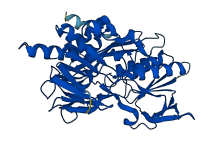
Descriptions
The autoinhibited protein was predicted that may have potential autoinhibitory elements via cis-regPred.
Autoinhibitory domains (AIDs)
Target domain |
|
Relief mechanism |
|
Assay |
cis-regPred |
Accessory elements
No accessory elements
Autoinhibited structure

Activated structure
1 structures for Q9SR59
| Entry ID | Method | Resolution | Chain | Position | Source |
|---|---|---|---|---|---|
| AF-Q9SR59-F1 | Predicted | AlphaFoldDB |
38 variants for Q9SR59
| Variant ID(s) | Position | Change | Description | Diseaes Association | Provenance |
|---|---|---|---|---|---|
| tmp_3_3058531_T_C | 28 | Q>R | No | 1000Genomes | |
| tmp_3_3058037_C_T | 71 | A>T | No | 1000Genomes | |
| ENSVATH13890499 | 91 | I>V | No | 1000Genomes | |
| ENSVATH00314277 | 93 | G>S | No | 1000Genomes | |
| tmp_3_3057872_C_T | 97 | V>I | No | 1000Genomes | |
| ENSVATH05800794 | 111 | G>D | No | 1000Genomes | |
| tmp_3_3057800_T_C | 121 | I>V | No | 1000Genomes | |
| ENSVATH05800793 | 123 | T>N | No | 1000Genomes | |
| tmp_3_3057679_T_C | 133 | I>V | No | 1000Genomes | |
| tmp_3_3057651_T_C | 142 | N>S | No | 1000Genomes | |
| ENSVATH02127185 | 157 | L>F | No | 1000Genomes | |
| tmp_3_3057544_G_C | 178 | L>V | No | 1000Genomes | |
| tmp_3_3057380_A_C | 204 | F>V | No | 1000Genomes | |
| tmp_3_3057371_C_T | 207 | A>T | No | 1000Genomes | |
| ENSVATH10574163 | 209 | I>T | No | 1000Genomes | |
| tmp_3_3057347_T_C | 215 | S>G | No | 1000Genomes | |
| tmp_3_3057320_T_A | 224 | I>F | No | 1000Genomes | |
| ENSVATH10574162 | 232 | G>R | No | 1000Genomes | |
| ENSVATH02127184 | 247 | E>K | No | 1000Genomes | |
| tmp_3_3057221_C_T | 257 | V>I | No | 1000Genomes | |
| ENSVATH10574160 | 275 | E>Q | No | 1000Genomes | |
| ENSVATH05800789 | 279 | G>D | No | 1000Genomes | |
| tmp_3_3057055_C_T | 284 | D>N | No | 1000Genomes | |
| ENSVATH00314271 | 292 | P>A | No | 1000Genomes | |
| ENSVATH13890498 | 294 | V>A | No | 1000Genomes | |
| tmp_3_3056984_C_T | 307 | M>I | No | 1000Genomes | |
| ENSVATH00314270 | 307 | M>T | No | 1000Genomes | |
| ENSVATH13890497 | 311 | T>A | No | 1000Genomes | |
| tmp_3_3056953_C_G | 318 | D>H | No | 1000Genomes | |
| ENSVATH10574157 | 319 | N>S | No | 1000Genomes | |
| ENSVATH00314269 | 329 | K>R | No | 1000Genomes | |
| ENSVATH00314266 | 334 | G>A | No | 1000Genomes | |
| tmp_3_3056823_T_C | 335 | E>G | No | 1000Genomes | |
| tmp_3_3056801_A_T | 342 | D>E | No | 1000Genomes | |
| ENSVATH10574124 | 376 | P>T | No | 1000Genomes | |
| tmp_3_3056590_C_T | 413 | A>T | No | 1000Genomes | |
| ENSVATH05800780 | 433 | A>V | No | 1000Genomes | |
| ENSVATH02127182 | 438 | S>T | No | 1000Genomes |
1 associated diseases with Q9SR59
[MIM: 208920]: Ataxia-oculomotor apraxia syndrome (AOA)
An autosomal recessive syndrome characterized by early-onset cerebellar ataxia, oculomotor apraxia, early areflexia and late peripheral neuropathy. {ECO:0000269|PubMed:11586299, ECO:0000269|PubMed:11586300, ECO:0000269|PubMed:12196655, ECO:0000269|PubMed:12629250, ECO:0000269|PubMed:14506070, ECO:0000269|PubMed:15699391, ECO:0000269|PubMed:15852392, ECO:0000269|PubMed:24362567}. Note=The disease is caused by variants affecting the gene represented in this entry.
Without disease ID
- An autosomal recessive syndrome characterized by early-onset cerebellar ataxia, oculomotor apraxia, early areflexia and late peripheral neuropathy. {ECO:0000269|PubMed:11586299, ECO:0000269|PubMed:11586300, ECO:0000269|PubMed:12196655, ECO:0000269|PubMed:12629250, ECO:0000269|PubMed:14506070, ECO:0000269|PubMed:15699391, ECO:0000269|PubMed:15852392, ECO:0000269|PubMed:24362567}. Note=The disease is caused by variants affecting the gene represented in this entry.
4 regional properties for Q9SR59
| Type | Name | Position | InterPro Accession |
|---|---|---|---|
| conserved_site | Ribosome maturation protein SBDS, conserved site | 36 - 55 | IPR018023 |
| domain | Ribosome maturation protein SDO1/SBDS, central domain | 101 - 164 | IPR018978 |
| domain | Ribosome maturation protein SDO1/SBDS, N-terminal | 10 - 93 | IPR019783 |
| domain | Ribosome maturation protein SDO1/SBDS, C-terminal domain | 165 - 230 | IPR046928 |
Functions
| Description | ||
|---|---|---|
| EC Number | 1.6.5.4 | With a quinone or similar compound as acceptor |
| Subcellular Localization |
|
|
| PANTHER Family | ||
| PANTHER Subfamily | ||
| PANTHER Protein Class | ||
| PANTHER Pathway Category | No pathway information available | |
2 GO annotations of cellular component
3 GO annotations of molecular function
| Name | Definition |
|---|---|
| flavin adenine dinucleotide binding | Binding to FAD, flavin-adenine dinucleotide, the coenzyme or the prosthetic group of various flavoprotein oxidoreductase enzymes, in either the oxidized form, FAD, or the reduced form, FADH2. |
| monodehydroascorbate reductase (NADH) activity | Catalysis of the reaction: NADH + H+ + 2 monodehydroascorbate = NAD+ + 2 ascorbate. |
| oxidoreductase activity, acting on NAD(P)H | Catalysis of an oxidation-reduction (redox) reaction in which NADH or NADPH acts as a hydrogen or electron donor and reduces a hydrogen or electron acceptor. |
4 GO annotations of biological process
| Name | Definition |
|---|---|
| regulation of biological process involved in symbiotic interaction | Any process that modulates the frequency, rate or extent of symbiosis, an interaction between two organisms living together in more or less intimate association. |
| response to jasmonic acid | Any process that results in a change in state or activity of a cell or an organism (in terms of movement, secretion, enzyme production, gene expression, etc.) as a result of a jasmonic acid stimulus. |
| response to symbiotic fungus | Any process that results in a change in state or activity of a cell or an organism (in terms of movement, secretion, enzyme production, gene expression, etc.) as a result of a stimulus from a symbiotic fungus, a fungus living in close physical association with another organism. |
| response to water deprivation | Any process that results in a change in state or activity of a cell or an organism (in terms of movement, secretion, enzyme production, gene expression, etc.) as a result of a water deprivation stimulus, prolonged deprivation of water. |
3 homologous proteins in AiPD
| 10 | 20 | 30 | 40 | 50 | 60 |
| MAEEKSYKYV | IIGGGVAGGY | AAREFSNQGL | KPGELAIISK | EPVPPFERPE | LTKVYIDLEV |
| 70 | 80 | 90 | 100 | 110 | 120 |
| NPTLANIYVC | AGTGEAKQYP | NWYKEKGIDL | IVGTEIVKAD | LASKTLVSDD | GKIYKYQTLL |
| 130 | 140 | 150 | 160 | 170 | 180 |
| IATGSTNIRL | SEIGVQEADV | KNIFYLREIE | DSDELALAME | LYVQRGKAVI | IGGGFLGLEI |
| 190 | 200 | 210 | 220 | 230 | 240 |
| SSALRANNHE | VTMVFPEPWL | VHRFFTAEIA | SFYESYYANK | GIKIIKGTVA | TGFSTNSDGE |
| 250 | 260 | 270 | 280 | 290 | 300 |
| VTEVKLEDGR | TLEANIVVAG | VGARPATSLF | KGQLEEEKGG | IKTDGFFKTS | VPDVYALGDV |
| 310 | 320 | 330 | 340 | 350 | 360 |
| ATFPMKMYGG | TRRVEHADNA | RKSAAQAVKA | IKAGEEGKTI | PDYDYLPYFY | SRFFKLSWEF |
| 370 | 380 | 390 | 400 | 410 | 420 |
| YGENVGESVL | FGDNDPKSPK | PKFGTYWVKD | GKVVGVFLEG | GTQEEHKAIA | KVARAQPSVE |
| 430 | 440 | ||||
| SLDVLSEEGL | SFATKFYSTS | L |