Q9SMV6
Gene name |
XPO1 |
Protein name |
Protein EXPORTIN 1A |
Names |
AtCRM1, AtXPO1, Protein HEAT-INTOLERANT 2 |
Species |
Arabidopsis thaliana (Mouse-ear cress) |
KEGG Pathway |
ath:AT5G17020 |
EC number |
|
Protein Class |
|
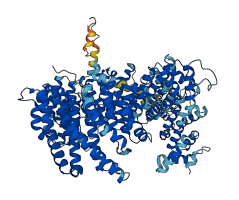
Descriptions
The autoinhibited protein was predicted that may have potential autoinhibitory elements via cis-regPred.
Autoinhibitory domains (AIDs)
Target domain |
|
Relief mechanism |
|
Assay |
cis-regPred |
Accessory elements
No accessory elements
Autoinhibited structure

Activated structure
1 structures for Q9SMV6
| Entry ID | Method | Resolution | Chain | Position | Source |
|---|---|---|---|---|---|
| AF-Q9SMV6-F1 | Predicted | AlphaFoldDB |
23 variants for Q9SMV6
| Variant ID(s) | Position | Change | Description | Diseaes Association | Provenance |
|---|---|---|---|---|---|
| ENSVATH03065935 | 32 | E>D | No | 1000Genomes | |
| ENSVATH10796348 | 109 | A>S | No | 1000Genomes | |
| tmp_5_5595940_T_A | 111 | F>Y | No | 1000Genomes | |
| ENSVATH06979492 | 286 | R>Q | No | 1000Genomes | |
| tmp_5_5597175_A_C | 294 | K>T | No | 1000Genomes | |
| ENSVATH14057395 | 303 | S>N | No | 1000Genomes | |
| ENSVATH10796378 | 317 | F>C | No | 1000Genomes | |
| ENSVATH10796415 | 330 | S>T | No | 1000Genomes | |
| tmp_5_5597781_C_T | 374 | A>V | No | 1000Genomes | |
| ENSVATH00626419 | 397 | M>I | No | 1000Genomes | |
| tmp_5_5598028_C_G | 410 | Q>E | No | 1000Genomes | |
| ENSVATH06979505 | 412 | Y>F | No | 1000Genomes | |
| tmp_5_5598042_C_G | 414 | H>Q | No | 1000Genomes | |
| ENSVATH06979526 | 708 | Y>F | No | 1000Genomes | |
| ENSVATH10796538 | 723 | V>A | No | 1000Genomes | |
| tmp_5_5601098_A_G | 824 | H>R | No | 1000Genomes | |
| tmp_5_5601307_A_T | 858 | I>F | No | 1000Genomes | |
| ENSVATH10796569 | 918 | R>Q | No | 1000Genomes | |
| ENSVATH00626435 | 961 | T>I | No | 1000Genomes | |
| ENSVATH14057528 | 975 | P>L | No | 1000Genomes | |
| tmp_5_5602188_C_T | 1015 | P>L | No | 1000Genomes | |
| ENSVATH14057529 | 1048 | Q>H | No | 1000Genomes | |
| tmp_5_5602390_A_G | 1051 | R>G | No | 1000Genomes |
No associated diseases with Q9SMV6
6 regional properties for Q9SMV6
| Type | Name | Position | InterPro Accession |
|---|---|---|---|
| domain | Importin-beta, N-terminal domain | 37 - 103 | IPR001494 |
| domain | Exportin-1/Importin-beta-like | 115 - 258 | IPR013598 |
| domain | Exportin-1, C-terminal | 712 - 1034 | IPR014877 |
| repeat | Exportin-1, repeat 3 | 489 - 538 | IPR040485 |
| repeat | Chromosome region maintenance repeat | 337 - 372 | IPR041123 |
| repeat | Exportin-1, repeat 2 | 408 - 475 | IPR041235 |
4 GO annotations of cellular component
| Name | Definition |
|---|---|
| cytoplasm | The contents of a cell excluding the plasma membrane and nucleus, but including other subcellular structures. |
| nuclear membrane | Either of the lipid bilayers that surround the nucleus and form the nuclear envelope; excludes the intermembrane space. |
| nuclear pore | A protein complex providing a discrete opening in the nuclear envelope of a eukaryotic cell, where the inner and outer nuclear membranes are joined. |
| nucleus | A membrane-bounded organelle of eukaryotic cells in which chromosomes are housed and replicated. In most cells, the nucleus contains all of the cell's chromosomes except the organellar chromosomes, and is the site of RNA synthesis and processing. In some species, or in specialized cell types, RNA metabolism or DNA replication may be absent. |
2 GO annotations of molecular function
| Name | Definition |
|---|---|
| nuclear export signal receptor activity | Combining with a nuclear export signal (NES) on a cargo to be transported, to mediate transport of a the cargo through the nuclear pore, from the nuclear lumen to the cytoplasm. The cargo can be either a RNA or a protein. |
| small GTPase binding | Binding to a small monomeric GTPase. |
9 GO annotations of biological process
| Name | Definition |
|---|---|
| embryo sac development | The process whose specific outcome is the progression of the embryo sac over time, from its formation to the mature structure. The process begins with the meiosis of the megasporocyte to form four haploid megaspores. Three of the megaspores disintegrate, and the fourth undergoes mitosis giving rise to a binucleate syncytial embryo sac. The two haploid nuclei migrate to the opposite poles of the embryo sac and then undergo two rounds of mitosis generating four haploid nuclei at each pole. One nucleus from each set of four migrates to the center of the cell. Cellularization occurs, resulting in an eight-nucleate seven-celled structure. This structure contains two synergid cells and an egg cell at the micropylar end, and three antipodal cells at the other end. A binucleate endosperm mother cell is formed at the center. The two polar nuclei fuse resulting in a mononucleate diploid endosperm mother cell. The three antipodal cells degenerate. |
| mRNA transport | The directed movement of mRNA, messenger ribonucleic acid, into, out of or within a cell, or between cells, by means of some agent such as a transporter or pore. |
| pollen development | The process whose specific outcome is the progression of the pollen grain over time, from its formation to the mature structure. The process begins with the meiosis of the microsporocyte to form four haploid microspores. The nucleus of each microspore then divides by mitosis to form a two-celled organism, the pollen grain, that contains a tube cell as well as a smaller generative cell. The pollen grain is surrounded by an elaborate cell wall. In some species, the generative cell immediately divides again to give a pair of sperm cells. In most flowering plants, however this division takes place later, in the tube that develops when a pollen grain germinates. |
| pollen germination | The physiological and developmental changes that occur in a heterosporous plant pollen grain, beginning with hydration and terminating with the emergence of the pollen tube through the aperture. |
| pollen tube growth | Growth of pollen via tip extension of the intine wall. |
| protein export from nucleus | The directed movement of a protein from the nucleus into the cytoplasm. |
| response to heat | Any process that results in a change in state or activity of a cell or an organism (in terms of movement, secretion, enzyme production, gene expression, etc.) as a result of a heat stimulus, a temperature stimulus above the optimal temperature for that organism. |
| ribosomal large subunit export from nucleus | The directed movement of a ribosomal large subunit from the nucleus into the cytoplasm. |
| ribosomal small subunit export from nucleus | The directed movement of a ribosomal small subunit from the nucleus into the cytoplasm. |
| 10 | 20 | 30 | 40 | 50 | 60 |
| MAAEKLRDLS | QPIDVGVLDA | TVAAFFVTGS | KEERAAADQI | LRDLQANPDM | WLQVVHILQN |
| 70 | 80 | 90 | 100 | 110 | 120 |
| TNSLDTKFFA | LQVLEGVIKY | RWNALPVEQR | DGMKNYISEV | IVQLSSNEAS | FRSERLYVNK |
| 130 | 140 | 150 | 160 | 170 | 180 |
| LNVILVQIVK | HDWPAKWTSF | IPDLVAAAKT | SETICENCMA | ILKLLSEEVF | DFSRGEMTQQ |
| 190 | 200 | 210 | 220 | 230 | 240 |
| KIKELKQSLN | SEFKLIHELC | LYVLSASQRQ | DLIRATLSAL | HAYLSWIPLG | YIFESTLLET |
| 250 | 260 | 270 | 280 | 290 | 300 |
| LLKFFPVPAY | RNLTIQCLTE | VAALNFGDFY | NVQYVKMYTI | FIGQLRIILP | PSTKIPEAYS |
| 310 | 320 | 330 | 340 | 350 | 360 |
| SGSGEEQAFI | QNLALFFTSF | FKFHIRVLES | TPEVVSLLLA | GLEYLINISY | VDDTEVFKVC |
| 370 | 380 | 390 | 400 | 410 | 420 |
| LDYWNSLVLE | LFDAHHNSDN | PAVSASLMGL | QPFLPGMVDG | LGSQVMQRRQ | LYSHPMSKLR |
| 430 | 440 | 450 | 460 | 470 | 480 |
| GLMINRMAKP | EEVLIVEDEN | GNIVRETMKD | NDVLVQYKIM | RETLIYLSHL | DHDDTEKQML |
| 490 | 500 | 510 | 520 | 530 | 540 |
| RKLNKQLSGE | EWAWNNLNTL | CWAIGSISGS | MAEDQENRFL | VMVIRDLLNL | CEITKGKDNK |
| 550 | 560 | 570 | 580 | 590 | 600 |
| AVIASNIMYV | VGQYPRFLRA | HWKFLKTVVN | KLFEFMHETH | PGVQDMACDT | FLKIVQKCKR |
| 610 | 620 | 630 | 640 | 650 | 660 |
| KFVIVQVGEN | EPFVSELLTG | LATTVQDLEP | HQIHSFYESV | GNMIQAESDP | QKRDEYLQRL |
| 670 | 680 | 690 | 700 | 710 | 720 |
| MALPNQKWAE | IIGQARHSVE | FLKDQVVIRT | VLNILQTNTS | AATSLGTYFL | SQISLIFLDM |
| 730 | 740 | 750 | 760 | 770 | 780 |
| LNVYRMYSEL | VSTNITEGGP | YASKTSFVKL | LRSVKRETLK | LIETFLDKAE | DQPHIGKQFV |
| 790 | 800 | 810 | 820 | 830 | 840 |
| PPMMESVLGD | YARNVPDARE | SEVLSLFATI | INKYKATMLD | DVPHIFEAVF | QCTLEMITKN |
| 850 | 860 | 870 | 880 | 890 | 900 |
| FEDYPEHRLK | FFSLLRAIAT | FCFPALIKLS | SPQLKLVMDS | IIWAFRHTER | NIAETGLNLL |
| 910 | 920 | 930 | 940 | 950 | 960 |
| LEMLKNFQQS | EFCNQFYRSY | FMQIEQEIFA | VLTDTFHKPG | FKLHVLVLQQ | LFCLPESGAL |
| 970 | 980 | 990 | 1000 | 1010 | 1020 |
| TEPLWDATTV | PYPYPDNVAF | VREYTIKLLS | SSFPNMTAAE | VTQFVNGLYE | SRNDPSGFKN |
| 1030 | 1040 | 1050 | 1060 | 1070 | |
| NIRDFLVQSK | EFSAQDNKDL | YAEEAAAQRE | RERQRMLSIP | GLIAPNEIQD | EMVDS |