Q9S7L5
Gene name |
ERF018 (At1g74930, F25A4.10, F9E10.22) |
Protein name |
Ethylene-responsive transcription factor ERF018 |
Names |
|
Species |
Arabidopsis thaliana (Mouse-ear cress) |
KEGG Pathway |
ath:AT1G74930 |
EC number |
|
Protein Class |
|
Descriptions
The autoinhibited protein was predicted that may have potential autoinhibitory elements via cis-regPred.
Autoinhibitory domains (AIDs)
Target domain |
|
Relief mechanism |
|
Assay |
cis-regPred |
Accessory elements
No accessory elements
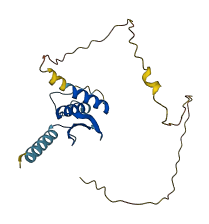
Autoinhibited structure

Activated structure
1 structures for Q9S7L5
| Entry ID | Method | Resolution | Chain | Position | Source |
|---|---|---|---|---|---|
| AF-Q9S7L5-F1 | Predicted | AlphaFoldDB |
10 variants for Q9S7L5
| Variant ID(s) | Position | Change | Description | Diseaes Association | Provenance |
|---|---|---|---|---|---|
| tmp_1_28144248_C_T | 4 | Q>* | No | 1000Genomes | |
| tmp_1_28144303_A_T | 22 | K>I | No | 1000Genomes | |
| ENSVATH01537348 | 66 | C>F | No | 1000Genomes | |
| ENSVATH01537350 | 84 | S>T | No | 1000Genomes | |
| tmp_1_28144522_A_G | 95 | Q>R | No | 1000Genomes | |
| ENSVATH13809921 | 119 | P>H | No | 1000Genomes | |
| ENSVATH13809922 | 123 | I>V | No | 1000Genomes | |
| tmp_1_28144677_G_A | 147 | D>N | No | 1000Genomes | |
| ENSVATH05146600 | 157 | S>F | No | 1000Genomes | |
| tmp_1_28144726_C_T | 163 | S>F | No | 1000Genomes |
No associated diseases with Q9S7L5
5 regional properties for Q9S7L5
| Type | Name | Position | InterPro Accession |
|---|---|---|---|
| domain | SH3 domain | 450 - 509 | IPR001452 |
| domain | Tensin/EPS8 phosphotyrosine-binding domain | 28 - 155 | IPR013625 |
| domain | Epidermal growth factor receptor kinase substrate, phosphotyrosine-binding domain | 25 - 154 | IPR033928 |
| domain | Eps8, SH3 domain | 455 - 507 | IPR035462 |
| domain | SAM domain | 524 - 583 | IPR041418 |
1 GO annotations of cellular component
| Name | Definition |
|---|---|
| nucleus | A membrane-bounded organelle of eukaryotic cells in which chromosomes are housed and replicated. In most cells, the nucleus contains all of the cell's chromosomes except the organellar chromosomes, and is the site of RNA synthesis and processing. In some species, or in specialized cell types, RNA metabolism or DNA replication may be absent. |
2 GO annotations of molecular function
| Name | Definition |
|---|---|
| DNA-binding transcription factor activity | A transcription regulator activity that modulates transcription of gene sets via selective and non-covalent binding to a specific double-stranded genomic DNA sequence (sometimes referred to as a motif) within a cis-regulatory region. Regulatory regions include promoters (proximal and distal) and enhancers. Genes are transcriptional units, and include bacterial operons. |
| transcription cis-regulatory region binding | Binding to a specific sequence of DNA that is part of a regulatory region that controls transcription of that section of the DNA. The transcribed region might be described as a gene, cistron, or operon. |
5 GO annotations of biological process
| Name | Definition |
|---|---|
| cell division | The process resulting in division and partitioning of components of a cell to form more cells; may or may not be accompanied by the physical separation of a cell into distinct, individually membrane-bounded daughter cells. |
| defense response to insect | A response to protect an organism from a directly detected or perceived external threat from an insect or insects to that organism. |
| ethylene-activated signaling pathway | The series of molecular signals generated by the reception of ethylene (ethene, C2H4) by a receptor and ending with modulation of a cellular process, e.g. transcription. |
| phloem or xylem histogenesis | The process whose specific outcome is the progression of phloem and/or xylem over time, from formation to the mature structure. An example of this process is found in Arabidopsis thaliana. |
| response to wounding | Any process that results in a change in state or activity of a cell or an organism (in terms of movement, secretion, enzyme production, gene expression, etc.) as a result of a stimulus indicating damage to the organism. |
| 10 | 20 | 30 | 40 | 50 | 60 |
| MVKQAMKEEE | KKRNTAMQSK | YKGVRKRKWG | KWVSEIRLPH | SRERIWLGSY | DTPEKAARAF |
| 70 | 80 | 90 | 100 | 110 | 120 |
| DAAQFCLRGG | DANFNFPNNP | PSISVEKSLT | PPEIQEAAAR | FANTFQDIVK | GEEESGLVPG |
| 130 | 140 | 150 | 160 | 170 | 180 |
| SEIRPESPST | SASVATSTVD | YDFSFLDLLP | MNFGFDSFSD | DFSGFSGGDR | FTEILPIEDY |
| 190 | |||||
| GGESLLDESL | ILWDF |