Q9R210
Gene name |
Tfeb |
Protein name |
Transcription factor EB |
Names |
|
Species |
Mus musculus (Mouse) |
KEGG Pathway |
mmu:21425 |
EC number |
|
Protein Class |
|
Descriptions
The autoinhibited protein was predicted that may have potential autoinhibitory elements via cis-regPred.
Autoinhibitory domains (AIDs)
Target domain |
|
Relief mechanism |
|
Assay |
cis-regPred |
Accessory elements
No accessory elements
Autoinhibited structure

Activated structure
1 structures for Q9R210
| Entry ID | Method | Resolution | Chain | Position | Source |
|---|---|---|---|---|---|
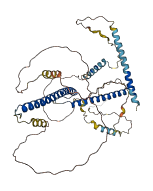
| AF-Q9R210-F1 | Predicted | AlphaFoldDB |
17 variants for Q9R210
| Variant ID(s) | Position | Change | Description | Diseaes Association | Provenance |
|---|---|---|---|---|---|
| rs3389463557 | 84 | Q>* | No | EVA | |
| rs3389481044 | 104 | A>D | No | EVA | |
| rs3389437281 | 188 | S>N | No | EVA | |
| rs3389485759 | 198 | Q>H | No | EVA | |
| rs3389417796 | 224 | A>V | No | EVA | |
| rs3406820383 | 285 | R>L | No | EVA | |
| rs3407727885 | 288 | Q>* | No | EVA | |
| rs3389481072 | 290 | D>E | No | EVA | |
| rs3389448294 | 313 | L>F | No | EVA | |
| rs3389471970 | 317 | E>D | No | EVA | |
| rs3389470110 | 354 | G>D | No | EVA | |
| rs3389417770 | 367 | E>D | No | EVA | |
| rs3389485783 | 375 | P>T | No | EVA | |
| rs3389448332 | 389 | P>L | No | EVA | |
| rs3389468141 | 395 | F>I | No | EVA | |
| rs3389481085 | 410 | T>A | No | EVA | |
| rs3389427054 | 441 | L>P | No | EVA |
No associated diseases with Q9R210
4 regional properties for Q9R210
| Type | Name | Position | InterPro Accession |
|---|---|---|---|
| domain | Myc-type, basic helix-loop-helix (bHLH) domain | 234 - 293 | IPR011598 |
| domain | MiT/TFE transcription factors, C-terminal | 320 - 472 | IPR021802 |
| domain | Transcription factor EB, bHLHzip domain | 225 - 315 | IPR024098 |
| domain | MiT/TFE transcription factors, N-terminal | 4 - 161 | IPR031867 |
Functions
5 GO annotations of cellular component
| Name | Definition |
|---|---|
| cytoplasm | The contents of a cell excluding the plasma membrane and nucleus, but including other subcellular structures. |
| cytosol | The part of the cytoplasm that does not contain organelles but which does contain other particulate matter, such as protein complexes. |
| lysosomal membrane | The lipid bilayer surrounding the lysosome and separating its contents from the cell cytoplasm. |
| nucleus | A membrane-bounded organelle of eukaryotic cells in which chromosomes are housed and replicated. In most cells, the nucleus contains all of the cell's chromosomes except the organellar chromosomes, and is the site of RNA synthesis and processing. In some species, or in specialized cell types, RNA metabolism or DNA replication may be absent. |
| transcription regulator complex | A protein complex that is capable of associating with DNA by direct binding, or via other DNA-binding proteins or complexes, and regulating transcription. |
9 GO annotations of molecular function
| Name | Definition |
|---|---|
| DNA binding | Any molecular function by which a gene product interacts selectively and non-covalently with DNA (deoxyribonucleic acid). |
| DNA-binding transcription activator activity, RNA polymerase II-specific | A DNA-binding transcription factor activity that activates or increases transcription of specific gene sets transcribed by RNA polymerase II. |
| DNA-binding transcription factor activity | A transcription regulator activity that modulates transcription of gene sets via selective and non-covalent binding to a specific double-stranded genomic DNA sequence (sometimes referred to as a motif) within a cis-regulatory region. Regulatory regions include promoters (proximal and distal) and enhancers. Genes are transcriptional units, and include bacterial operons. |
| DNA-binding transcription factor activity, RNA polymerase II-specific | A DNA-binding transcription factor activity that modulates the transcription of specific gene sets transcribed by RNA polymerase II. |
| enzyme binding | Binding to an enzyme, a protein with catalytic activity. |
| protein heterodimerization activity | Binding to a nonidentical protein to form a heterodimer. |
| RNA polymerase II cis-regulatory region sequence-specific DNA binding | Binding to a specific upstream regulatory DNA sequence (transcription factor recognition sequence or binding site) located in cis relative to the transcription start site (i.e., on the same strand of DNA) of a gene transcribed by RNA polymerase II. |
| sequence-specific double-stranded DNA binding | Binding to double-stranded DNA of a specific nucleotide composition, e.g. GC-rich DNA binding, or with a specific sequence motif or type of DNA, e.g. promotor binding or rDNA binding. |
| transcription cis-regulatory region binding | Binding to a specific sequence of DNA that is part of a regulatory region that controls transcription of that section of the DNA. The transcribed region might be described as a gene, cistron, or operon. |
15 GO annotations of biological process
| Name | Definition |
|---|---|
| adaptive immune response | An immune response mediated by cells expressing specific receptors for antigen produced through a somatic diversification process, and allowing for an enhanced secondary response to subsequent exposures to the same antigen (immunological memory). |
| antibacterial innate immune response | An defense response against a bacteria mediated through an innate immune response. An innate immune response is mediated by germline encoded components that directly recognize components of potential pathogens. |
| autophagy | The cellular catabolic process in which cells digest parts of their own cytoplasm; allows for both recycling of macromolecular constituents under conditions of cellular stress and remodeling the intracellular structure for cell differentiation. |
| cellular response to amino acid starvation | Any process that results in a change in state or activity of a cell (in terms of movement, secretion, enzyme production, gene expression, etc.) as a result of deprivation of amino acids. |
| cellular response to starvation | Any process that results in a change in state or activity of a cell (in terms of movement, secretion, enzyme production, gene expression, etc.) as a result of deprivation of nourishment. |
| defense response to Gram-negative bacterium | Reactions triggered in response to the presence of a Gram-negative bacterium that act to protect the cell or organism. |
| embryonic placenta development | The embryonically driven process whose specific outcome is the progression of the placenta over time, from its formation to the mature structure. The placenta is an organ of metabolic interchange between fetus and mother, partly of embryonic origin and partly of maternal origin. |
| humoral immune response | An immune response mediated through a body fluid. |
| lysosome localization | Any process in which a lysosome is transported to, and/or maintained in, a specific location. |
| lysosome organization | A process that is carried out at the cellular level which results in the assembly, arrangement of constituent parts, or disassembly of a lysosome. A lysosome is a cytoplasmic, membrane-bounded organelle that is found in most animal cells and that contains a variety of hydrolases. |
| positive regulation of autophagy | Any process that activates, maintains or increases the rate of autophagy. Autophagy is the process in which cells digest parts of their own cytoplasm. |
| positive regulation of DNA-templated transcription | Any process that activates or increases the frequency, rate or extent of cellular DNA-templated transcription. |
| positive regulation of transcription by RNA polymerase II | Any process that activates or increases the frequency, rate or extent of transcription from an RNA polymerase II promoter. |
| regulation of gene expression | Any process that modulates the frequency, rate or extent of gene expression. Gene expression is the process in which a gene's coding sequence is converted into a mature gene product (protein or RNA). |
| regulation of transcription by RNA polymerase II | Any process that modulates the frequency, rate or extent of transcription mediated by RNA polymerase II. |
4 homologous proteins in AiPD
| UniProt AC | Gene Name | Protein Name | Species | Evidence Code |
|---|---|---|---|---|
| Q15853 | USF2 | Upstream stimulatory factor 2 | Homo sapiens (Human) | PR |
| P19484 | TFEB | Transcription factor EB | Homo sapiens (Human) | PR |
| Q08874 | Mitf | Microphthalmia-associated transcription factor | Mus musculus (Mouse) | PR |
| Q8S3F1 | NAI1 | Transcription factor NAI1 | Arabidopsis thaliana (Mouse-ear cress) | PR |
| 10 | 20 | 30 | 40 | 50 | 60 |
| MASRIGLRMQ | LMREQAQQEE | QRERMQQQAV | MHYMQQQQQQ | QQQLGGPPTP | AINTPVHFQS |
| 70 | 80 | 90 | 100 | 110 | 120 |
| PPPVPGEVLK | VQSYLENPTS | YHLQQSQHQK | VREYLSETYG | NKFAAHVSPA | QGSPKPAPAA |
| 130 | 140 | 150 | 160 | 170 | 180 |
| SPGVRAGHVL | STSAGNSAPN | SPMAMLHISS | NPEKEFDDVI | DNIMRLDSVL | GYINPEMQMP |
| 190 | 200 | 210 | 220 | 230 | 240 |
| NTLPLSSSHL | NVYSGDPQVT | ASMVGVTSSS | CPADLTQKRE | LTDAESRALA | KERQKKDNHN |
| 250 | 260 | 270 | 280 | 290 | 300 |
| LIERRRRFNI | NDRIKELGML | IPKANDLDVR | WNKGTILKAS | VDYIRRMQKD | LQKSRELENH |
| 310 | 320 | 330 | 340 | 350 | 360 |
| SRRLEMTNKQ | LWLRIQELEM | QARVHGLPTT | SPSGVNMAEL | AQQVVKQELP | SEDGPGEALM |
| 370 | 380 | 390 | 400 | 410 | 420 |
| LGPEVPEPEQ | MPALPPQAPL | PSAAQPQSPF | HHLDFSHGLS | FGGGGDEGPT | GYPDTLGTEH |
| 430 | 440 | 450 | 460 | 470 | |
| GSPFPNLSKK | DLDLMLLDDS | LLPLASDPLF | STMSPEASKA | SSRRSSFSME | EGDVL |