Q08874
Gene name |
Mitf (Bw, Mi, Vit) |
Protein name |
Microphthalmia-associated transcription factor |
Names |
|
Species |
Mus musculus (Mouse) |
KEGG Pathway |
mmu:17342 |
EC number |
|
Protein Class |
|
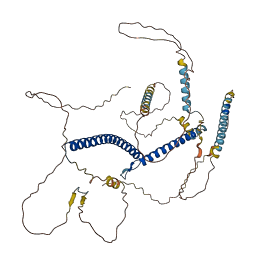
Descriptions
The autoinhibited protein was predicted that may have potential autoinhibitory elements via cis-regPred.
Autoinhibitory domains (AIDs)
Target domain |
|
Relief mechanism |
|
Assay |
cis-regPred |
Accessory elements
No accessory elements
Autoinhibited structure

Activated structure
19 variants for Q08874
| Variant ID(s) | Position | Change | Description | Diseaes Association | Provenance |
|---|---|---|---|---|---|
| 36 | S>del | microphthalmia-red-eyed white/mi-rw [UniProt] | No | ||
| rs3396946843 | 57 | I>M | No | EVA | |
| rs3388837156 | 101 | S>G | No | EVA | |
| 119 | V>del | microphthalmia-white spot/mi-ws [UniProt] | No | ||
| 139 | V>del | microphthalmia-black and white spot/mi-bws [UniProt] | No | ||
| rs3397156240 | 232 | S>H | No | EVA | |
| rs3397116017 | 234 | E>* | No | EVA | |
| 294 | A>V | microphthalmia-eyeless-white/mi-ew [UniProt] | No | ||
| 294 | A>del | microphthalmia-spotted/mi-sp [UniProt] | No | ||
| 319 | I>N | microphthalmia-white/mi-wh [UniProt] | No | ||
| 323 | R>del | microphthalmia/mi [UniProt] | No | ||
| rs3388845948 | 327 | I>K | No | EVA | |
| 329 | D>N | microphthalmia-vitiligo/mi-vi [UniProt] | No | ||
| rs3388843574 | 337 | L>V | No | EVA | |
| rs3388848078 | 339 | P>H | No | EVA | |
| rs3397117093 | 347 | R>L | No | EVA | |
| 370 | R>del | microphthalmia-cloudy-eyed/mi-ce and microphthalmia-defective iris/mi-di [UniProt] | No | ||
| rs45997580 | 459 | N>S | No | EVA | |
| rs3388844214 | 500 | L>M | No | EVA |
1 associated diseases with Q08874
Without disease ID
Functions
3 GO annotations of cellular component
| Name | Definition |
|---|---|
| cytoplasm | The contents of a cell excluding the plasma membrane and nucleus, but including other subcellular structures. |
| nucleus | A membrane-bounded organelle of eukaryotic cells in which chromosomes are housed and replicated. In most cells, the nucleus contains all of the cell's chromosomes except the organellar chromosomes, and is the site of RNA synthesis and processing. In some species, or in specialized cell types, RNA metabolism or DNA replication may be absent. |
| protein-containing complex | A stable assembly of two or more macromolecules, i.e. proteins, nucleic acids, carbohydrates or lipids, in which at least one component is a protein and the constituent parts function together. |
9 GO annotations of molecular function
| Name | Definition |
|---|---|
| chromatin binding | Binding to chromatin, the network of fibers of DNA, protein, and sometimes RNA, that make up the chromosomes of the eukaryotic nucleus during interphase. |
| DNA binding | Any molecular function by which a gene product interacts selectively and non-covalently with DNA (deoxyribonucleic acid). |
| DNA-binding transcription activator activity, RNA polymerase II-specific | A DNA-binding transcription factor activity that activates or increases transcription of specific gene sets transcribed by RNA polymerase II. |
| DNA-binding transcription factor activity | A transcription regulator activity that modulates transcription of gene sets via selective and non-covalent binding to a specific double-stranded genomic DNA sequence (sometimes referred to as a motif) within a cis-regulatory region. Regulatory regions include promoters (proximal and distal) and enhancers. Genes are transcriptional units, and include bacterial operons. |
| DNA-binding transcription factor activity, RNA polymerase II-specific | A DNA-binding transcription factor activity that modulates the transcription of specific gene sets transcribed by RNA polymerase II. |
| E-box binding | Binding to an E-box, a DNA motif with the consensus sequence CANNTG that is found in the promoters of a wide array of genes expressed in neurons, muscle and other tissues. |
| protein dimerization activity | The formation of a protein dimer, a macromolecular structure consists of two noncovalently associated identical or nonidentical subunits. |
| RNA polymerase II cis-regulatory region sequence-specific DNA binding | Binding to a specific upstream regulatory DNA sequence (transcription factor recognition sequence or binding site) located in cis relative to the transcription start site (i.e., on the same strand of DNA) of a gene transcribed by RNA polymerase II. |
| sequence-specific DNA binding | Binding to DNA of a specific nucleotide composition, e.g. GC-rich DNA binding, or with a specific sequence motif or type of DNA e.g. promotor binding or rDNA binding. |
24 GO annotations of biological process
| Name | Definition |
|---|---|
| bone remodeling | The continuous turnover of bone matrix and mineral that involves first, an increase in resorption (osteoclastic activity) and later, reactive bone formation (osteoblastic activity). The process of bone remodeling takes place in the adult skeleton at discrete foci. The process ensures the mechanical integrity of the skeleton throughout life and plays an important role in calcium homeostasis. An imbalance in the regulation of bone resorption and bone formation results in many of the metabolic bone diseases, such as osteoporosis. |
| camera-type eye development | The process whose specific outcome is the progression of the camera-type eye over time, from its formation to the mature structure. The camera-type eye is an organ of sight that receives light through an aperture and focuses it through a lens, projecting it on a photoreceptor field. |
| cell differentiation | The process in which relatively unspecialized cells, e.g. embryonic or regenerative cells, acquire specialized structural and/or functional features that characterize the cells, tissues, or organs of the mature organism or some other relatively stable phase of the organism's life history. Differentiation includes the processes involved in commitment of a cell to a specific fate and its subsequent development to the mature state. |
| cell fate commitment | The commitment of cells to specific cell fates and their capacity to differentiate into particular kinds of cells. Positional information is established through protein signals that emanate from a localized source within a cell (the initial one-cell zygote) or within a developmental field. |
| DNA-templated transcription | The synthesis of an RNA transcript from a DNA template. |
| melanocyte apoptotic process | Any apoptotic process in a melanocyte, the main structural component of the epidermis. |
| melanocyte differentiation | The process in which a relatively unspecialized cell acquires specialized features of a melanocyte. |
| negative regulation of apoptotic process | Any process that stops, prevents, or reduces the frequency, rate or extent of cell death by apoptotic process. |
| negative regulation of cell migration | Any process that stops, prevents, or reduces the frequency, rate or extent of cell migration. |
| negative regulation of transcription by RNA polymerase II | Any process that stops, prevents, or reduces the frequency, rate or extent of transcription mediated by RNA polymerase II. |
| osteoclast differentiation | The process in which a relatively unspecialized monocyte acquires the specialized features of an osteoclast. An osteoclast is a specialized phagocytic cell associated with the absorption and removal of the mineralized matrix of bone tissue. |
| pigmentation | The accumulation of pigment in an organism, tissue or cell, either by increased deposition or by increased number of cells. |
| positive regulation of DNA-templated transcription | Any process that activates or increases the frequency, rate or extent of cellular DNA-templated transcription. |
| positive regulation of DNA-templated transcription initiation | Any process that activates or increases the frequency, rate or extent of DNA-templated transcription initiation. |
| positive regulation of gene expression | Any process that increases the frequency, rate or extent of gene expression. Gene expression is the process in which a gene's coding sequence is converted into a mature gene product (protein or RNA). |
| positive regulation of transcription by RNA polymerase II | Any process that activates or increases the frequency, rate or extent of transcription from an RNA polymerase II promoter. |
| protein-containing complex assembly | The aggregation, arrangement and bonding together of a set of macromolecules to form a protein-containing complex. |
| regulation of cell population proliferation | Any process that modulates the frequency, rate or extent of cell proliferation. |
| regulation of DNA-templated transcription | Any process that modulates the frequency, rate or extent of cellular DNA-templated transcription. |
| regulation of gene expression | Any process that modulates the frequency, rate or extent of gene expression. Gene expression is the process in which a gene's coding sequence is converted into a mature gene product (protein or RNA). |
| regulation of osteoclast differentiation | Any process that modulates the frequency, rate or extent of osteoclast differentiation. |
| regulation of RNA biosynthetic process | Any process that modulates the frequency, rate or extent of RNA biosynthetic process. |
| regulation of transcription by RNA polymerase II | Any process that modulates the frequency, rate or extent of transcription mediated by RNA polymerase II. |
| Wnt signaling pathway | The series of molecular signals initiated by binding of a Wnt protein to a frizzled family receptor on the surface of the target cell and ending with a change in cell state. |
4 homologous proteins in AiPD
| UniProt AC | Gene Name | Protein Name | Species | Evidence Code |
|---|---|---|---|---|
| Q15853 | USF2 | Upstream stimulatory factor 2 | Homo sapiens (Human) | PR |
| P19484 | TFEB | Transcription factor EB | Homo sapiens (Human) | PR |
| Q9R210 | Tfeb | Transcription factor EB | Mus musculus (Mouse) | PR |
| Q8S3F1 | NAI1 | Transcription factor NAI1 | Arabidopsis thaliana (Mouse-ear cress) | PR |
| 10 | 20 | 30 | 40 | 50 | 60 |
| MQSESGIVAD | FEVGEEFHEE | PKTYYELKSQ | PLKSSSSAEH | SGASKPPLSS | STMTSRILLR |
| 70 | 80 | 90 | 100 | 110 | 120 |
| QQLMREQMQE | QERREQQQKL | QAAQFMQQRV | AVSQTPAINV | SVPTTLPSAT | QVPMEVLKVQ |
| 130 | 140 | 150 | 160 | 170 | 180 |
| THLENPTKYH | IQQAQRHQVK | QYLSTTLANK | HASQVLSSPC | PNQPGDHAMP | PVPGSSAPNS |
| 190 | 200 | 210 | 220 | 230 | 240 |
| PMAMLTLNSN | CEKEAFYKFE | EQSRAESECP | GMNTHSRASC | MQMDDVIDDI | ISLESSYNEE |
| 250 | 260 | 270 | 280 | 290 | 300 |
| ILGLMDPALQ | MANTLPVSGN | LIDLYSNQGL | PPPGLTISNS | CPANLPNIKR | ELTACIFPTE |
| 310 | 320 | 330 | 340 | 350 | 360 |
| SEARALAKER | QKKDNHNLIE | RRRRFNINDR | IKELGTLIPK | SNDPDMRWNK | GTILKASVDY |
| 370 | 380 | 390 | 400 | 410 | 420 |
| IRKLQREQQR | AKDLENRQKK | LEHANRHLLL | RVQELEMQAR | AHGLSLIPST | GLCSPDLVNR |
| 430 | 440 | 450 | 460 | 470 | 480 |
| IIKQEPVLEN | CSQELVQHQA | DLTCTTTLDL | TDGTITFTNN | LGTMPESSPA | YSIPRKMGSN |
| 490 | 500 | 510 | 520 | ||
| LEDILMDDAL | SPVGVTDPLL | SSVSPGASKT | SSRRSSMSAE | ETEHAC |