Q9QXW9
Gene name |
Slc7a8 (Lat2) |
Protein name |
Large neutral amino acids transporter small subunit 2 |
Names |
L-type amino acid transporter 2, mLAT2, Solute carrier family 7 member 8 |
Species |
Mus musculus (Mouse) |
KEGG Pathway |
mmu:50934 |
EC number |
|
Protein Class |
|
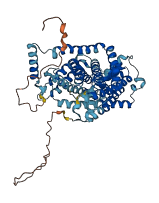
Descriptions
The autoinhibited protein was predicted that may have potential autoinhibitory elements via cis-regPred.
Autoinhibitory domains (AIDs)
Target domain |
|
Relief mechanism |
|
Assay |
cis-regPred |
Accessory elements
No accessory elements
Autoinhibited structure

Activated structure
1 structures for Q9QXW9
| Entry ID | Method | Resolution | Chain | Position | Source |
|---|---|---|---|---|---|
| AF-Q9QXW9-F1 | Predicted | AlphaFoldDB |
26 variants for Q9QXW9
| Variant ID(s) | Position | Change | Description | Diseaes Association | Provenance |
|---|---|---|---|---|---|
| rs3389329967 | 9 | N>Y | No | EVA | |
| rs221911230 | 12 | A>S | No | EVA | |
| rs3389301175 | 41 | L>S | No | EVA | |
| rs3389311513 | 65 | L>M | No | EVA | |
| rs3389329926 | 65 | L>RDG* | No | EVA | |
| rs3389292719 | 67 | N>D | No | EVA | |
| rs3389334456 | 68 | A>V | No | EVA | |
| rs3389338627 | 99 | I>T | No | EVA | |
| rs3389327004 | 104 | G>A | No | EVA | |
| rs265598019 | 158 | S>T | No | EVA | |
| rs3389320523 | 176 | C>S | No | EVA | |
| rs3389345271 | 181 | W>* | No | EVA | |
| rs47001985 | 184 | R>Q | No | EVA | |
| rs3389324411 | 202 | I>V | No | EVA | |
| rs3389251767 | 227 | E>D | No | EVA | |
| rs3389327455 | 277 | F>L | No | EVA | |
| rs3389327450 | 289 | A>V | No | EVA | |
| rs3389324678 | 295 | L>M | No | EVA | |
| rs3389334454 | 317 | M>V | No | EVA | |
| rs3389345273 | 377 | M>I | No | EVA | |
| rs3405428519 | 381 | S>G | No | EVA | |
| rs3389320502 | 414 | D>Y | No | EVA | |
| rs3389334459 | 462 | Y>S | No | EVA | |
| rs3389327469 | 474 | C>S | No | EVA | |
| rs3389327412 | 487 | Q>* | No | EVA | |
| rs3413058546 | 501 | G>W | No | EVA |
No associated diseases with Q9QXW9
1 regional properties for Q9QXW9
| Type | Name | Position | InterPro Accession |
|---|---|---|---|
| domain | Ribosomal protein L5 eukaryotic, C-terminal | 244 - 297 | IPR025607 |
Functions
7 GO annotations of cellular component
| Name | Definition |
|---|---|
| apical plasma membrane | The region of the plasma membrane located at the apical end of the cell. |
| basal plasma membrane | The region of the plasma membrane located at the basal end of the cell. Often used in reference to animal polarized epithelial membranes, where the basal membrane is the part attached to the extracellular matrix, or in plant cells, where the basal membrane is defined with respect to the zygotic axis. |
| basolateral plasma membrane | The region of the plasma membrane that includes the basal end and sides of the cell. Often used in reference to animal polarized epithelial membranes, where the basal membrane is the part attached to the extracellular matrix, or in plant cells, where the basal membrane is defined with respect to the zygotic axis. |
| cytoplasm | The contents of a cell excluding the plasma membrane and nucleus, but including other subcellular structures. |
| integral component of membrane | The component of a membrane consisting of the gene products and protein complexes having at least some part of their peptide sequence embedded in the hydrophobic region of the membrane. |
| microvillus membrane | The portion of the plasma membrane surrounding a microvillus. |
| plasma membrane | The membrane surrounding a cell that separates the cell from its external environment. It consists of a phospholipid bilayer and associated proteins. |
10 GO annotations of molecular function
| Name | Definition |
|---|---|
| amine transmembrane transporter activity | Enables the transfer of amines, including polyamines, from one side of a membrane to the other. Amines are organic compounds that are weakly basic in character and contain an amino (-NH2) or substituted amino group. |
| amino acid transmembrane transporter activity | Enables the transfer of amino acids from one side of a membrane to the other. Amino acids are organic molecules that contain an amino group and a carboxyl group. |
| glycine transmembrane transporter activity | Enables the transfer of glycine from one side of a membrane to the other. Glycine is aminoethanoic acid. |
| L-alanine transmembrane transporter activity | Enables the transfer of L-alanine from one side of a membrane to the other. L-alanine is the L-enantiomer of 2-aminopropanoic acid. |
| L-amino acid transmembrane transporter activity | Enables the transfer of an L-amino acid from one side of a membrane to the other. L-amino acids are the L-enantiomers of amino acids. |
| L-leucine transmembrane transporter activity | Enables the transfer of L-leucine from one side of a membrane to the other. L-leucine is 2-amino-4-methylpentanoic acid. |
| neutral amino acid transmembrane transporter activity | Enables the transfer of neutral amino acids from one side of a membrane to the other. Neutral amino acids have side chains with no charge at pH 7.3. |
| organic cation transmembrane transporter activity | Enables the transfer of organic cations from one side of a membrane to the other. Organic cations are atoms or small molecules with a positive charge that contain carbon in covalent linkage. |
| thyroid hormone transmembrane transporter activity | Enables the transfer of thyroid hormones from one side of a membrane to the other. Thyroid hormone are any of the compounds secreted by the thyroid gland, largely thyroxine and triiodothyronine. |
| toxin transmembrane transporter activity | Enables the transfer of a toxin from one side of a membrane to the other. A toxin is a poisonous compound (typically a protein) that is produced by cells or organisms and that can cause disease when introduced into the body or tissues of an organism. |
13 GO annotations of biological process
| Name | Definition |
|---|---|
| amino acid import across plasma membrane | The directed movement of an amino acid from outside of a cell, across the plasma membrane and into the cytosol. |
| amino acid transport | The directed movement of amino acids, organic acids containing one or more amino substituents, into, out of or within a cell, or between cells, by means of some agent such as a transporter or pore. |
| glycine transport | The directed movement of glycine, aminoethanoic acid, into, out of or within a cell, or between cells, by means of some agent such as a transporter or pore. |
| L-alanine import across plasma membrane | The directed import of L-alanine from the extracellular region across the plasma membrane and into the cytosol. |
| L-amino acid transport | The directed movement of L-enantiomer amino acids into, out of or within a cell, or between cells, by means of some agent such as a transporter or pore. |
| L-leucine import across plasma membrane | The directed movement of L-leucine from outside of a cell, across the plasma membrane and into the cytosol. |
| leucine import across plasma membrane | The directed movement of leucine from outside of a cell, across the plasma membrane and into the cytosol. |
| leucine transport | The directed movement of leucine, 2-amino-4-methylpentanoic acid, into, out of or within a cell, or between cells, by means of some agent such as a transporter or pore. |
| neutral amino acid transport | The directed movement of neutral amino acids, amino acids with no net charge, into, out of or within a cell, or between cells, by means of some agent such as a transporter or pore. |
| proline transmembrane transport | The directed movement of proline, pyrrolidine-2-carboxylic acid, across a membrane by means of some agent such as a transporter or pore. |
| thyroid hormone transport | The directed movement of thyroid hormone into, out of or within a cell, or between cells, by means of some agent such as a transporter or pore. |
| tryptophan transport | The directed movement of tryptophan, 2-amino-3-(1H-indol-3-yl)propanoic acid, into, out of or within a cell, or between cells, by means of some agent such as a transporter or pore. |
| valine transport | The directed movement of valine, 2-amino-3-methylbutanoic acid, into, out of or within a cell, or between cells, by means of some agent such as a transporter or pore. |
3 homologous proteins in AiPD
| 10 | 20 | 30 | 40 | 50 | 60 |
| MEKGARQRNN | TAKNHPGSDT | SPEAEASSGG | GGVALKKEIG | LVSACGIIVG | NIIGSGIFVS |
| 70 | 80 | 90 | 100 | 110 | 120 |
| PKGVLENAGS | VGLALIVWIV | TGIITAVGAL | CYAELGVTIP | KSGGDYSYVK | DIFGGLAGFL |
| 130 | 140 | 150 | 160 | 170 | 180 |
| RLWIAVLVIY | PTNQAVIALT | FSNYVLQPLF | PTCFPPESGL | RLLAAICLLL | LTWVNCSSVR |
| 190 | 200 | 210 | 220 | 230 | 240 |
| WATRVQDIFT | AGKLLALALI | IIMGIVQICK | GEFFWLEPKN | AFENFQEPDI | GLVALAFLQG |
| 250 | 260 | 270 | 280 | 290 | 300 |
| SFAYGGWNFL | NYVTEELVDP | YKNLPRAIFI | SIPLVTFVYV | FANIAYVTAM | SPQELLASNA |
| 310 | 320 | 330 | 340 | 350 | 360 |
| VAVTFGEKLL | GVMAWIMPIS | VALSTFGGVN | GSLFTSSRLF | FAGAREGHLP | SVLAMIHVKR |
| 370 | 380 | 390 | 400 | 410 | 420 |
| CTPIPALLFT | CLSTLLMLVT | SDMYTLINYV | GFINYLFYGV | TVAGQIVLRW | KKPDIPRPIK |
| 430 | 440 | 450 | 460 | 470 | 480 |
| VSLLFPIIYL | LFWAFLLIFS | LWSEPVVCGI | GLAIMLTGVP | VYFLGVYWQH | KPKCFNDFIK |
| 490 | 500 | 510 | 520 | 530 | |
| SLTLVSQKMC | VVVYPQEGNS | GAEETTDDLE | EQHKPIFKPT | PVKDPDSEEQ | P |