Q9QXT8
Gene name |
Kcnip3 (Csen, Dream, Kchip3) |
Protein name |
Calsenilin |
Names |
A-type potassium channel modulatory protein 3, DRE-antagonist modulator, DREAM, Kv channel-interacting protein 3, KChIP3 |
Species |
Mus musculus (Mouse) |
KEGG Pathway |
mmu:56461 |
EC number |
|
Protein Class |
|
Descriptions
The autoinhibited protein was predicted that may have potential autoinhibitory elements via cis-regPred.
Autoinhibitory domains (AIDs)
Target domain |
|
Relief mechanism |
|
Assay |
cis-regPred |
Accessory elements
No accessory elements
Autoinhibited structure

Activated structure
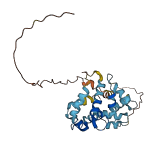
2 structures for Q9QXT8
| Entry ID | Method | Resolution | Chain | Position | Source |
|---|---|---|---|---|---|
| 2JUL | NMR | - | A | 1-256 | PDB |
| AF-Q9QXT8-F1 | Predicted | AlphaFoldDB |
13 variants for Q9QXT8
| Variant ID(s) | Position | Change | Description | Diseaes Association | Provenance |
|---|---|---|---|---|---|
| rs51749766 | 14 | N>S | strain: 129/Ola, BALB/c and FVB/NJ [UniProt] | No | EVA |
| rs225688106 | 22 | I>M | No | EVA | |
| rs3388592310 | 25 | S>N | No | EVA | |
| rs256664369 | 35 | P>T | No | EVA | |
| rs3388590271 | 76 | P>Q | No | EVA | |
| rs3388583458 | 107 | G>V | No | EVA | |
| rs3388576393 | 129 | T>A | No | EVA | |
| rs3388593059 | 132 | H>Y | No | EVA | |
| rs3388583466 | 189 | A>T | No | EVA | |
| rs3388590246 | 190 | I>N | No | EVA | |
| rs3412945355 | 196 | D>Y | No | EVA | |
| rs3388591202 | 200 | R>H | No | EVA | |
| rs3410331994 | 215 | V>L | No | EVA |
No associated diseases with Q9QXT8
1 regional properties for Q9QXT8
| Type | Name | Position | InterPro Accession |
|---|---|---|---|
| domain | YqgF/RNase H-like domain | 4 - 104 | IPR006641 |
Functions
9 GO annotations of cellular component
| Name | Definition |
|---|---|
| axon | The long process of a neuron that conducts nerve impulses, usually away from the cell body to the terminals and varicosities, which are sites of storage and release of neurotransmitter. |
| axon terminus | Terminal inflated portion of the axon, containing the specialized apparatus necessary to release neurotransmitters. The axon terminus is considered to be the whole region of thickening and the terminal button is a specialized region of it. |
| cytosol | The part of the cytoplasm that does not contain organelles but which does contain other particulate matter, such as protein complexes. |
| dendrite | A neuron projection that has a short, tapering, morphology. Dendrites receive and integrate signals from other neurons or from sensory stimuli, and conduct nerve impulses towards the axon or the cell body. In most neurons, the impulse is conveyed from dendrites to axon via the cell body, but in some types of unipolar neuron, the impulse does not travel via the cell body. |
| endoplasmic reticulum | The irregular network of unit membranes, visible only by electron microscopy, that occurs in the cytoplasm of many eukaryotic cells. The membranes form a complex meshwork of tubular channels, which are often expanded into slitlike cavities called cisternae. The ER takes two forms, rough (or granular), with ribosomes adhering to the outer surface, and smooth (with no ribosomes attached). |
| Golgi apparatus | A membrane-bound cytoplasmic organelle of the endomembrane system that further processes the core oligosaccharides (e.g. N-glycans) added to proteins in the endoplasmic reticulum and packages them into membrane-bound vesicles. The Golgi apparatus operates at the intersection of the secretory, lysosomal, and endocytic pathways. |
| nucleus | A membrane-bounded organelle of eukaryotic cells in which chromosomes are housed and replicated. In most cells, the nucleus contains all of the cell's chromosomes except the organellar chromosomes, and is the site of RNA synthesis and processing. In some species, or in specialized cell types, RNA metabolism or DNA replication may be absent. |
| protein-DNA complex | A macromolecular complex containing both protein and DNA molecules. |
| voltage-gated potassium channel complex | A protein complex that forms a transmembrane channel through which potassium ions may cross a cell membrane in response to changes in membrane potential. |
15 GO annotations of molecular function
| Name | Definition |
|---|---|
| calcium ion binding | Binding to a calcium ion (Ca2+). |
| calcium-dependent protein binding | Binding to a protein or protein complex in the presence of calcium. |
| core promoter sequence-specific DNA binding | Binding to a sequence of DNA that is part of a core promoter region. The core promoter is composed of the transcription start site and binding sites for the RNA polymerase and the basal transcription machinery. The transcribed region might be described as a gene, cistron, or operon. |
| DNA binding | Any molecular function by which a gene product interacts selectively and non-covalently with DNA (deoxyribonucleic acid). |
| DNA-binding transcription repressor activity, RNA polymerase II-specific | A DNA-binding transcription factor activity that represses or decreases the transcription of specific gene sets transcribed by RNA polymerase II. |
| ion binding | Binding to an ion, a charged atoms or groups of atoms. |
| magnesium ion binding | Binding to a magnesium (Mg) ion. |
| molecular function activator activity | A molecular function regulator that activates or increases the activity of its target via non-covalent binding that does not result in covalent modification to the target. |
| potassium channel activity | Enables the facilitated diffusion of a potassium ion (by an energy-independent process) involving passage through a transmembrane aqueous pore or channel without evidence for a carrier-mediated mechanism. |
| potassium channel regulator activity | Binds to and modulates the activity of a potassium channel. |
| protein C-terminus binding | Binding to a protein C-terminus, the end of a peptide chain at which the 1-carboxyl function of a constituent amino acid is not attached in peptide linkage to another amino-acid residue. |
| RNA polymerase II cis-regulatory region sequence-specific DNA binding | Binding to a specific upstream regulatory DNA sequence (transcription factor recognition sequence or binding site) located in cis relative to the transcription start site (i.e., on the same strand of DNA) of a gene transcribed by RNA polymerase II. |
| sequence-specific DNA binding | Binding to DNA of a specific nucleotide composition, e.g. GC-rich DNA binding, or with a specific sequence motif or type of DNA e.g. promotor binding or rDNA binding. |
| transmembrane transporter binding | Binding to a transmembrane transporter, a protein or protein complex that enables the transfer of a substance, usually a specific substance or a group of related substances, from one side of a membrane to the other. |
| voltage-gated ion channel activity | Enables the transmembrane transfer of an ion by a voltage-gated channel. An ion is an atom or group of atoms carrying an electric charge by virtue of having gained or lost one or more electrons. A voltage-gated channel is a channel whose open state is dependent on the voltage across the membrane in which it is embedded. |
12 GO annotations of biological process
| Name | Definition |
|---|---|
| apoptotic process | A programmed cell death process which begins when a cell receives an internal (e.g. DNA damage) or external signal (e.g. an extracellular death ligand), and proceeds through a series of biochemical events (signaling pathway phase) which trigger an execution phase. The execution phase is the last step of an apoptotic process, and is typically characterized by rounding-up of the cell, retraction of pseudopodes, reduction of cellular volume (pyknosis), chromatin condensation, nuclear fragmentation (karyorrhexis), plasma membrane blebbing and fragmentation of the cell into apoptotic bodies. When the execution phase is completed, the cell has died. |
| behavioral response to pain | Any process that results in a change in the behavior of an organism as a result of a pain stimulus. Pain stimuli cause activation of nociceptors, peripheral receptors for pain, include receptors which are sensitive to painful mechanical stimuli, extreme heat or cold, and chemical stimuli. |
| intracellular protein transport | The directed movement of proteins in a cell, including the movement of proteins between specific compartments or structures within a cell, such as organelles of a eukaryotic cell. |
| negative regulation of DNA-templated transcription | Any process that stops, prevents, or reduces the frequency, rate or extent of cellular DNA-templated transcription. |
| negative regulation of transcription by RNA polymerase II | Any process that stops, prevents, or reduces the frequency, rate or extent of transcription mediated by RNA polymerase II. |
| potassium ion transport | The directed movement of potassium ions (K+) into, out of or within a cell, or between cells, by means of some agent such as a transporter or pore. |
| protein localization to plasma membrane | A process in which a protein is transported to, or maintained in, a specific location in the plasma membrane. |
| regulation of neuron apoptotic process | Any process that modulates the occurrence or rate of cell death by apoptotic process in neurons. |
| regulation of potassium ion transmembrane transport | Any process that modulates the frequency, rate or extent of potassium ion transmembrane transport. |
| response to magnesium ion | Any process that results in a change in state or activity of a cell or an organism (in terms of movement, secretion, enzyme production, gene expression, etc.) as a result of a magnesium ion stimulus. |
| response to pain | Any process that results in a change in state or activity of a cell or an organism (in terms of movement, secretion, enzyme production, gene expression, etc.) as a result of a pain stimulus. Pain stimuli cause activation of nociceptors, peripheral receptors for pain, include receptors which are sensitive to painful mechanical stimuli, extreme heat or cold, and chemical stimuli. |
| sensory perception of pain | The series of events required for an organism to receive a painful stimulus, convert it to a molecular signal, and recognize and characterize the signal. Pain is medically defined as the physical sensation of discomfort or distress caused by injury or illness, so can hence be described as a harmful stimulus which signals current (or impending) tissue damage. Pain may come from extremes of temperature, mechanical damage, electricity or from noxious chemical substances. This is a neurological process. |
4 homologous proteins in AiPD
| UniProt AC | Gene Name | Protein Name | Species | Evidence Code |
|---|---|---|---|---|
| Q9NS61 | KCNIP2 | Kv channel-interacting protein 2 | Homo sapiens (Human) | PR |
| Q9JJ69 | Kcnip2 | Kv channel-interacting protein 2 | Mus musculus (Mouse) | PR |
| Q75KU4 | CBL4 | Calcineurin B-like protein 4 | Oryza sativa subsp japonica (Rice) | PR |
| Q7XC27 | CBL1 | Calcineurin B-like protein 1 | Oryza sativa subsp japonica (Rice) | PR |
| 10 | 20 | 30 | 40 | 50 | 60 |
| MQRTKEAVKA | SDGNLLGDPG | RIPLSKRESI | KWQRPRFTRQ | ALMRCCLIKW | ILSSAAPQGS |
| 70 | 80 | 90 | 100 | 110 | 120 |
| DSSDSELELS | TVRHQPEGLD | QLQAQTKFTK | KELQSLYRGF | KNECPTGLVD | EDTFKLIYSQ |
| 130 | 140 | 150 | 160 | 170 | 180 |
| FFPQGDATTY | AHFLFNAFDA | DGNGAIHFED | FVVGLSILLR | GTVHEKLKWA | FNLYDINKDG |
| 190 | 200 | 210 | 220 | 230 | 240 |
| CITKEEMLAI | MKSIYDMMGR | HTYPILREDA | PLEHVERFFQ | KMDRNQDGVV | TIDEFLETCQ |
| 250 | |||||
| KDENIMNSMQ | LFENVI |