Descriptions
The autoinhibited protein was predicted that may have potential autoinhibitory elements via cis-regPred.
Autoinhibitory domains (AIDs)
Target domain |
|
Relief mechanism |
|
Assay |
cis-regPred |
Accessory elements
No accessory elements
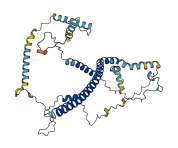
Autoinhibited structure

Activated structure
1 structures for Q9PTG6
| Entry ID | Method | Resolution | Chain | Position | Source |
|---|---|---|---|---|---|
| AF-Q9PTG6-F1 | Predicted | AlphaFoldDB |
No variants for Q9PTG6
| Variant ID(s) | Position | Change | Description | Diseaes Association | Provenance |
|---|---|---|---|---|---|
| No variants for Q9PTG6 | |||||
No associated diseases with Q9PTG6
No regional properties for Q9PTG6
| Type | Name | Position | InterPro Accession |
|---|---|---|---|
| No domain, repeats, and functional sites for Q9PTG6 | |||
7 GO annotations of cellular component
| Name | Definition |
|---|---|
| centrosome | A structure comprised of a core structure (in most organisms, a pair of centrioles) and peripheral material from which a microtubule-based structure, such as a spindle apparatus, is organized. Centrosomes occur close to the nucleus during interphase in many eukaryotic cells, though in animal cells it changes continually during the cell-division cycle. |
| cytoplasm | The contents of a cell excluding the plasma membrane and nucleus, but including other subcellular structures. |
| dynactin complex | A 20S multiprotein assembly of total mass about 1.2 MDa that activates dynein-based activity in vivo. A large structural component of the complex is an actin-like 40 nm filament composed of actin-related protein, to which other components attach. |
| dynein complex | Any of several large complexes that contain two or three dynein heavy chains and several light chains, and have microtubule motor activity. |
| membrane | A lipid bilayer along with all the proteins and protein complexes embedded in it an attached to it. |
| microtubule | Any of the long, generally straight, hollow tubes of internal diameter 12-15 nm and external diameter 24 nm found in a wide variety of eukaryotic cells; each consists (usually) of 13 protofilaments of polymeric tubulin, staggered in such a manner that the tubulin monomers are arranged in a helical pattern on the microtubular surface, and with the alpha/beta axes of the tubulin subunits parallel to the long axis of the tubule; exist in equilibrium with pool of tubulin monomers and can be rapidly assembled or disassembled in response to physiological stimuli; concerned with force generation, e.g. in the spindle. |
| vesicle | Any small, fluid-filled, spherical organelle enclosed by membrane. |
No GO annotations of molecular function
| Name | Definition |
|---|---|
| No GO annotations for molecular function |
1 GO annotations of biological process
| Name | Definition |
|---|---|
| mitotic spindle organization | A process that is carried out at the cellular level which results in the assembly, arrangement of constituent parts, or disassembly of the microtubule spindle during a mitotic cell cycle. |
| 10 | 20 | 30 | 40 | 50 | 60 |
| MADPKYADLP | GIARNEPDVY | ETSDLPEDDQ | AEFEAELEEL | TSTSVEHLII | NPNAAFEKFK |
| 70 | 80 | 90 | 100 | 110 | 120 |
| DKRLGTDGVD | FSDRISKSRT | TGYESGEYEI | LGEGLGAKET | PQQRYQRLQH | EVQELIRDVE |
| 130 | 140 | 150 | 160 | 170 | 180 |
| QIQSAVKESA | AEEELTPMAL | ARQLEGLKQQ | LVSCHLQKLL | GPTAAIDFAD | PEGALAKRLQ |
| 190 | 200 | 210 | 220 | 230 | 240 |
| QQLEVPSVKK | AAPAKSPPKA | PGPTTDALTF | ELFWRRPEQD | QFSQTAKIAE | LEKRLAQLEA |
| 250 | 260 | 270 | 280 | 290 | 300 |
| MVRCEPDSQN | PLLVGAEGTS | LVETVQILQA | KVNILDAAVL | DQVEARLQRR | PGSKVNEIAK |
| 310 | 320 | 330 | 340 | 350 | 360 |
| HKAIVQDADT | QSKIHQVVYE | MMQRWDHMAS | SLPDVVQRLL | TLRDLHEQAS | RFVQVLVHLD |
| 370 | 380 | 390 | 400 | ||
| TTQQEVDVVQ | RLLAEVQKTM | KENLAVVEDN | FAEVEARIKR | LQ |