Q7T3H1
Gene name |
dctn2 |
Protein name |
Dynactin subunit 2 |
Names |
|
Species |
Danio rerio (Zebrafish) (Brachydanio rerio) |
KEGG Pathway |
dre:394141 |
EC number |
|
Protein Class |
|
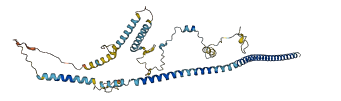
Descriptions
The autoinhibited protein was predicted that may have potential autoinhibitory elements via cis-regPred.
Autoinhibitory domains (AIDs)
Target domain |
|
Relief mechanism |
|
Assay |
cis-regPred |
Accessory elements
No accessory elements
Autoinhibited structure

Activated structure
1 structures for Q7T3H1
| Entry ID | Method | Resolution | Chain | Position | Source |
|---|---|---|---|---|---|
| AF-Q7T3H1-F1 | Predicted | AlphaFoldDB |
No variants for Q7T3H1
| Variant ID(s) | Position | Change | Description | Diseaes Association | Provenance |
|---|---|---|---|---|---|
| No variants for Q7T3H1 | |||||
No associated diseases with Q7T3H1
No regional properties for Q7T3H1
| Type | Name | Position | InterPro Accession |
|---|---|---|---|
| No domain, repeats, and functional sites for Q7T3H1 | |||
7 GO annotations of cellular component
| Name | Definition |
|---|---|
| centrosome | A structure comprised of a core structure (in most organisms, a pair of centrioles) and peripheral material from which a microtubule-based structure, such as a spindle apparatus, is organized. Centrosomes occur close to the nucleus during interphase in many eukaryotic cells, though in animal cells it changes continually during the cell-division cycle. |
| cytoplasm | The contents of a cell excluding the plasma membrane and nucleus, but including other subcellular structures. |
| dynactin complex | A 20S multiprotein assembly of total mass about 1.2 MDa that activates dynein-based activity in vivo. A large structural component of the complex is an actin-like 40 nm filament composed of actin-related protein, to which other components attach. |
| dynein complex | Any of several large complexes that contain two or three dynein heavy chains and several light chains, and have microtubule motor activity. |
| membrane | A lipid bilayer along with all the proteins and protein complexes embedded in it an attached to it. |
| microtubule | Any of the long, generally straight, hollow tubes of internal diameter 12-15 nm and external diameter 24 nm found in a wide variety of eukaryotic cells; each consists (usually) of 13 protofilaments of polymeric tubulin, staggered in such a manner that the tubulin monomers are arranged in a helical pattern on the microtubular surface, and with the alpha/beta axes of the tubulin subunits parallel to the long axis of the tubule; exist in equilibrium with pool of tubulin monomers and can be rapidly assembled or disassembled in response to physiological stimuli; concerned with force generation, e.g. in the spindle. |
| vesicle | Any small, fluid-filled, spherical organelle enclosed by membrane. |
No GO annotations of molecular function
| Name | Definition |
|---|---|
| No GO annotations for molecular function |
8 GO annotations of biological process
| Name | Definition |
|---|---|
| auditory receptor cell development | The process whose specific outcome is the progression of an auditory receptor cell over time, from its formation to the mature structure. Cell development does not include the steps involved in committing a cell to a specific fate. |
| establishment or maintenance of apical/basal cell polarity | Any cellular process that results in the specification, formation or maintenance polarization of a cell's architecture along its apical/basal axis so that the apical and basal regions of the cell have different membrane, extracellular matrix and sub-membrane cellular components. |
| eye photoreceptor cell differentiation | The process in which a relatively unspecialized cell acquires the specialized features of a photoreceptor cell, as found in the eye, the primary visual organ of most organisms. |
| glial cell differentiation | The process in which a relatively unspecialized cell acquires the specialized features of a glial cell. |
| mitotic spindle organization | A process that is carried out at the cellular level which results in the assembly, arrangement of constituent parts, or disassembly of the microtubule spindle during a mitotic cell cycle. |
| nuclear migration | The directed movement of the nucleus to a specific location within a cell. |
| P granule organization | A process that is carried out at the cellular level which results in the assembly, arrangement of constituent parts, or disassembly of polar granules, cytoplasmic, non-membranous RNA/protein complex aggregates in the primordial germ cells of many higher eukaryotes. |
| photoreceptor cell maintenance | Any process preventing the degeneration of the photoreceptor, a specialized cell type that is sensitive to light. |
| 10 | 20 | 30 | 40 | 50 | 60 |
| MADPKYANLP | GIASNEPDVY | ETSDLPEDDQ | AQFESELEEL | CSDSVERIVV | NPNAAYDKFK |
| 70 | 80 | 90 | 100 | 110 | 120 |
| DKHVSAKSLD | FSDRISKNRR | VGYESGDYEL | LAEGCGVKET | PQQKYQRLVN | EIHELCQDVE |
| 130 | 140 | 150 | 160 | 170 | 180 |
| KIQTSTKESG | AEERLTPVAL | AQQAAQLKQQ | LVSAHLDSLL | GPDAHINLTD | PDGALAKRLL |
| 190 | 200 | 210 | 220 | 230 | 240 |
| TQLEVARGVR | SGAGADGKTA | APKGPDGVIL | YELHSRPEQE | KFTESAKVAE | LERRLAELET |
| 250 | 260 | 270 | 280 | 290 | 300 |
| AVGSGSDKRG | PLSSGVQGSS | LTETLELLQA | RVSALDAATL | DQVEARLQSV | LGKMNEIAKH |
| 310 | 320 | 330 | 340 | 350 | 360 |
| KATMEDAETQ | SKVSQLYDVV | QKWDAMATSL | PQVVRRLTAV | RELHEQAMQF | GQLLTHLDTT |
| 370 | 380 | 390 | 400 | ||
| QQMINNSLKD | NSTLLTQVQQ | TMKENLLAVE | ENFSALDQRM | KKLNK |