Q9N4D6
Gene name |
sesn-1 |
Protein name |
Sestrin homolog |
Names |
|
Species |
Caenorhabditis elegans |
KEGG Pathway |
cel:CELE_Y74C9A.5 |
EC number |
|
Protein Class |
|
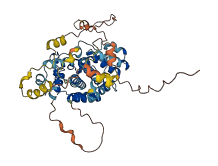
Descriptions
The autoinhibited protein was predicted that may have potential autoinhibitory elements via cis-regPred.
Autoinhibitory domains (AIDs)
Target domain |
|
Relief mechanism |
|
Assay |
cis-regPred |
Accessory elements
No accessory elements
Autoinhibited structure

Activated structure
1 structures for Q9N4D6
| Entry ID | Method | Resolution | Chain | Position | Source |
|---|---|---|---|---|---|
| AF-Q9N4D6-F1 | Predicted | AlphaFoldDB |
No variants for Q9N4D6
| Variant ID(s) | Position | Change | Description | Diseaes Association | Provenance |
|---|---|---|---|---|---|
| No variants for Q9N4D6 | |||||
No associated diseases with Q9N4D6
No regional properties for Q9N4D6
| Type | Name | Position | InterPro Accession |
|---|---|---|---|
| No domain, repeats, and functional sites for Q9N4D6 | |||
2 GO annotations of cellular component
| Name | Definition |
|---|---|
| cytoplasm | The contents of a cell excluding the plasma membrane and nucleus, but including other subcellular structures. |
| nucleus | A membrane-bounded organelle of eukaryotic cells in which chromosomes are housed and replicated. In most cells, the nucleus contains all of the cell's chromosomes except the organellar chromosomes, and is the site of RNA synthesis and processing. In some species, or in specialized cell types, RNA metabolism or DNA replication may be absent. |
2 GO annotations of molecular function
| Name | Definition |
|---|---|
| leucine binding | Binding to 2-amino-4-methylpentanoic acid. |
| oxidoreductase activity, acting on peroxide as acceptor | Catalysis of an oxidation-reduction (redox) reaction in which the peroxide group acts as a hydrogen or electron acceptor. |
5 GO annotations of biological process
| Name | Definition |
|---|---|
| cellular response to leucine | Any process that results in a change in state or activity of a cell (in terms of movement, secretion, enzyme production, gene expression, etc.) as a result of a leucine stimulus. |
| cellular response to leucine starvation | Any process that results in a change in state or activity of a cell (in terms of movement, secretion, enzyme production, gene expression, etc.) as a result of deprivation of leucine. |
| negative regulation of TORC1 signaling | Any process that stops, prevents or reduces the frequency, rate or extent of TORC1 signaling. |
| positive regulation of macroautophagy | Any process, such as recognition of nutrient depletion, that activates or increases the rate of macroautophagy to bring cytosolic macromolecules to the vacuole/lysosome for degradation. |
| regulation of response to reactive oxygen species | Any process that modulates the frequency, rate or extent of response to reactive oxygen species. |
| 10 | 20 | 30 | 40 | 50 | 60 |
| MHTTTKRRKA | MDWLNFDPIP | EVDRLFRFTC | KHPTLHVHMT | GSYGHMFVDI | SDLPASARHY |
| 70 | 80 | 90 | 100 | 110 | 120 |
| LALMAASRHR | CLSLMDHHRR | KFLEKGGQQM | WLLGIDWSYM | KFRKLDYLNR | MLCHRPWMIH |
| 130 | 140 | 150 | 160 | 170 | 180 |
| WKNLAVLFAR | RTPDGGPAFF | SVCSLHHAVG | IMSMTHAMCT | VICCIGLERR | VDLTQDEIDF |
| 190 | 200 | 210 | 220 | 230 | 240 |
| LNIDDLDYWE | ARMSAYFRKV | PDRRPTEVEY | LISELKKTEK | GQTRPPAKMC | AMTTETIESL |
| 250 | 260 | 270 | 280 | 290 | 300 |
| ISAPAATYSS | NRKNYSPVLL | LANIDENGED | IMEKEPPCNY | PIYSHHRTFG | YIDFRKRPEK |
| 310 | 320 | 330 | 340 | 350 | 360 |
| DIPPFRVEEF | GWDHVYNTMN | EYTDTLTSRL | DRMFDHIRTL | TGNMPSGSSH | ASGDGEPPAA |
| 370 | 380 | 390 | 400 | 410 | 420 |
| VNQNEIDTAA | FREAIWNYTQ | GLYGVRVDDY | DYSKINRVLD | KGTKTFIKLA | ACYPHKLTTE |
| 430 | 440 | 450 | 460 | 470 | |
| FTRALPGFKD | SEKIHVVMMV | AMARFQASMF | HYTRAVCNYN | AMCLSKKGWR | KPLD |