Q9M345
Gene name |
LECRK42 |
Protein name |
L-type lectin-domain containing receptor kinase IV.2 |
Names |
Arabidopsis thaliana lectin-receptor kinase a4, AthlecRK-a4, LecRK-IV.2, Protein SMALL, GLUED-TOGETHER, AND COLLAPSED POLLEN |
Species |
Arabidopsis thaliana (Mouse-ear cress) |
KEGG Pathway |
ath:AT3G53810 |
EC number |
2.7.11.1: Protein-serine/threonine kinases |
Protein Class |
|
Descriptions
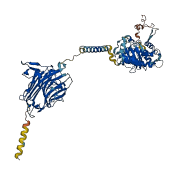
The autoinhibited protein was predicted that may have potential autoinhibitory elements via cis-regPred.
Autoinhibitory domains (AIDs)
Target domain |
|
Relief mechanism |
|
Assay |
cis-regPred |
Accessory elements
489-513 (Activation loop from InterPro)
Target domain |
347-625 (Protein kinase domain) |
Relief mechanism |
|
Assay |
|
Autoinhibited structure

Activated structure
1 structures for Q9M345
| Entry ID | Method | Resolution | Chain | Position | Source |
|---|---|---|---|---|---|
| AF-Q9M345-F1 | Predicted | AlphaFoldDB |
35 variants for Q9M345
| Variant ID(s) | Position | Change | Description | Diseaes Association | Provenance |
|---|---|---|---|---|---|
| tmp_3_19935173_A_C | 5 | L>R | No | 1000Genomes | |
| ENSVATH02501581 | 12 | F>S | No | 1000Genomes | |
| tmp_3_19935134_A_T | 18 | M>K | No | 1000Genomes | |
| tmp_3_19935128_G_A | 20 | S>F | No | 1000Genomes | |
| ENSVATH14430547 | 24 | N>T | No | 1000Genomes | |
| tmp_3_19935042_G_T | 49 | P>T | No | 1000Genomes | |
| tmp_3_19935038_T_C | 50 | N>S | No | 1000Genomes | |
| ENSVATH02501579 | 60 | V>L | No | 1000Genomes | |
| ENSVATH00418092 | 68 | C>Y | No | 1000Genomes | |
| ENSVATH12748183 | 73 | R>Q | No | 1000Genomes | |
| tmp_3_19934955_G_C | 78 | Q>E | No | 1000Genomes | |
| tmp_3_19934951_T_C | 79 | N>S | No | 1000Genomes | |
| ENSVATH06310115 | 105 | I>F | No | 1000Genomes | |
| ENSVATH06310114 | 110 | A>T | No | 1000Genomes | |
| tmp_3_19934729_C_T | 153 | G>E | No | 1000Genomes | |
| tmp_3_19934583_C_T | 202 | D>N | No | 1000Genomes | |
| ENSVATH14430523 | 267 | A>P | No | 1000Genomes | |
| ENSVATH06310110 | 273 | S>W | No | 1000Genomes | |
| tmp_3_19934361_G_A | 276 | P>S | No | 1000Genomes | |
| tmp_3_19934252_A_G | 312 | I>T | No | 1000Genomes | |
| tmp_3_19934085_T_A | 368 | T>S | No | 1000Genomes | |
| ENSVATH02501574 | 448 | T>K | No | 1000Genomes | |
| tmp_3_19933707_C_T | 494 | A>T | No | 1000Genomes | |
| ENSVATH00418088 | 528 | T>A | No | 1000Genomes | |
| tmp_3_19933536_G_A | 551 | H>Y | No | 1000Genomes | |
| tmp_3_19933478_C_T | 570 | R>K | No | 1000Genomes | |
| tmp_3_19933400_T_A | 596 | K>I | No | 1000Genomes | |
| tmp_3_19933395_C_T | 598 | G>S | No | 1000Genomes | |
| tmp_3_19933382_G_A | 602 | S>L | No | 1000Genomes | |
| tmp_3_19933326_C_T | 621 | G>R | No | 1000Genomes | |
| tmp_3_19933311_G_C | 626 | P>A | No | 1000Genomes | |
| ENSVATH06310103 | 633 | L>M | No | 1000Genomes | |
| ENSVATH06310102 | 635 | A>G | No | 1000Genomes | |
| tmp_3_19933251_C_T | 646 | G>S | No | 1000Genomes | |
| ENSVATH06310100 | 647 | F>C | No | 1000Genomes |
2 associated diseases with Q9M345
[MIM: 242860]: Immunodeficiency-centromeric instability-facial anomalies syndrome 1 (ICF1)
A rare disorder characterized by a variable immunodeficiency resulting in recurrent infections, facial anomalies, and branching of chromosomes 1, 9, and 16. Other variable symptoms include growth retardation, failure to thrive, and psychomotor retardation. Laboratory studies show limited hypomethylation of DNA in a small fraction of the genome in some, but not all, patients. . Note=The disease is caused by variants affecting the gene represented in this entry.
[MIM: 619478]: Facioscapulohumeral muscular dystrophy 4, digenic (FSHD4)
A digenic form of facioscapulohumeral muscular dystrophy, a degenerative muscle disease characterized by slowly progressive weakness of the muscles of the face, upper-arm, and shoulder girdle. With disease progression, other muscles may also become affected. There is significant clinical variability and incomplete penetrance. . Note=The disease is caused by variants affecting distinct genetic loci, including the gene represented in this entry. DNMT3B mutations lead to DUX4 expression in somatic tissues, including muscle cells, when an haplotype on chromosome 4 is permissive for DUX4 expression. Ectopic expression of DUX4 in skeletal muscle activates the expression of stem cell and germline genes, and, when overexpressed in somatic cells, DUX4 can ultimately lead to cell death. .
Without disease ID
- A rare disorder characterized by a variable immunodeficiency resulting in recurrent infections, facial anomalies, and branching of chromosomes 1, 9, and 16. Other variable symptoms include growth retardation, failure to thrive, and psychomotor retardation. Laboratory studies show limited hypomethylation of DNA in a small fraction of the genome in some, but not all, patients. . Note=The disease is caused by variants affecting the gene represented in this entry.
- A digenic form of facioscapulohumeral muscular dystrophy, a degenerative muscle disease characterized by slowly progressive weakness of the muscles of the face, upper-arm, and shoulder girdle. With disease progression, other muscles may also become affected. There is significant clinical variability and incomplete penetrance. . Note=The disease is caused by variants affecting distinct genetic loci, including the gene represented in this entry. DNMT3B mutations lead to DUX4 expression in somatic tissues, including muscle cells, when an haplotype on chromosome 4 is permissive for DUX4 expression. Ectopic expression of DUX4 in skeletal muscle activates the expression of stem cell and germline genes, and, when overexpressed in somatic cells, DUX4 can ultimately lead to cell death. .
15 regional properties for Q9M345
| Type | Name | Position | InterPro Accession |
|---|---|---|---|
| domain | Sema domain | 20 - 509 | IPR001627 |
| repeat | Plexin repeat | 511 - 552 | IPR002165-1 |
| repeat | Plexin repeat | 658 - 701 | IPR002165-2 |
| repeat | Plexin repeat | 807 - 851 | IPR002165-3 |
| domain | IPT domain | 860 - 955 | IPR002909-1 |
| domain | IPT domain | 956 - 1041 | IPR002909-2 |
| domain | IPT domain | 1043 - 1143 | IPR002909-3 |
| domain | IPT domain | 1145 - 1240 | IPR002909-4 |
| domain | Plexin, cytoplasmic RasGAP domain | 1315 - 1862 | IPR013548 |
| domain | PSI domain | 511 - 561 | IPR016201-1 |
| domain | PSI domain | 658 - 705 | IPR016201-2 |
| domain | PSI domain | 806 - 859 | IPR016201-3 |
| domain | Plexin, TIG domain 1 | 566 - 657 | IPR041019 |
| domain | Plexin, TIG domain 2 | 712 - 805 | IPR041362 |
| domain | Plexin, cytoplasmic RhoGTPase-binding domain | 1484 - 1596 | IPR046800 |
Functions
| Description | ||
|---|---|---|
| EC Number | 2.7.11.1 | Protein-serine/threonine kinases |
| Subcellular Localization |
|
|
| PANTHER Family | ||
| PANTHER Subfamily | ||
| PANTHER Protein Class | ||
| PANTHER Pathway Category | No pathway information available | |
3 GO annotations of cellular component
| Name | Definition |
|---|---|
| cytosol | The part of the cytoplasm that does not contain organelles but which does contain other particulate matter, such as protein complexes. |
| integral component of membrane | The component of a membrane consisting of the gene products and protein complexes having at least some part of their peptide sequence embedded in the hydrophobic region of the membrane. |
| plasma membrane | The membrane surrounding a cell that separates the cell from its external environment. It consists of a phospholipid bilayer and associated proteins. |
4 GO annotations of molecular function
| Name | Definition |
|---|---|
| ATP binding | Binding to ATP, adenosine 5'-triphosphate, a universally important coenzyme and enzyme regulator. |
| carbohydrate binding | Binding to a carbohydrate, which includes monosaccharides, oligosaccharides and polysaccharides as well as substances derived from monosaccharides by reduction of the carbonyl group (alditols), by oxidation of one or more hydroxy groups to afford the corresponding aldehydes, ketones, or carboxylic acids, or by replacement of one or more hydroxy group(s) by a hydrogen atom. Cyclitols are generally not regarded as carbohydrates. |
| protein serine kinase activity | Catalysis of the reactions: ATP + protein serine = ADP + protein serine phosphate. |
| transmembrane receptor protein serine/threonine kinase activity | Combining with a signal and transmitting the signal from one side of the membrane to the other to initiate a change in cell activity by catalysis of the reaction: ATP protein serine = ADP + protein serine phosphate, and ATP + protein threonine = ADP + protein threonine phosphate. |
4 GO annotations of biological process
| Name | Definition |
|---|---|
| defense response to bacterium | Reactions triggered in response to the presence of a bacterium that act to protect the cell or organism. |
| defense response to oomycetes | Reactions triggered in response to the presence of oomycetes that act to protect the cell or organism. |
| pollen development | The process whose specific outcome is the progression of the pollen grain over time, from its formation to the mature structure. The process begins with the meiosis of the microsporocyte to form four haploid microspores. The nucleus of each microspore then divides by mitosis to form a two-celled organism, the pollen grain, that contains a tube cell as well as a smaller generative cell. The pollen grain is surrounded by an elaborate cell wall. In some species, the generative cell immediately divides again to give a pair of sperm cells. In most flowering plants, however this division takes place later, in the tube that develops when a pollen grain germinates. |
| protein phosphorylation | The process of introducing a phosphate group on to a protein. |
20 homologous proteins in AiPD
| UniProt AC | Gene Name | Protein Name | Species | Evidence Code |
|---|---|---|---|---|
| P46197 | NPR2 | Atrial natriuretic peptide receptor 2 | Bos taurus (Bovine) | PR |
| Q24488 | Ror | Tyrosine-protein kinase transmembrane receptor Ror | Drosophila melanogaster (Fruit fly) | SS |
| Q9V6K3 | Nrk | Tyrosine-protein kinase transmembrane receptor Ror2 | Drosophila melanogaster (Fruit fly) | SS |
| Q96S53 | TESK2 | Dual specificity testis-specific protein kinase 2 | Homo sapiens (Human) | PR |
| Q06806 | Tie1 | Tyrosine-protein kinase receptor Tie-1 | Mus musculus (Mouse) | SS |
| Q02858 | Tek | Angiopoietin-1 receptor | Mus musculus (Mouse) | SS |
| O08680 | Epha3 | Ephrin type-A receptor 3 | Rattus norvegicus (Rat) | SS |
| P54757 | Epha5 | Ephrin type-A receptor 5 | Rattus norvegicus (Rat) | SS |
| P54759 | Epha7 | Ephrin type-A receptor 7 | Rattus norvegicus (Rat) | SS |
| P09759 | Ephb1 | Ephrin type-B receptor 1 | Rattus norvegicus (Rat) | SS |
| P0C0K7 | Ephb6 | Ephrin type-B receptor 6 | Rattus norvegicus (Rat) | SS |
| O80939 | LECRK41 | L-type lectin-domain containing receptor kinase IV.1 | Arabidopsis thaliana (Mouse-ear cress) | PR |
| O81291 | LECRK44 | L-type lectin-domain containing receptor kinase IV.4 | Arabidopsis thaliana (Mouse-ear cress) | PR |
| O81292 | LECRK43 | L-type lectin-domain containing receptor kinase IV.3 | Arabidopsis thaliana (Mouse-ear cress) | PR |
| Q9M1G4 | LECRK15 | Probable L-type lectin-domain containing receptor kinase I.5 | Arabidopsis thaliana (Mouse-ear cress) | PR |
| Q9STF0 | LECRKS3 | Receptor like protein kinase S.3 | Arabidopsis thaliana (Mouse-ear cress) | PR |
| Q9M2S4 | LECRKS4 | L-type lectin-domain containing receptor kinase S.4 | Arabidopsis thaliana (Mouse-ear cress) | PR |
| Q96285 | LECRK55 | L-type lectin-domain containing receptor kinase V.5 | Arabidopsis thaliana (Mouse-ear cress) | PR |
| Q9FG33 | LECRKS5 | Probable L-type lectin-domain containing receptor kinase S.5 | Arabidopsis thaliana (Mouse-ear cress) | PR |
| Q9LSR8 | LECRK19 | L-type lectin-domain containing receptor kinase I.9 | Arabidopsis thaliana (Mouse-ear cress) | PR |
| 10 | 20 | 30 | 40 | 50 | 60 |
| MFVKLKLIFF | FFLLCQIMIS | SSQNLNFTYN | GFHPPLTDIS | LQGLATVTPN | GLLKLTNTSV |
| 70 | 80 | 90 | 100 | 110 | 120 |
| QKTGHAFCTE | RIRFKDSQNG | NVSSFSTTFV | FAIHSQIPTL | SGHGIAFVVA | PTLGLPFALP |
| 130 | 140 | 150 | 160 | 170 | 180 |
| SQYIGLFNIS | NNGNDTNHIF | AVEFDTIQSS | EFGDPNDNHV | GIDLNGLRSA | NYSTAGYRDD |
| 190 | 200 | 210 | 220 | 230 | 240 |
| HDKFQNLSLI | SRKRIQVWID | YDNRSHRIDV | TVAPFDSDKP | RKPLVSYVRD | LSSILLEDMY |
| 250 | 260 | 270 | 280 | 290 | 300 |
| VGFSSATGSV | LSEHFLVGWS | FRLNGEAPML | SLSKLPKLPR | FEPRRISEFY | KIGMPLISLS |
| 310 | 320 | 330 | 340 | 350 | 360 |
| LIFSIIFLAF | YIVRRKKKYE | EELDDWETEF | GKNRFRFKEL | YHATKGFKEK | DLLGSGGFGR |
| 370 | 380 | 390 | 400 | 410 | 420 |
| VYRGILPTTK | LEVAVKRVSH | DSKQGMKEFV | AEIVSIGRMS | HRNLVPLLGY | CRRRGELLLV |
| 430 | 440 | 450 | 460 | 470 | 480 |
| YDYMPNGSLD | KYLYNNPETT | LDWKQRSTII | KGVASGLFYL | HEEWEQVVIH | RDVKASNVLL |
| 490 | 500 | 510 | 520 | 530 | 540 |
| DADFNGRLGD | FGLARLYDHG | SDPQTTHVVG | TLGYLAPEHS | RTGRATTTTD | VYAFGAFLLE |
| 550 | 560 | 570 | 580 | 590 | 600 |
| VVSGRRPIEF | HSASDDTFLL | VEWVFSLWLR | GNIMEAKDPK | LGSSGYDLEE | VEMVLKLGLL |
| 610 | 620 | 630 | 640 | 650 | 660 |
| CSHSDPRARP | SMRQVLQYLR | GDMALPELTP | LDLSAGSVMN | LGGRDGFSGI | AMTDFSTVFK |
| 670 | |||||
| GFTGGSSIAD | SLLSGGR |