O80939
Gene name |
LECRK41 (LECRKE, LRK1, At2g37710, F13M22.21) |
Protein name |
L-type lectin-domain containing receptor kinase IV.1 |
Names |
Arabidopsis thaliana lectin-receptor kinase e, AthlecRK-e, LecRK-IV.1, Lectin Receptor Kinase 1 |
Species |
Arabidopsis thaliana (Mouse-ear cress) |
KEGG Pathway |
ath:AT2G37710 |
EC number |
2.7.11.1: Protein-serine/threonine kinases |
Protein Class |
|
Descriptions
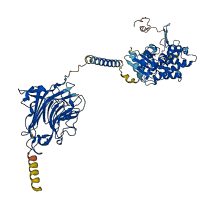
The autoinhibited protein was predicted that may have potential autoinhibitory elements via cis-regPred.
Autoinhibitory domains (AIDs)
Target domain |
|
Relief mechanism |
|
Assay |
cis-regPred |
Accessory elements
489-513 (Activation loop from InterPro)
Target domain |
347-624 (Protein kinase domain) |
Relief mechanism |
|
Assay |
|
Autoinhibited structure

Activated structure
1 structures for O80939
| Entry ID | Method | Resolution | Chain | Position | Source |
|---|---|---|---|---|---|
| AF-O80939-F1 | Predicted | AlphaFoldDB |
47 variants for O80939
| Variant ID(s) | Position | Change | Description | Diseaes Association | Provenance |
|---|---|---|---|---|---|
| ENSVATH01961645 | 7 | T>P | No | 1000Genomes | |
| ENSVATH05673146 | 10 | F>L | No | 1000Genomes | |
| ENSVATH05673145 | 16 | L>I | No | 1000Genomes | |
| ENSVATH01961644 | 17 | I>L | No | 1000Genomes | |
| tmp_2_15816884_G_C | 26 | N>K | No | 1000Genomes | |
| tmp_2_15816862_T_C | 34 | N>D | No | 1000Genomes | |
| tmp_2_15816852_G_A | 37 | T>M | No | 1000Genomes | |
| tmp_2_15816844_A_G | 40 | S>P | No | 1000Genomes | |
| ENSVATH01961641 | 46 | T>N | No | 1000Genomes | |
| ENSVATH00263742 | 49 | P>A | No | 1000Genomes | |
| ENSVATH00263740 | 99 | I>S | No | 1000Genomes | |
| ENSVATH13563622 | 123 | Y>F | No | 1000Genomes | |
| ENSVATH01961639 | 129 | L>F | No | 1000Genomes | |
| ENSVATH01961639 | 129 | L>I | No | 1000Genomes | |
| ENSVATH01961638 | 130 | A>T | No | 1000Genomes | |
| ENSVATH05673143 | 132 | N>D | No | 1000Genomes | |
| ENSVATH05673142 | 134 | N>K | No | 1000Genomes | |
| ENSVATH05673141 | 136 | T>A | No | 1000Genomes | |
| tmp_2_15816538_C_A | 142 | V>F | No | 1000Genomes | |
| ENSVATH00263736 | 148 | L>V | No | 1000Genomes | |
| ENSVATH01961637 | 168 | K>N | No | 1000Genomes | |
| ENSVATH13563621 | 168 | K>T | No | 1000Genomes | |
| ENSVATH00263735 | 179 | D>N | No | 1000Genomes | |
| tmp_2_15816417_C_G | 182 | G>A | No | 1000Genomes | |
| tmp_2_15816408_T_C | 185 | K>R | No | 1000Genomes | |
| tmp_2_15816387_C_A | 192 | R>L | No | 1000Genomes | |
| ENSVATH01961636 | 227 | A>T | No | 1000Genomes | |
| ENSVATH01961635 | 228 | V>I | No | 1000Genomes | |
| ENSVATH13563620 | 267 | A>T | No | 1000Genomes | |
| tmp_2_15816141_C_T | 274 | R>K | No | 1000Genomes | |
| ENSVATH01961634 | 299 | L>Q | No | 1000Genomes | |
| ENSVATH01961633 | 301 | L>F | No | 1000Genomes | |
| ENSVATH01961632 | 302 | I>F | No | 1000Genomes | |
| ENSVATH01961631 | 306 | I>F | No | 1000Genomes | |
| ENSVATH01961631 | 306 | I>V | No | 1000Genomes | |
| ENSVATH13563618 | 381 | E>A | No | 1000Genomes | |
| tmp_2_15815778_C_G | 395 | S>T | No | 1000Genomes | |
| tmp_2_15815685_T_A | 426 | N>I | No | 1000Genomes | |
| ENSVATH00263723 | 482 | G>R | No | 1000Genomes | |
| tmp_2_15815491_A_C | 491 | F>V | No | 1000Genomes | |
| tmp_2_15815316_T_A | 549 | E>V | No | 1000Genomes | |
| ENSVATH00263718 | 552 | Q>H | No | 1000Genomes | |
| tmp_2_15815298_T_G | 555 | D>A | No | 1000Genomes | |
| tmp_2_15815137_G_A | 609 | P>S | No | 1000Genomes | |
| tmp_2_15815127_C_A | 612 | R>I | No | 1000Genomes | |
| ENSVATH01961610 | 641 | V>A | No | 1000Genomes | |
| ENSVATH13563617 | 662 | G>S | No | 1000Genomes |
4 associated diseases with O80939
[MIM: 204000]: Leber congenital amaurosis 1 (LCA1)
A severe dystrophy of the retina, typically becoming evident in the first years of life. Visual function is usually poor and often accompanied by nystagmus, sluggish or near-absent pupillary responses, photophobia, high hyperopia and keratoconus. {ECO:0000269|PubMed:11035546, ECO:0000269|PubMed:12365911, ECO:0000269|PubMed:15123990, ECO:0000269|PubMed:17724218, ECO:0000269|PubMed:21602930, ECO:0000269|PubMed:27475985, ECO:0000269|PubMed:30319355, ECO:0000269|PubMed:8944027, ECO:0000269|PubMed:9888789}. Note=The disease is caused by variants affecting the gene represented in this entry.
[MIM: 601777]: Cone-rod dystrophy 6 (CORD6)
An inherited retinal dystrophy characterized by retinal pigment deposits visible on fundus examination, predominantly in the macular region, and initial loss of cone photoreceptors followed by rod degeneration. This leads to decreased visual acuity and sensitivity in the central visual field, followed by loss of peripheral vision. Severe loss of vision occurs earlier than in retinitis pigmentosa, due to cone photoreceptors degenerating at a higher rate than rod photoreceptors. {ECO:0000269|PubMed:12552567, ECO:0000269|PubMed:15111605, ECO:0000269|PubMed:18332321, ECO:0000269|PubMed:18487367, ECO:0000269|PubMed:20517349, ECO:0000269|PubMed:21552474, ECO:0000269|PubMed:22194653, ECO:0000269|PubMed:23734073, ECO:0000269|PubMed:24480840, ECO:0000269|PubMed:25515582, ECO:0000269|PubMed:27475985, ECO:0000269|PubMed:30319355, ECO:0000269|PubMed:9618177, ECO:0000269|PubMed:9683616}. Note=The disease is caused by variants affecting the gene represented in this entry.
[MIM: 215500]: Choroidal dystrophy, central areolar, 1 (CACD1)
A form of central areolar choroidal dystrophy, a retinal disease that affects the macula and results in a well-demarcated circumscribed area of atrophy of the pigment epithelium and choriocapillaris. CACD1 inheritance is autosomal recessive. {ECO:0000269|PubMed:22695961}. Note=The disease may be caused by variants affecting the gene represented in this entry.
[MIM: 618555]: Night blindness, congenital stationary, 1I (CSNB1I)
A form of congenital stationary night blindness, a non-progressive retinal disorder characterized by impaired night vision or in dim light, with good vision only on bright days. CSNB1I patients present with night blindness from infancy or early childhood. Visual acuity is preserved, but some patients have color vision and/or visual field defects. Progression to mild retinitis pigmentosa may occur. CSNB1I inheritance is autosomal recessive. {ECO:0000269|PubMed:29559409}. Note=The disease is caused by variants affecting the gene represented in this entry.
Without disease ID
- A severe dystrophy of the retina, typically becoming evident in the first years of life. Visual function is usually poor and often accompanied by nystagmus, sluggish or near-absent pupillary responses, photophobia, high hyperopia and keratoconus. {ECO:0000269|PubMed:11035546, ECO:0000269|PubMed:12365911, ECO:0000269|PubMed:15123990, ECO:0000269|PubMed:17724218, ECO:0000269|PubMed:21602930, ECO:0000269|PubMed:27475985, ECO:0000269|PubMed:30319355, ECO:0000269|PubMed:8944027, ECO:0000269|PubMed:9888789}. Note=The disease is caused by variants affecting the gene represented in this entry.
- An inherited retinal dystrophy characterized by retinal pigment deposits visible on fundus examination, predominantly in the macular region, and initial loss of cone photoreceptors followed by rod degeneration. This leads to decreased visual acuity and sensitivity in the central visual field, followed by loss of peripheral vision. Severe loss of vision occurs earlier than in retinitis pigmentosa, due to cone photoreceptors degenerating at a higher rate than rod photoreceptors. {ECO:0000269|PubMed:12552567, ECO:0000269|PubMed:15111605, ECO:0000269|PubMed:18332321, ECO:0000269|PubMed:18487367, ECO:0000269|PubMed:20517349, ECO:0000269|PubMed:21552474, ECO:0000269|PubMed:22194653, ECO:0000269|PubMed:23734073, ECO:0000269|PubMed:24480840, ECO:0000269|PubMed:25515582, ECO:0000269|PubMed:27475985, ECO:0000269|PubMed:30319355, ECO:0000269|PubMed:9618177, ECO:0000269|PubMed:9683616}. Note=The disease is caused by variants affecting the gene represented in this entry.
- A form of central areolar choroidal dystrophy, a retinal disease that affects the macula and results in a well-demarcated circumscribed area of atrophy of the pigment epithelium and choriocapillaris. CACD1 inheritance is autosomal recessive. {ECO:0000269|PubMed:22695961}. Note=The disease may be caused by variants affecting the gene represented in this entry.
- A form of congenital stationary night blindness, a non-progressive retinal disorder characterized by impaired night vision or in dim light, with good vision only on bright days. CSNB1I patients present with night blindness from infancy or early childhood. Visual acuity is preserved, but some patients have color vision and/or visual field defects. Progression to mild retinitis pigmentosa may occur. CSNB1I inheritance is autosomal recessive. {ECO:0000269|PubMed:29559409}. Note=The disease is caused by variants affecting the gene represented in this entry.
3 regional properties for O80939
| Type | Name | Position | InterPro Accession |
|---|---|---|---|
| domain | Cyclin, N-terminal | 36 - 143 | IPR006671 |
| domain | Cyclin-like domain | 41 - 139 | IPR013763-1 |
| domain | Cyclin-like domain | 152 - 231 | IPR013763-2 |
Functions
| Description | ||
|---|---|---|
| EC Number | 2.7.11.1 | Protein-serine/threonine kinases |
| Subcellular Localization |
|
|
| PANTHER Family | ||
| PANTHER Subfamily | ||
| PANTHER Protein Class | ||
| PANTHER Pathway Category | No pathway information available | |
3 GO annotations of cellular component
| Name | Definition |
|---|---|
| endoplasmic reticulum | The irregular network of unit membranes, visible only by electron microscopy, that occurs in the cytoplasm of many eukaryotic cells. The membranes form a complex meshwork of tubular channels, which are often expanded into slitlike cavities called cisternae. The ER takes two forms, rough (or granular), with ribosomes adhering to the outer surface, and smooth (with no ribosomes attached). |
| integral component of membrane | The component of a membrane consisting of the gene products and protein complexes having at least some part of their peptide sequence embedded in the hydrophobic region of the membrane. |
| plasma membrane | The membrane surrounding a cell that separates the cell from its external environment. It consists of a phospholipid bilayer and associated proteins. |
4 GO annotations of molecular function
| Name | Definition |
|---|---|
| ATP binding | Binding to ATP, adenosine 5'-triphosphate, a universally important coenzyme and enzyme regulator. |
| carbohydrate binding | Binding to a carbohydrate, which includes monosaccharides, oligosaccharides and polysaccharides as well as substances derived from monosaccharides by reduction of the carbonyl group (alditols), by oxidation of one or more hydroxy groups to afford the corresponding aldehydes, ketones, or carboxylic acids, or by replacement of one or more hydroxy group(s) by a hydrogen atom. Cyclitols are generally not regarded as carbohydrates. |
| protein serine kinase activity | Catalysis of the reactions: ATP + protein serine = ADP + protein serine phosphate. |
| transmembrane receptor protein serine/threonine kinase activity | Combining with a signal and transmitting the signal from one side of the membrane to the other to initiate a change in cell activity by catalysis of the reaction: ATP protein serine = ADP + protein serine phosphate, and ATP + protein threonine = ADP + protein threonine phosphate. |
4 GO annotations of biological process
| Name | Definition |
|---|---|
| defense response to bacterium | Reactions triggered in response to the presence of a bacterium that act to protect the cell or organism. |
| defense response to oomycetes | Reactions triggered in response to the presence of oomycetes that act to protect the cell or organism. |
| protein phosphorylation | The process of introducing a phosphate group on to a protein. |
| response to salicylic acid | Any process that results in a change in state or activity of a cell or an organism (in terms of movement, secretion, enzyme production, gene expression, etc.) as a result of a salicylic acid stimulus. |
15 homologous proteins in AiPD
| UniProt AC | Gene Name | Protein Name | Species | Evidence Code |
|---|---|---|---|---|
| P46197 | NPR2 | Atrial natriuretic peptide receptor 2 | Bos taurus (Bovine) | PR |
| Q06806 | Tie1 | Tyrosine-protein kinase receptor Tie-1 | Mus musculus (Mouse) | SS |
| Q02858 | Tek | Angiopoietin-1 receptor | Mus musculus (Mouse) | SS |
| P18910 | Npr1 | Atrial natriuretic peptide receptor 1 | Rattus norvegicus (Rat) | PR |
| P51842 | Gucy2f | Retinal guanylyl cyclase 2 | Rattus norvegicus (Rat) | PR |
| P16067 | Npr2 | Atrial natriuretic peptide receptor 2 | Rattus norvegicus (Rat) | PR |
| O81291 | LECRK44 | L-type lectin-domain containing receptor kinase IV.4 | Arabidopsis thaliana (Mouse-ear cress) | PR |
| O81292 | LECRK43 | L-type lectin-domain containing receptor kinase IV.3 | Arabidopsis thaliana (Mouse-ear cress) | PR |
| Q9M1G4 | LECRK15 | Probable L-type lectin-domain containing receptor kinase I.5 | Arabidopsis thaliana (Mouse-ear cress) | PR |
| Q9M345 | LECRK42 | L-type lectin-domain containing receptor kinase IV.2 | Arabidopsis thaliana (Mouse-ear cress) | PR |
| Q9STF0 | LECRKS3 | Receptor like protein kinase S.3 | Arabidopsis thaliana (Mouse-ear cress) | PR |
| Q9M2S4 | LECRKS4 | L-type lectin-domain containing receptor kinase S.4 | Arabidopsis thaliana (Mouse-ear cress) | PR |
| Q96285 | LECRK55 | L-type lectin-domain containing receptor kinase V.5 | Arabidopsis thaliana (Mouse-ear cress) | PR |
| Q9FG33 | LECRKS5 | Probable L-type lectin-domain containing receptor kinase S.5 | Arabidopsis thaliana (Mouse-ear cress) | PR |
| Q9LSR8 | LECRK19 | L-type lectin-domain containing receptor kinase I.9 | Arabidopsis thaliana (Mouse-ear cress) | PR |
| 10 | 20 | 30 | 40 | 50 | 60 |
| MFLKLLTIFF | FFFFNLIFQS | SSQSLNFAYN | NGFNPPTDLS | IQGITTVTPN | GLLKLTNTTV |
| 70 | 80 | 90 | 100 | 110 | 120 |
| QKTGHAFYTK | PIRFKDSPNG | TVSSFSTSFV | FAIHSQIAIL | SGHGIAFVVA | PNASLPYGNP |
| 130 | 140 | 150 | 160 | 170 | 180 |
| SQYIGLFNLA | NNGNETNHVF | AVELDTILST | EFNDTNDNHV | GIDINSLKSV | QSSPAGYWDE |
| 190 | 200 | 210 | 220 | 230 | 240 |
| KGQFKNLTLI | SRKPMQVWVD | YDGRTNKIDV | TMAPFNEDKP | TRPLVTAVRD | LSSVLLQDMY |
| 250 | 260 | 270 | 280 | 290 | 300 |
| VGFSSATGSV | LSEHYILGWS | FGLNEKAPPL | ALSRLPKLPR | FEPKRISEFY | KIGMPLISLF |
| 310 | 320 | 330 | 340 | 350 | 360 |
| LIFSFIFLVC | YIVRRRRKFA | EELEEWEKEF | GKNRFRFKDL | YYATKGFKEK | GLLGTGGFGS |
| 370 | 380 | 390 | 400 | 410 | 420 |
| VYKGVMPGTK | LEIAVKRVSH | ESRQGMKEFV | AEIVSIGRMS | HRNLVPLLGY | CRRRGELLLV |
| 430 | 440 | 450 | 460 | 470 | 480 |
| YDYMPNGSLD | KYLYNTPEVT | LNWKQRIKVI | LGVASGLFYL | HEEWEQVVIH | RDVKASNVLL |
| 490 | 500 | 510 | 520 | 530 | 540 |
| DGELNGRLGD | FGLARLYDHG | SDPQTTHVVG | TLGYLAPEHT | RTGRATMATD | VFAFGAFLLE |
| 550 | 560 | 570 | 580 | 590 | 600 |
| VACGRRPIEF | QQETDETFLL | VDWVFGLWNK | GDILAAKDPN | MGSECDEKEV | EMVLKLGLLC |
| 610 | 620 | 630 | 640 | 650 | 660 |
| SHSDPRARPS | MRQVLHYLRG | DAKLPELSPL | DLSGSGMMFG | VHDGFSELGM | SYSSSVFKGF |
| 670 | |||||
| TGGSSIADSQ | LSGGR |