Q9JM53
Gene name |
Aifm1 (Aif, Pdcd8) |
Protein name |
Apoptosis-inducing factor 1, mitochondrial |
Names |
Programmed cell death protein 8 |
Species |
Rattus norvegicus (Rat) |
KEGG Pathway |
rno:83533 |
EC number |
|
Protein Class |
|
Descriptions
The autoinhibited protein was predicted that may have potential autoinhibitory elements via cis-regPred.
Autoinhibitory domains (AIDs)
Target domain |
|
Relief mechanism |
|
Assay |
cis-regPred |
Accessory elements
No accessory elements
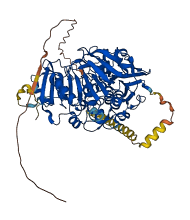
Autoinhibited structure

Activated structure
1 structures for Q9JM53
| Entry ID | Method | Resolution | Chain | Position | Source |
|---|---|---|---|---|---|
| AF-Q9JM53-F1 | Predicted | AlphaFoldDB |
1 variants for Q9JM53
| Variant ID(s) | Position | Change | Description | Diseaes Association | Provenance |
|---|---|---|---|---|---|
| rs8151193 | 576 | V>L | No | EVA |
No associated diseases with Q9JM53
1 regional properties for Q9JM53
| Type | Name | Position | InterPro Accession |
|---|---|---|---|
| domain | Anaphase-promoting complex subunit 4, long domain | 225 - 407 | IPR024790 |
Functions
7 GO annotations of cellular component
| Name | Definition |
|---|---|
| cytoplasm | The contents of a cell excluding the plasma membrane and nucleus, but including other subcellular structures. |
| cytosol | The part of the cytoplasm that does not contain organelles but which does contain other particulate matter, such as protein complexes. |
| mitochondrial inner membrane | The inner, i.e. lumen-facing, lipid bilayer of the mitochondrial envelope. It is highly folded to form cristae. |
| mitochondrial intermembrane space | The region between the inner and outer lipid bilayers of the mitochondrial envelope. |
| mitochondrion | A semiautonomous, self replicating organelle that occurs in varying numbers, shapes, and sizes in the cytoplasm of virtually all eukaryotic cells. It is notably the site of tissue respiration. |
| nucleus | A membrane-bounded organelle of eukaryotic cells in which chromosomes are housed and replicated. In most cells, the nucleus contains all of the cell's chromosomes except the organellar chromosomes, and is the site of RNA synthesis and processing. In some species, or in specialized cell types, RNA metabolism or DNA replication may be absent. |
| perinuclear region of cytoplasm | Cytoplasm situated near, or occurring around, the nucleus. |
7 GO annotations of molecular function
| Name | Definition |
|---|---|
| DNA binding | Any molecular function by which a gene product interacts selectively and non-covalently with DNA (deoxyribonucleic acid). |
| FAD binding | Binding to the oxidized form, FAD, of flavin-adenine dinucleotide, the coenzyme or the prosthetic group of various flavoprotein oxidoreductase enzymes. |
| NAD(P)H oxidase H2O2-forming activity | Catalysis of the reaction: NAD(P)H + H+ + O2 = NAD(P)+ + hydrogen peroxide. |
| NADH dehydrogenase activity | Catalysis of the reaction: NADH + H+ + acceptor = NAD+ + reduced acceptor. |
| oxidoreductase activity, acting on NAD(P)H | Catalysis of an oxidation-reduction (redox) reaction in which NADH or NADPH acts as a hydrogen or electron donor and reduces a hydrogen or electron acceptor. |
| poly-ADP-D-ribose binding | Binding to polymeric ADP-D-ribose, a polymer that is composed of poly-ADP-D-ribose units linked through 1,2-glycosidic bonds at the ribose ring. |
| protein dimerization activity | The formation of a protein dimer, a macromolecular structure consists of two noncovalently associated identical or nonidentical subunits. |
20 GO annotations of biological process
| Name | Definition |
|---|---|
| activation of cysteine-type endopeptidase activity involved in apoptotic process | Any process that initiates the activity of the inactive enzyme cysteine-type endopeptidase in the context of an apoptotic process. |
| apoptotic process | A programmed cell death process which begins when a cell receives an internal (e.g. DNA damage) or external signal (e.g. an extracellular death ligand), and proceeds through a series of biochemical events (signaling pathway phase) which trigger an execution phase. The execution phase is the last step of an apoptotic process, and is typically characterized by rounding-up of the cell, retraction of pseudopodes, reduction of cellular volume (pyknosis), chromatin condensation, nuclear fragmentation (karyorrhexis), plasma membrane blebbing and fragmentation of the cell into apoptotic bodies. When the execution phase is completed, the cell has died. |
| cellular response to aldosterone | Any process that results in a change in state or activity of a cell (in terms of movement, secretion, enzyme production, gene expression, etc.) as a result of an aldosterone stimulus. |
| cellular response to estradiol stimulus | Any process that results in a change in state or activity of a cell (in terms of movement, secretion, enzyme production, gene expression, etc.) as a result of stimulus by estradiol, a C18 steroid hormone hydroxylated at C3 and C17 that acts as a potent estrogen. |
| cellular response to hydrogen peroxide | Any process that results in a change in state or activity of a cell (in terms of movement, secretion, enzyme production, gene expression, etc.) as a result of a hydrogen peroxide (H2O2) stimulus. |
| cellular response to nitric oxide | Any process that results in a change in state or activity of a cell (in terms of movement, secretion, enzyme production, gene expression, etc.) as a result of a nitric oxide stimulus. |
| cellular response to oxygen-glucose deprivation | Any process that results in a change in state or activity of a cell (in terms of movement, secretion, enzyme production, gene expression, etc.) as a result of the deprivation of oxygen and glucose. |
| intrinsic apoptotic signaling pathway in response to endoplasmic reticulum stress | The series of molecular signals in which an intracellular signal is conveyed to trigger the apoptotic death of a cell. The pathway is induced in response to a stimulus indicating endoplasmic reticulum (ER) stress, and ends when the execution phase of apoptosis is triggered. ER stress usually results from the accumulation of unfolded or misfolded proteins in the ER lumen. |
| mitochondrial respiratory chain complex assembly | The aggregation, arrangement and bonding together of a set of components to form a mitochondrial respiratory chain complex. |
| mitochondrial respiratory chain complex I assembly | The aggregation, arrangement and bonding together of a set of components to form mitochondrial respiratory chain complex I. |
| neuron apoptotic process | Any apoptotic process in a neuron, the basic cellular unit of nervous tissue. Each neuron consists of a body, an axon, and dendrites. Their purpose is to receive, conduct, and transmit impulses in the nervous system. |
| positive regulation of cell death | Any process that increases the rate or frequency of cell death. Cell death is the specific activation or halting of processes within a cell so that its vital functions markedly cease, rather than simply deteriorating gradually over time, which culminates in cell death. |
| positive regulation of necroptotic process | Any process that increases the rate, frequency or extent of a necroptotic process, a necrotic cell death process that results from the activation of endogenous cellular processes, such as signaling involving death domain receptors or Toll-like receptors. |
| positive regulation of neuron apoptotic process | Any process that activates or increases the frequency, rate or extent of cell death of neurons by apoptotic process. |
| programmed cell death | A process which begins when a cell receives an internal or external signal and activates a series of biochemical events (signaling pathway). The process ends with the death of the cell. |
| protein import into mitochondrial intermembrane space | The import of proteins into the space between the inner and outer mitochondrial membranes. |
| regulation of apoptotic DNA fragmentation | Any process that modulates the frequency, rate or extent of apoptotic DNA fragmentation. |
| response to ischemia | Any process that results in a change in state or activity of an organism (in terms of movement, secretion, enzyme production, gene expression, etc.) as a result of a inadequate blood supply. |
| response to L-glutamate | Any process that results in a change in state or activity of a cell or an organism (in terms of movement, secretion, enzyme production, gene expression, etc.) as a result of an L-glutamate stimulus. |
| response to toxic substance | Any process that results in a change in state or activity of a cell or an organism (in terms of movement, secretion, enzyme production, gene expression, etc.) as a result of a toxic stimulus. |
5 homologous proteins in AiPD
| UniProt AC | Gene Name | Protein Name | Species | Evidence Code |
|---|---|---|---|---|
| Q96NN9 | AIFM3 | Apoptosis-inducing factor 3 | Homo sapiens (Human) | PR |
| O95831 | AIFM1 | Apoptosis-inducing factor 1, mitochondrial | Homo sapiens (Human) | PR |
| Q3TY86 | Aifm3 | Apoptosis-inducing factor 3 | Mus musculus (Mouse) | PR |
| Q9Z0X1 | Aifm1 | Apoptosis-inducing factor 1, mitochondrial | Mus musculus (Mouse) | PR |
| Q93WJ8 | MDAR2 | Monodehydroascorbate reductase 2 | Arabidopsis thaliana (Mouse-ear cress) | PR |
| 10 | 20 | 30 | 40 | 50 | 60 |
| MFRCGGLAGA | FKQKLVPLVR | SVCVQRPKQR | NRLPGNLFQQ | WRVPLELQMA | RQMASSGPSG |
| 70 | 80 | 90 | 100 | 110 | 120 |
| GKMDNSVLVL | IVGLSTIGAG | AYAYKTIKED | QKRYNERIMG | LGLSPEEKQR | RAIASAAEGG |
| 130 | 140 | 150 | 160 | 170 | 180 |
| SVPPIRVPSH | VPFLLIGGGT | AAFAAARSIR | ARDPGARVLI | VSEDPELPYM | RPPLSKELWF |
| 190 | 200 | 210 | 220 | 230 | 240 |
| SDDPNVTKTL | QFRQWNGKER | SIYFQPPSFY | VSAQDLPHIE | NGGVAVLTGK | KVVHLDVRGN |
| 250 | 260 | 270 | 280 | 290 | 300 |
| MVKLNDGSQI | TFEKCLIATG | GTPRSLSAID | RAGAEVKSRT | TLFRKIGDFR | ALEKISREVK |
| 310 | 320 | 330 | 340 | 350 | 360 |
| SITVIGGGFL | GSELACALGR | KSQASGIEVI | QLFPEKGNMG | KILPEYLSNW | TMEKVKREGV |
| 370 | 380 | 390 | 400 | 410 | 420 |
| KVMPNAIVQS | VGVSGGKLLI | KLKDGRKVET | DHIVTAVGLE | PNVELAKTGG | LEIDSDFGGF |
| 430 | 440 | 450 | 460 | 470 | 480 |
| RVNAELQARS | NIWVAGDAAC | FYDIKLGRRR | VEHHDHAVVS | GRLAGENMTG | AAKPYWHQSM |
| 490 | 500 | 510 | 520 | 530 | 540 |
| FWSDLGPDVG | YEAIGLVDSS | LPTVGVFAKA | TAQDNPKSAT | EQSGTGIRSE | SETESEASEI |
| 550 | 560 | 570 | 580 | 590 | 600 |
| TIPPSDPAVP | QVPVEGEDYG | KGVIFYLRDK | VVVGIVLWNV | FNRMPIARKI | IKDGEQHEDL |
| 610 | |||||
| NEVAKLFNIH | ED |