Q9JLJ5
Gene name |
Elovl1 |
Protein name |
Elongation of very long chain fatty acids protein 1 |
Names |
3-keto acyl-CoA synthase Elovl1, ELOVL fatty acid elongase 1, ELOVL FA elongase 1, Very long chain 3-ketoacyl-CoA synthase 1, Very long chain 3-oxoacyl-CoA synthase 1 |
Species |
Mus musculus (Mouse) |
KEGG Pathway |
mmu:54325 |
EC number |
2.3.1.199: Transferring groups other than amino-acyl groups |
Protein Class |
|
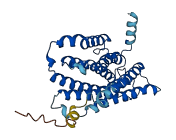
Descriptions
The autoinhibited protein was predicted that may have potential autoinhibitory elements via cis-regPred.
Autoinhibitory domains (AIDs)
Target domain |
|
Relief mechanism |
|
Assay |
cis-regPred |
Accessory elements
No accessory elements
Autoinhibited structure

Activated structure
1 structures for Q9JLJ5
| Entry ID | Method | Resolution | Chain | Position | Source |
|---|---|---|---|---|---|
| AF-Q9JLJ5-F1 | Predicted | AlphaFoldDB |
14 variants for Q9JLJ5
| Variant ID(s) | Position | Change | Description | Diseaes Association | Provenance |
|---|---|---|---|---|---|
| rs3394752545 | 27 | S>P | No | EVA | |
| rs239353338 | 40 | Y>C | No | EVA | |
| rs3394734626 | 53 | R>W | No | EVA | |
| rs3388691761 | 66 | N>K | No | EVA | |
| rs3388699065 | 81 | L>Q | No | EVA | |
| rs3394811913 | 102 | P>L | No | EVA | |
| rs3388702128 | 110 | V>M | No | EVA | |
| rs3388705862 | 125 | T>I | No | EVA | |
| rs3388701004 | 148 | L>F | No | EVA | |
| rs3388704466 | 165 | S>A | No | EVA | |
| rs3388707284 | 178 | M>K | No | EVA | |
| rs3388707292 | 240 | G>D | No | EVA | |
| rs3388707349 | 276 | V>I | No | EVA | |
| rs3388706233 | 277 | K>N | No | EVA |
No associated diseases with Q9JLJ5
4 regional properties for Q9JLJ5
| Type | Name | Position | InterPro Accession |
|---|---|---|---|
| domain | RNA recognition motif domain | 225 - 302 | IPR000504-1 |
| domain | RNA recognition motif domain | 326 - 406 | IPR000504-2 |
| domain | RNA recognition motif domain | 446 - 521 | IPR000504-3 |
| domain | ESRP1, RNA recognition motif 1 | 216 - 308 | IPR034427 |
Functions
| Description | ||
|---|---|---|
| EC Number | 2.3.1.199 | Transferring groups other than amino-acyl groups |
| Subcellular Localization |
|
|
| PANTHER Family | ||
| PANTHER Subfamily | ||
| PANTHER Protein Class | ||
| PANTHER Pathway Category | No pathway information available | |
2 GO annotations of cellular component
| Name | Definition |
|---|---|
| endoplasmic reticulum | The irregular network of unit membranes, visible only by electron microscopy, that occurs in the cytoplasm of many eukaryotic cells. The membranes form a complex meshwork of tubular channels, which are often expanded into slitlike cavities called cisternae. The ER takes two forms, rough (or granular), with ribosomes adhering to the outer surface, and smooth (with no ribosomes attached). |
| integral component of endoplasmic reticulum membrane | The component of the endoplasmic reticulum membrane consisting of the gene products and protein complexes having at least some part of their peptide sequence embedded in the hydrophobic region of the membrane. |
4 GO annotations of molecular function
| Name | Definition |
|---|---|
| 3-oxo-cerotoyl-CoA synthase activity | Catalysis of the reaction: tetracosanoyl-CoA(4-) + malonyl-CoA(5-) + H+ <=> 3-oxohexacosanoyl-CoA + carbon dioxide + coenzyme A. |
| 3-oxo-lignoceronyl-CoA synthase activity | Catalysis of the reaction: behenoyl-CoA(4-) + malonyl-CoA(5-) + H+ <=> 3-oxotetracosanoyl-CoA. + carbon dioxide + coenzyme A. |
| fatty acid elongase activity | Catalysis of the reaction: fatty acid (C-16 or longer) + 2-C = fatty acid (C-16 or longer + 2-C). |
| very-long-chain 3-ketoacyl-CoA synthase activity | Catalysis of the reaction: malonyl-CoA + a very-long-chain 2,3,4-saturated fatty acyl CoA = carbon dioxide + coenzyme A + a very-long-chain oxoacyl-CoA. |
9 GO annotations of biological process
| Name | Definition |
|---|---|
| ceramide biosynthetic process | The chemical reactions and pathways resulting in the formation of ceramides, any N-acylated sphingoid. |
| establishment of skin barrier | Establishment of the epithelial barrier, the functional barrier in the skin that limits its permeability. |
| fatty acid elongation, monounsaturated fatty acid | Elongation of a fatty acid chain into which one C-C double bond has been introduced. |
| fatty acid elongation, polyunsaturated fatty acid | Elongation of a fatty acid chain into which two or more C-C double bonds have been introduced. |
| fatty acid elongation, saturated fatty acid | Elongation of a saturated fatty acid chain. |
| long-chain fatty-acyl-CoA biosynthetic process | The chemical reactions and pathways resulting in the formation of a long-chain fatty-acyl-CoA any derivative of coenzyme A in which the sulfhydryl group is in a thioester linkage with a long-chain fatty-acyl group. Long-chain fatty-acyl-CoAs have chain lengths of C13 or more. |
| sphingolipid biosynthetic process | The chemical reactions and pathways resulting in the formation of sphingolipids, any of a class of lipids containing the long-chain amine diol sphingosine or a closely related base (a sphingoid). |
| unsaturated fatty acid biosynthetic process | The chemical reactions and pathways resulting in the formation of an unsaturated fatty acid, any fatty acid containing one or more double bonds between carbon atoms. |
| very long-chain fatty acid biosynthetic process | The chemical reactions and pathways resulting in the formation of a fatty acid which has a chain length greater than C22. |
4 homologous proteins in AiPD
| UniProt AC | Gene Name | Protein Name | Species | Evidence Code |
|---|---|---|---|---|
| A1L3X0 | ELOVL7 | Elongation of very long chain fatty acids protein 7 | Homo sapiens (Human) | PR |
| Q9BW60 | ELOVL1 | Elongation of very long chain fatty acids protein 1 | Homo sapiens (Human) | PR |
| Q9D2Y9 | Elovl7 | Elongation of very long chain fatty acids protein 7 | Mus musculus (Mouse) | PR |
| Q3S8M4 | ELOVL4 | Elongation of very long chain fatty acids protein 4 | Macaca mulatta (Rhesus macaque) | PR |
| 10 | 20 | 30 | 40 | 50 | 60 |
| MEAVVNLYHE | LMKHADPRIQ | SYPLMGSPLL | ITSILLTYVY | FILSLGPRIM | ANRKPFQLRG |
| 70 | 80 | 90 | 100 | 110 | 120 |
| FMIVYNFSLV | ILSLYIVYEF | LMSGWLSTYT | WRCDPIDFSN | SPEALRMVRV | AWLFMLSKVI |
| 130 | 140 | 150 | 160 | 170 | 180 |
| ELMDTVIFIL | RKKDGQVTFL | HVFHHSVLPW | SWWWGIKIAP | GGMGSFHAMI | NSSVHVVMYL |
| 190 | 200 | 210 | 220 | 230 | 240 |
| YYGLSALGPV | AQPYLWWKKH | MTAIQLIQFV | LVSLHISQYY | FMPSCNYQYP | IIIHLIWMYG |
| 250 | 260 | 270 | |||
| TIFFILFSNF | WYHSYTKGKR | LPRAVQQNGA | PATTKVKAN |