Q9JKV1
Gene name |
Adrm1 (Gp110) |
Protein name |
Proteasomal ubiquitin receptor ADRM1 |
Names |
110 kDa cell membrane glycoprotein, Gp110, Adhesion-regulating molecule 1, ARM-1, Rpn13 homolog |
Species |
Mus musculus (Mouse) |
KEGG Pathway |
mmu:56436 |
EC number |
|
Protein Class |
|
Descriptions
The autoinhibited protein was predicted that may have potential autoinhibitory elements via cis-regPred.
Autoinhibitory domains (AIDs)
Target domain |
|
Relief mechanism |
|
Assay |
cis-regPred |
Accessory elements
No accessory elements
Autoinhibited structure

Activated structure
3 structures for Q9JKV1
| Entry ID | Method | Resolution | Chain | Position | Source |
|---|---|---|---|---|---|
| 2R2Y | X-ray | 170 A | A | 2-150 | PDB |
| 2Z59 | NMR | - | A | 22-130 | PDB |
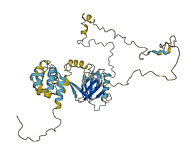
| AF-Q9JKV1-F1 | Predicted | AlphaFoldDB |
8 variants for Q9JKV1
| Variant ID(s) | Position | Change | Description | Diseaes Association | Provenance |
|---|---|---|---|---|---|
| rs3388618222 | 141 | G>E | No | EVA | |
| rs3388618199 | 153 | E>D | No | EVA | |
| rs244806823 | 221 | S>T | No | EVA | |
| rs3388615252 | 233 | A>S | No | EVA | |
| rs3388618417 | 234 | P>T | No | EVA | |
| rs3388612220 | 270 | I>V | No | EVA | |
| rs1135215537 | 327 | I>S | No | EVA | |
| rs3388612230 | 388 | D>E | No | EVA |
No associated diseases with Q9JKV1
1 regional properties for Q9JKV1
| Type | Name | Position | InterPro Accession |
|---|---|---|---|
| domain | GPCR, rhodopsin-like, 7TM | 43 - 285 | IPR017452 |
5 GO annotations of cellular component
| Name | Definition |
|---|---|
| cytosol | The part of the cytoplasm that does not contain organelles but which does contain other particulate matter, such as protein complexes. |
| nucleoplasm | That part of the nuclear content other than the chromosomes or the nucleolus. |
| plasma membrane | The membrane surrounding a cell that separates the cell from its external environment. It consists of a phospholipid bilayer and associated proteins. |
| proteasome complex | A large multisubunit complex which catalyzes protein degradation, found in eukaryotes, archaea and some bacteria. In eukaryotes, this complex consists of the barrel shaped proteasome core complex and one or two associated proteins or complexes that act in regulating entry into or exit from the core. |
| proteasome regulatory particle, lid subcomplex | The subcomplex of the proteasome regulatory particle that forms the peripheral lid, which is added on top of the base subcomplex. |
4 GO annotations of molecular function
| Name | Definition |
|---|---|
| endopeptidase activator activity | Binds to and increases the activity of an endopeptidase, any enzyme that hydrolyzes nonterminal peptide bonds in polypeptides. |
| protease binding | Binding to a protease or a peptidase. |
| proteasome binding | Binding to a proteasome, a large multisubunit protein complex that catalyzes protein degradation. |
| ubiquitin binding | Binding to ubiquitin, a protein that when covalently bound to other cellular proteins marks them for proteolytic degradation. |
13 GO annotations of biological process
| Name | Definition |
|---|---|
| adipose tissue development | The process whose specific outcome is the progression of adipose tissue over time, from its formation to the mature structure. Adipose tissue is specialized tissue that is used to store fat. |
| follicle-stimulating hormone signaling pathway | A G protein-coupled receptor signaling pathway initiated by follicle-stimulating hormone binding to its receptor on the surface of a target cell, and ending with the regulation of a downstream cellular process. |
| oogenesis | The complete process of formation and maturation of an ovum or female gamete from a primordial female germ cell. Examples of this process are found in Mus musculus and Drosophila melanogaster. |
| ovarian follicle development | The process whose specific outcome is the progression of the ovarian follicle over time, from its formation to the mature structure. |
| positive regulation of growth hormone receptor signaling pathway | Any process that increases the rate, frequency or extent of the growth hormone receptor signaling pathway. The growth hormone receptor signaling pathway is the series of molecular signals generated as a consequence of growth hormone receptor binding to its physiological ligand. |
| proteasome assembly | The aggregation, arrangement and bonding together of a mature, active proteasome complex. |
| regulation of T cell differentiation in thymus | Any process that modulates the frequency, rate or extent of T cell differentiation in the thymus. |
| seminiferous tubule development | The reproductive developmental process whose specific outcome is the progression of the seminiferous tubule over time, from its formation to the mature structure. Seminiferous tubules are ducts located in the testicles, and are the specific location of meiosis, and the subsequent creation of gametes, namely spermatozoa. |
| Sertoli cell development | The process whose specific outcome is the progression of a Sertoli cell over time, from its formation to the mature structure. Cell development does not include the steps involved in committing a cell to a Sertoli cell fate. |
| spermatid development | The process whose specific outcome is the progression of a spermatid over time, from its formation to the mature structure. |
| thymus development | The process whose specific outcome is the progression of the thymus over time, from its formation to the mature structure. The thymus is a symmetric bi-lobed organ involved primarily in the differentiation of immature to mature T cells, with unique vascular, nervous, epithelial, and lymphoid cell components. |
| transcription elongation by RNA polymerase II promoter | The extension of an RNA molecule after transcription initiation and promoter clearance at an RNA polymerase II promoter by the addition of ribonucleotides catalyzed by RNA polymerase II. |
| ubiquitin-dependent protein catabolic process | The chemical reactions and pathways resulting in the breakdown of a protein or peptide by hydrolysis of its peptide bonds, initiated by the covalent attachment of a ubiquitin group, or multiple ubiquitin groups, to the protein. |
| 10 | 20 | 30 | 40 | 50 | 60 |
| MTTSGALFPS | LVPGSRGSST | KYLVEFRAGK | MSLKGTTVTP | DKRKGLVYIQ | QTDDSLIHFC |
| 70 | 80 | 90 | 100 | 110 | 120 |
| WKDRTSGTVE | DDLIIFPDDC | EFKRVPQCPS | GRVYVLKFKA | GSKRLFFWMQ | EPKTDQDEEH |
| 130 | 140 | 150 | 160 | 170 | 180 |
| CRKVNECLNN | PPMPGSLGAS | GSSGHELSAL | GGEGGLQSLL | GNMSHSQLMQ | LIGPAGLGGL |
| 190 | 200 | 210 | 220 | 230 | 240 |
| GGLGALTGPG | LASLLGSSGP | PASSSSSSSR | SQSAAVTPSS | STSSARATPA | PSAPAAASAT |
| 250 | 260 | 270 | 280 | 290 | 300 |
| SPSPAPSSGN | GTSTAASPTQ | PIQLSDLQSI | LATMNVPAGP | GGSQQVDLAS | VLTPEIMAPI |
| 310 | 320 | 330 | 340 | 350 | 360 |
| LANADVQERL | LPYLPSGESL | PQTADEIQNT | LTSPQFQQAL | GMFSAALASG | QLGPLMCQFG |
| 370 | 380 | 390 | 400 | ||
| LPAEAVEAAN | KGDVEAFAKA | MQNNAKSDPK | EGDTKDKKDE | EEDMSLD |