Q9JJV4
Gene name |
Cacng4 |
Protein name |
Voltage-dependent calcium channel gamma-4 subunit |
Names |
Neuronal voltage-gated calcium channel gamma-4 subunit, Transmembrane AMPAR regulatory protein gamma-4, TARP gamma-4 |
Species |
Mus musculus (Mouse) |
KEGG Pathway |
mmu:54377 |
EC number |
|
Protein Class |
|
Descriptions
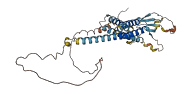
The autoinhibited protein was predicted that may have potential autoinhibitory elements via cis-regPred.
Autoinhibitory domains (AIDs)
Target domain |
|
Relief mechanism |
|
Assay |
cis-regPred |
Accessory elements
No accessory elements
Autoinhibited structure

Activated structure
1 structures for Q9JJV4
| Entry ID | Method | Resolution | Chain | Position | Source |
|---|---|---|---|---|---|
| AF-Q9JJV4-F1 | Predicted | AlphaFoldDB |
13 variants for Q9JJV4
| Variant ID(s) | Position | Change | Description | Diseaes Association | Provenance |
|---|---|---|---|---|---|
| rs3389174705 | 108 | S>N | No | EVA | |
| rs3389174757 | 115 | T>A | No | EVA | |
| rs3389214589 | 171 | R>S | No | EVA | |
| rs3389182653 | 180 | N>K | No | EVA | |
| rs3389222080 | 208 | E>G | No | EVA | |
| rs3389186362 | 217 | T>I | No | EVA | |
| rs3389216167 | 246 | S>C | No | EVA | |
| rs3389210990 | 255 | S>P | No | EVA | |
| rs3389212336 | 274 | L>M | No | EVA | |
| rs3389222073 | 278 | T>R | No | EVA | |
| rs3389174712 | 299 | G>D | No | EVA | |
| rs3389216158 | 316 | H>R | No | EVA | |
| rs3389212267 | 324 | T>K | No | EVA |
No associated diseases with Q9JJV4
No regional properties for Q9JJV4
| Type | Name | Position | InterPro Accession |
|---|---|---|---|
| No domain, repeats, and functional sites for Q9JJV4 | |||
9 GO annotations of cellular component
| Name | Definition |
|---|---|
| AMPA glutamate receptor complex | An assembly of four or five subunits which form a structure with an extracellular N-terminus and a large loop that together form the ligand binding domain. The C-terminus is intracellular. The ionotropic glutamate receptor complex itself acts as a ligand gated ion channel; on binding glutamate, charged ions pass through a channel in the center of the receptor complex. The AMPA receptors mediate fast synaptic transmission in the CNS and are composed of subunits GluR1-4, products from separate genes. These subunits have an extracellular N-terminus and an intracellular C-terminus. |
| cell body | The portion of a cell bearing surface projections such as axons, dendrites, cilia, or flagella that includes the nucleus, but excludes all cell projections. |
| cell surface | The external part of the cell wall and/or plasma membrane. |
| glutamatergic synapse | A synapse that uses glutamate as a neurotransmitter. |
| integral component of postsynaptic density membrane | The component of the postsynaptic density membrane consisting of the gene products and protein complexes having at least some part of their peptide sequence embedded in the hydrophobic region of the membrane. |
| L-type voltage-gated calcium channel complex | A type of voltage-dependent calcium channel responsible for excitation-contraction coupling of skeletal, smooth, and cardiac muscle. 'L' stands for 'long-lasting' referring to the length of activation. |
| postsynaptic density | An electron dense network of proteins within and adjacent to the postsynaptic membrane of an asymmetric, neuron-neuron synapse. Its major components include neurotransmitter receptors and the proteins that spatially and functionally organize them such as anchoring and scaffolding molecules, signaling enzymes and cytoskeletal components. |
| postsynaptic density membrane | The membrane component of the postsynaptic density. This is the region of the postsynaptic membrane in which the population of neurotransmitter receptors involved in synaptic transmission are concentrated. |
| somatodendritic compartment | The region of a neuron that includes the cell body (cell soma) and dendrite(s), but excludes the axon. |
4 GO annotations of molecular function
| Name | Definition |
|---|---|
| calcium channel regulator activity | Modulates the activity of a calcium channel. |
| channel regulator activity | Bonds to and modulates the activity of a channel. A channel catalyzes energy-independent facilitated diffusion, mediated by passage of a solute through a transmembrane aqueous pore or channel. |
| ionotropic glutamate receptor binding | Binding to an ionotropic glutamate receptor. Ionotropic glutamate receptors bind glutamate and exert an effect through the regulation of ion channels. |
| voltage-gated calcium channel activity | Enables the transmembrane transfer of a calcium ion by a voltage-gated channel. A voltage-gated channel is a channel whose open state is dependent on the voltage across the membrane in which it is embedded. |
9 GO annotations of biological process
| Name | Definition |
|---|---|
| neurotransmitter receptor internalization | A receptor-mediated endocytosis process that results in the internalization of a neurotransmitter receptor. |
| neurotransmitter receptor transport, postsynaptic endosome to lysosome | The directed movement of neurotransmitter receptor from the postsynaptic endosome in tranpsort vesicles to the lysosome for degradation. |
| positive regulation of AMPA receptor activity | Any process that activates or increases the frequency, rate or extent of AMPA selective glutamate receptor activity. |
| positive regulation of synaptic transmission, glutamatergic | Any process that activates, maintains or increases the frequency, rate or extent of glutamatergic synaptic transmission, the process of communication from a neuron to another neuron across a synapse using the neurotransmitter glutamate. |
| postsynaptic neurotransmitter receptor diffusion trapping | The process by which diffusing neurotransmitter receptor becomes trapped at the postsynaptic specialization membrane. This is typically due to interaction with components of the post-synaptic specialization. |
| regulation of AMPA receptor activity | Any process that modulates the frequency, rate or extent of AMPA selective glutamate receptor activity. |
| regulation of postsynaptic neurotransmitter receptor activity | Any process that modulates the frequency, rate or extent of neurotransmitter receptor activity involved in synaptic transmission. Modulation may be via an effect on ligand affinity, or effector funtion such as ion selectivity or pore opening/closing in ionotropic receptors. |
| response to cocaine | Any process that results in a change in state or activity of a cell or an organism (in terms of movement, secretion, enzyme production, gene expression, etc.) as a result of a cocaine stimulus. Cocaine is a crystalline alkaloid obtained from the leaves of the coca plant. |
| transmission of nerve impulse | The neurological system process in which a signal is transmitted through the nervous system by a combination of action potential propagation and synaptic transmission. |
| 10 | 20 | 30 | 40 | 50 | 60 |
| MVRCDRGLQM | LLTTAGAFAA | FSLMAIAIGT | DYWLYSSAHI | CNGTNLTMDD | GPPPRRARGD |
| 70 | 80 | 90 | 100 | 110 | 120 |
| LTHSGLWRVC | CIEGIYRGHC | FRINHFPEDN | DYDHDSSEYL | LRIVRASSVF | PILSTILLLL |
| 130 | 140 | 150 | 160 | 170 | 180 |
| GGLCIGAGRI | YSRKNNIVLS | AGILFVAAGL | SNIIGIIVYI | SSNTGDPSDK | RDEDKKNHYN |
| 190 | 200 | 210 | 220 | 230 | 240 |
| YGWSFYFGAL | SFIVAETVGV | LAVNIYIEKN | KELRFKTKRE | FLKASSSSPY | ARMPSYRYRR |
| 250 | 260 | 270 | 280 | 290 | 300 |
| RRSRSSSRST | EASPSRDASP | VGLKITGAIP | MGELSMYTLS | REPLKVTTAA | SYSPDQDAGF |
| 310 | 320 | ||||
| LQMHDFFQQD | LKEGFHVSML | NRRTTPV |