Q9JIF3
Gene name |
Slc2a8 |
Protein name |
Solute carrier family 2, facilitated glucose transporter member 8 |
Names |
Glucose transporter type 8, GLUT-8, Glucose transporter type X1 |
Species |
Mus musculus (Mouse) |
KEGG Pathway |
mmu:56017 |
EC number |
|
Protein Class |
|
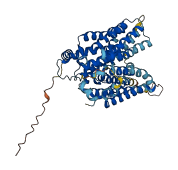
Descriptions
The autoinhibited protein was predicted that may have potential autoinhibitory elements via cis-regPred.
Autoinhibitory domains (AIDs)
Target domain |
|
Relief mechanism |
|
Assay |
cis-regPred |
Accessory elements
No accessory elements
Autoinhibited structure

Activated structure
1 structures for Q9JIF3
| Entry ID | Method | Resolution | Chain | Position | Source |
|---|---|---|---|---|---|
| AF-Q9JIF3-F1 | Predicted | AlphaFoldDB |
21 variants for Q9JIF3
| Variant ID(s) | Position | Change | Description | Diseaes Association | Provenance |
|---|---|---|---|---|---|
| rs262463257 | 67 | N>S | No | EVA | |
| rs3391297166 | 89 | W>C | No | EVA | |
| rs3391453384 | 90 | L>P | No | EVA | |
| rs223796761 | 120 | V>M | No | EVA | |
| rs3388546799 | 193 | T>N | No | EVA | |
| rs3388547718 | 238 | G>E | No | EVA | |
| rs219991761 | 239 | A>T | No | EVA | |
| rs1135280905 | 243 | G>S | No | EVA | |
| rs3388545526 | 270 | L>M | No | EVA | |
| rs3388545492 | 281 | N>H | No | EVA | |
| rs3388543860 | 287 | A>T | No | EVA | |
| rs3388546365 | 298 | T>N | No | EVA | |
| rs27171129 | 339 | T>A | No | EVA | |
| rs3388548067 | 339 | T>I | No | EVA | |
| rs3388549294 | 347 | L>P | No | EVA | |
| rs3388546491 | 372 | W>* | No | EVA | |
| rs3391309402 | 394 | W>R | No | EVA | |
| rs3388546875 | 405 | V>D | No | EVA | |
| rs27171131 | 412 | I>V | No | EVA | |
| rs253912321 | 434 | M>I | No | EVA | |
| rs3388538676 | 460 | P>S | No | EVA |
No associated diseases with Q9JIF3
4 regional properties for Q9JIF3
| Type | Name | Position | InterPro Accession |
|---|---|---|---|
| conserved_site | Sugar transporter, conserved site | 87 - 104 | IPR005829-1 |
| conserved_site | Sugar transporter, conserved site | 129 - 154 | IPR005829-2 |
| conserved_site | Sugar transporter, conserved site | 310 - 327 | IPR005829-3 |
| domain | Major facilitator superfamily domain | 29 - 463 | IPR020846 |
Functions
4 GO annotations of cellular component
| Name | Definition |
|---|---|
| cytoplasmic vesicle membrane | The lipid bilayer surrounding a cytoplasmic vesicle. |
| integral component of plasma membrane | The component of the plasma membrane consisting of the gene products and protein complexes having at least some part of their peptide sequence embedded in the hydrophobic region of the membrane. |
| membrane | A lipid bilayer along with all the proteins and protein complexes embedded in it an attached to it. |
| synaptic vesicle | A secretory organelle, typically 50 nm in diameter, of presynaptic nerve terminals; accumulates in high concentrations of neurotransmitters and secretes these into the synaptic cleft by fusion with the 'active zone' of the presynaptic plasma membrane. |
7 GO annotations of molecular function
| Name | Definition |
|---|---|
| dehydroascorbic acid transmembrane transporter activity | Enables the transfer of dehydroascorbate, 5-(1,2-dihydroxyethyl)furan-2,3,4(5H)-trione, from one side of a membrane to the other. |
| fructose transmembrane transporter activity | Enables the transfer of fructose from one side of a membrane to the other. Fructose exists in a open chain form or as a ring compound. D-fructose is the sweetest of the sugars and is found free in a large number of fruits and honey. |
| fructose uniporter activity | Enables the transfer of a solute or solutes from one side of a membrane to the other according to the reaction: fructose(out) = fructose(in). |
| galactose transmembrane transporter activity | Enables the transfer of galactose from one side of a membrane to the other. D-galactose is widely distributed in combined form in plants, animals and microorganisms as a constituent of oligo- and polysaccharides; it also occurs in galactolipids and as its glucoside in lactose and melibiose. |
| glucose binding | Binding to D- or L-enantiomers of glucose. |
| glucose transmembrane transporter activity | Enables the transfer of the hexose monosaccharide glucose from one side of a membrane to the other. |
| transmembrane transporter activity | Enables the transfer of a substance, usually a specific substance or a group of related substances, from one side of a membrane to the other. |
9 GO annotations of biological process
| Name | Definition |
|---|---|
| dehydroascorbic acid transport | The directed movement of dehydroascorbate into, out of or within a cell, or between cells, by means of some agent such as a transporter or pore. Dehydroascorbate, 5-(1,2-dihydroxyethyl)furan-2,3,4(5H)-trione, is an oxidized form of vitamin C. |
| fructose transmembrane transport | The directed movement of fructose into, out of or within a cell, or between cells, by means of some agent such as a transporter or pore. Fructose exists in a open chain form or as a ring compound. D-fructose is the sweetest of the sugars and is found free in a large number of fruits and honey. |
| galactose transmembrane transport | The process in which galactose is transported across a lipid bilayer, from one side of a membrane to the other. D-galactose is widely distributed in combined form in plants, animals and microorganisms as a constituent of oligo- and polysaccharides; it also occurs in galactolipids and as its glucoside in lactose and melibiose. |
| glucose metabolic process | The chemical reactions and pathways involving glucose, the aldohexose gluco-hexose. D-glucose is dextrorotatory and is sometimes known as dextrose; it is an important source of energy for living organisms and is found free as well as combined in homo- and hetero-oligosaccharides and polysaccharides. |
| glucose transmembrane transport | The process in which glucose is transported across a membrane. |
| insulin receptor signaling pathway | The series of molecular signals generated as a consequence of the insulin receptor binding to insulin. |
| male meiosis I | A cell cycle process comprising the steps by which a cell progresses through male meiosis I, the first meiotic division in the male germline. |
| response to hypoxia | Any process that results in a change in state or activity of a cell or an organism (in terms of movement, secretion, enzyme production, gene expression, etc.) as a result of a stimulus indicating lowered oxygen tension. Hypoxia, defined as a decline in O2 levels below normoxic levels of 20.8 - 20.95%, results in metabolic adaptation at both the cellular and organismal level. |
| transmembrane transport | The process in which a solute is transported across a lipid bilayer, from one side of a membrane to the other. |
| 10 | 20 | 30 | 40 | 50 | 60 |
| MSPEDPQETQ | PLLRPPEART | PRGRRVFLAS | FAAALGPLSF | GFALGYSSPA | IPSLRRTAPP |
| 70 | 80 | 90 | 100 | 110 | 120 |
| ALRLGDNAAS | WFGAVVTLGA | AAGGILGGWL | LDRAGRKLSL | LLCTVPFVTG | FAVITAARDV |
| 130 | 140 | 150 | 160 | 170 | 180 |
| WMLLGGRLLT | GLACGVASLV | APVYISEIAY | PAVRGLLGSC | VQLMVVTGIL | LAYVAGWVLE |
| 190 | 200 | 210 | 220 | 230 | 240 |
| WRWLAVLGCV | PPTLMLLLMC | YMPETPRFLL | TQHQYQEAMA | ALRFLWGSEE | GWEEPPVGAE |
| 250 | 260 | 270 | 280 | 290 | 300 |
| HQGFQLALLR | RPGIYKPLII | GISLMVFQQL | SGVNAIMFYA | NSIFEEAKFK | DSSLASVTVG |
| 310 | 320 | 330 | 340 | 350 | 360 |
| IIQVLFTAVA | ALIMDRAGRR | LLLALSGVIM | VFSMSAFGTY | FKLTQSLPSN | SSHVGLVPIA |
| 370 | 380 | 390 | 400 | 410 | 420 |
| AEPVDVQVGL | AWLAVGSMCL | FIAGFAVGWG | PIPWLLMSEI | FPLHVKGVAT | GICVLTNWFM |
| 430 | 440 | 450 | 460 | 470 | |
| AFLVTKEFSS | VMEMLRPYGA | FWLTAAFCAL | SVLFTLTVVP | ETKGRTLEQV | TAHFEGR |