Q9EQG9
Gene name |
Cert1 (Cert, Col4a3bp, Stard11) |
Protein name |
Ceramide transfer protein |
Names |
CERT, Collagen type IV alpha-3-binding protein, Goodpasture antigen-binding protein, GPBP, START domain-containing protein 11, StARD11, StAR-related lipid transfer protein 11 |
Species |
Mus musculus (Mouse) |
KEGG Pathway |
mmu:68018 |
EC number |
|
Protein Class |
|
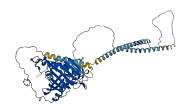
Descriptions
The autoinhibited protein was predicted that may have potential autoinhibitory elements via cis-regPred.
Autoinhibitory domains (AIDs)
Target domain |
|
Relief mechanism |
|
Assay |
cis-regPred |
Accessory elements
No accessory elements
Autoinhibited structure

Activated structure
1 structures for Q9EQG9
| Entry ID | Method | Resolution | Chain | Position | Source |
|---|---|---|---|---|---|
| AF-Q9EQG9-F1 | Predicted | AlphaFoldDB |
14 variants for Q9EQG9
| Variant ID(s) | Position | Change | Description | Diseaes Association | Provenance |
|---|---|---|---|---|---|
| rs3389298809 | 119 | S>* | No | EVA | |
| rs3389296201 | 149 | S>F | No | EVA | |
| rs3389301364 | 182 | F>I | No | EVA | |
| rs3389283064 | 183 | D>N | No | EVA | |
| rs3389272487 | 270 | E>D | No | EVA | |
| rs3389313530 | 278 | D>G | No | EVA | |
| rs3389309646 | 297 | E>K | No | EVA | |
| rs3389296179 | 300 | K>M | No | EVA | |
| rs3389255981 | 352 | S>T | No | EVA | |
| rs3389296176 | 449 | A>T | No | EVA | |
| rs3389272469 | 453 | V>L | No | EVA | |
| rs3389226720 | 459 | C>* | No | EVA | |
| rs3389313500 | 530 | N>S | No | EVA | |
| rs3389309644 | 603 | P>L | No | EVA |
No associated diseases with Q9EQG9
6 GO annotations of cellular component
| Name | Definition |
|---|---|
| cytosol | The part of the cytoplasm that does not contain organelles but which does contain other particulate matter, such as protein complexes. |
| endoplasmic reticulum | The irregular network of unit membranes, visible only by electron microscopy, that occurs in the cytoplasm of many eukaryotic cells. The membranes form a complex meshwork of tubular channels, which are often expanded into slitlike cavities called cisternae. The ER takes two forms, rough (or granular), with ribosomes adhering to the outer surface, and smooth (with no ribosomes attached). |
| Golgi apparatus | A membrane-bound cytoplasmic organelle of the endomembrane system that further processes the core oligosaccharides (e.g. N-glycans) added to proteins in the endoplasmic reticulum and packages them into membrane-bound vesicles. The Golgi apparatus operates at the intersection of the secretory, lysosomal, and endocytic pathways. |
| mitochondrion | A semiautonomous, self replicating organelle that occurs in varying numbers, shapes, and sizes in the cytoplasm of virtually all eukaryotic cells. It is notably the site of tissue respiration. |
| nucleoplasm | That part of the nuclear content other than the chromosomes or the nucleolus. |
| perinuclear region of cytoplasm | Cytoplasm situated near, or occurring around, the nucleus. |
7 GO annotations of molecular function
| Name | Definition |
|---|---|
| ceramide 1-phosphate binding | Binding to ceramide 1-phosphate. |
| ceramide 1-phosphate transfer activity | Removes a ceramide 1-phosphate from a membrane or a monolayer lipid particle, transports it through the aqueous phase while protected in a hydrophobic pocket, and brings it to an acceptor membrane or lipid particle. |
| ceramide binding | Binding to a ceramide, a class of lipids composed of sphingosine linked to a fatty acid. Ceramides are a major component of cell membranes. |
| ceramide transfer activity | Removes a ceramide from a membrane or a monolayer lipid particle, transports it through the aqueous phase while protected in a hydrophobic pocket, and brings it to an acceptor membrane or lipid particle. |
| identical protein binding | Binding to an identical protein or proteins. |
| kinase activity | Catalysis of the transfer of a phosphate group, usually from ATP, to a substrate molecule. |
| phosphatidylinositol-4-phosphate binding | Binding to phosphatidylinositol-4-phosphate, a derivative of phosphatidylinositol in which the inositol ring is phosphorylated at the 4' position. |
15 GO annotations of biological process
| Name | Definition |
|---|---|
| cell morphogenesis | The developmental process in which the size or shape of a cell is generated and organized. |
| cell population proliferation | The multiplication or reproduction of cells, resulting in the expansion of a cell population. |
| ceramide metabolic process | The chemical reactions and pathways involving ceramides, any N-acylated sphingoid. |
| ceramide transport | The directed movement of ceramides into, out of or within a cell, or between cells, by means of some agent such as a transporter or pore. Ceramides are a class of lipid composed of sphingosine linked to a fatty acid. |
| endoplasmic reticulum organization | A process that is carried out at the cellular level which results in the assembly, arrangement of constituent parts, or disassembly of the endoplasmic reticulum. |
| ER to Golgi ceramide transport | The directed movement of a ceramide from the endoplasmic reticulum (ER) to the Golgi. Ceramides are a class of lipid composed of sphingosine linked to a fatty acid. |
| heart morphogenesis | The developmental process in which the heart is generated and organized. The heart is a hollow, muscular organ, which, by contracting rhythmically, keeps up the circulation of the blood. |
| in utero embryonic development | The process whose specific outcome is the progression of the embryo in the uterus over time, from formation of the zygote in the oviduct, to birth. An example of this process is found in Mus musculus. |
| intermembrane lipid transfer | The transport of lipids between membranes in which a lipid molecule is transported through an aqueous phase from the outer leaflet of a donor membrane to the outer leaflet of an acceptor membrane. This process does not require metabolic energy and can be either spontaneous or mediated by lipid transfer proteins (LTPs). |
| intermembrane sphingolipid transfer | The transport of sphingolipids between membranes in which a sphingolipid molecule is transported through an aqueous phase from the outer leaflet of a donor membrane to the outer leaflet of an acceptor membrane. This process does not require metabolic energy and can be either spontaneous or mediated by lipid transfer proteins (LTPs). |
| lipid homeostasis | Any process involved in the maintenance of an internal steady state of lipid within an organism or cell. |
| mitochondrion morphogenesis | The process in which the anatomical structures of a mitochondrion are generated and organized. |
| muscle contraction | A process in which force is generated within muscle tissue, resulting in a change in muscle geometry. Force generation involves a chemo-mechanical energy conversion step that is carried out by the actin/myosin complex activity, which generates force through ATP hydrolysis. |
| response to endoplasmic reticulum stress | Any process that results in a change in state or activity of a cell (in terms of movement, secretion, enzyme production, gene expression, etc.) as a result of a stress acting at the endoplasmic reticulum. ER stress usually results from the accumulation of unfolded or misfolded proteins in the ER lumen. |
| signal transduction | The cellular process in which a signal is conveyed to trigger a change in the activity or state of a cell. Signal transduction begins with reception of a signal (e.g. a ligand binding to a receptor or receptor activation by a stimulus such as light), or for signal transduction in the absence of ligand, signal-withdrawal or the activity of a constitutively active receptor. Signal transduction ends with regulation of a downstream cellular process, e.g. regulation of transcription or regulation of a metabolic process. Signal transduction covers signaling from receptors located on the surface of the cell and signaling via molecules located within the cell. For signaling between cells, signal transduction is restricted to events at and within the receiving cell. |
| 10 | 20 | 30 | 40 | 50 | 60 |
| MSDNQSWNSS | GSEEDPETES | GPPVERCGVL | SKWTNYIHGW | QDRWVVLKNN | TLSYYKSEDE |
| 70 | 80 | 90 | 100 | 110 | 120 |
| TEYGCRGSIC | LSKAVITPHD | FDECRFDISV | NDSVWYLRAQ | DPEHRQQWVD | AIEQHKTESG |
| 130 | 140 | 150 | 160 | 170 | 180 |
| YGSESSLRRH | GSMVSLVSGA | SGYSATSTSS | FKKGHSLREK | LAEMETFRDI | LCRQVDTLQK |
| 190 | 200 | 210 | 220 | 230 | 240 |
| YFDVCADAVS | KDELQRDKVV | EDDEDDFPTT | RSDGDFLHNT | NGNKEKLFPH | VTPKGINGID |
| 250 | 260 | 270 | 280 | 290 | 300 |
| FKGEAITFKA | TTAGILATLS | HCIELMVKRE | ESWQKRHDRE | VEKRRRVEEA | YKNVMEELKK |
| 310 | 320 | 330 | 340 | 350 | 360 |
| KPRFGGPDYE | EGPNSLINEE | EFFDAVEAAL | DRQDKIEEQS | QSEKVRLHWP | TSLPSGDTFS |
| 370 | 380 | 390 | 400 | 410 | 420 |
| SVGTHRFVQK | PYSRSSSMSS | IDLVSASDDV | HRFSSQVEEM | VQNHMNYSLQ | DVGGDANWQL |
| 430 | 440 | 450 | 460 | 470 | 480 |
| VVEEGEMKVY | RREVEENGIV | LDPLKATHAV | KGVTGHEVCN | YFWNVDVRND | WETTIENFHV |
| 490 | 500 | 510 | 520 | 530 | 540 |
| VETLADNAII | VYQTHKRVWP | ASQRDVLYLS | AIRKIPALTE | NDPETWIVCN | FSVDHDSAPL |
| 550 | 560 | 570 | 580 | 590 | 600 |
| NNRCVRAKIN | IAMICQTLVS | PPEGDQEISR | DNILCKITYV | ANVNPGGWAP | ASVLRAVAKR |
| 610 | 620 | ||||
| EYPKFLKRFT | SYVQEKTAGK | PILF |