Q9DCT2
Gene name |
Ndufs3 |
Protein name |
NADH dehydrogenase [ubiquinone] iron-sulfur protein 3, mitochondrial |
Names |
Complex I-30kD, CI-30kD, NADH-ubiquinone oxidoreductase 30 kDa subunit |
Species |
Mus musculus (Mouse) |
KEGG Pathway |
mmu:68349 |
EC number |
7.1.1.2: Hydron translocation or charge separation linked to oxidoreductase reactions |
Protein Class |
|
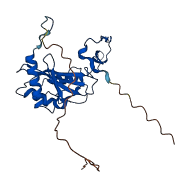
Descriptions
The autoinhibited protein was predicted that may have potential autoinhibitory elements via cis-regPred.
Autoinhibitory domains (AIDs)
Target domain |
|
Relief mechanism |
|
Assay |
cis-regPred |
Accessory elements
No accessory elements
Autoinhibited structure

Activated structure
14 structures for Q9DCT2
| Entry ID | Method | Resolution | Chain | Position | Source |
|---|---|---|---|---|---|
| 6G2J | EM | 330 A | C | 1-263 | PDB |
| 6G72 | EM | 390 A | C | 1-263 | PDB |
| 6ZR2 | EM | 310 A | C | 1-263 | PDB |
| 6ZTQ | EM | 300 A | C | 1-263 | PDB |
| 7AK5 | EM | 317 A | C | 1-263 | PDB |
| 7AK6 | EM | 382 A | C | 1-263 | PDB |
| 7B93 | EM | 304 A | C | 1-263 | PDB |
| 7PSA | EM | 340 A | C | 1-263 | PDB |
| 8C2S | EM | 390 A | C | 1-263 | PDB |
| 8CA3 | EM | 320 A | C | 1-263 | PDB |
| 8CA5 | EM | 390 A | C | 1-263 | PDB |
| 8OLT | EM | 284 A | C | 1-263 | PDB |
| 8OM1 | EM | 239 A | C | 1-263 | PDB |
| AF-Q9DCT2-F1 | Predicted | AlphaFoldDB |
12 variants for Q9DCT2
| Variant ID(s) | Position | Change | Description | Diseaes Association | Provenance |
|---|---|---|---|---|---|
| rs250165435 | 23 | A>P | No | EVA | |
| rs3391904022 | 30 | W>* | No | EVA | |
| rs3391898979 | 30 | W>R | No | EVA | |
| rs3391907085 | 30 | W>S | No | EVA | |
| rs27368610 | 49 | R>W | No | EVA | |
| rs3388571090 | 52 | V>M | No | EVA | |
| rs3391886090 | 65 | A>* | No | EVA | |
| rs3388565084 | 95 | T>M | No | EVA | |
| rs3388566910 | 108 | K>N | No | EVA | |
| rs3391904012 | 188 | T>P | No | EVA | |
| rs3388569905 | 224 | E>K | No | EVA | |
| rs3388565075 | 249 | E>K | No | EVA |
No associated diseases with Q9DCT2
Functions
| Description | ||
|---|---|---|
| EC Number | 7.1.1.2 | Hydron translocation or charge separation linked to oxidoreductase reactions |
| Subcellular Localization |
|
|
| PANTHER Family | ||
| PANTHER Subfamily | ||
| PANTHER Protein Class | ||
| PANTHER Pathway Category | No pathway information available | |
6 GO annotations of cellular component
| Name | Definition |
|---|---|
| mitochondrial inner membrane | The inner, i.e. lumen-facing, lipid bilayer of the mitochondrial envelope. It is highly folded to form cristae. |
| mitochondrial membrane | Either of the lipid bilayers that surround the mitochondrion and form the mitochondrial envelope. |
| mitochondrial respiratory chain complex I | A protein complex located in the mitochondrial inner membrane that forms part of the mitochondrial respiratory chain. It contains about 25 different polypeptide subunits, including NADH dehydrogenase (ubiquinone), flavin mononucleotide and several different iron-sulfur clusters containing non-heme iron. The iron undergoes oxidation-reduction between Fe(II) and Fe(III), and catalyzes proton translocation linked to the oxidation of NADH by ubiquinone. |
| mitochondrion | A semiautonomous, self replicating organelle that occurs in varying numbers, shapes, and sizes in the cytoplasm of virtually all eukaryotic cells. It is notably the site of tissue respiration. |
| myelin sheath | An electrically insulating fatty layer that surrounds the axons of many neurons. It is an outgrowth of glial cells: Schwann cells supply the myelin for peripheral neurons while oligodendrocytes supply it to those of the central nervous system. |
| nuclear body | Extra-nucleolar nuclear domains usually visualized by confocal microscopy and fluorescent antibodies to specific proteins. |
2 GO annotations of molecular function
| Name | Definition |
|---|---|
| NADH dehydrogenase (ubiquinone) activity | Catalysis of the reaction: NADH + ubiquinone + 5 H(+)(in) <=> NAD(+) + ubiquinol + 4 H(+)(out). |
| NADH dehydrogenase activity | Catalysis of the reaction: NADH + H+ + acceptor = NAD+ + reduced acceptor. |
7 GO annotations of biological process
| Name | Definition |
|---|---|
| aerobic respiration | The enzymatic release of energy from inorganic and organic compounds (especially carbohydrates and fats) which requires oxygen as the terminal electron acceptor. |
| mitochondrial electron transport, NADH to ubiquinone | The transfer of electrons from NADH to ubiquinone that occurs during oxidative phosphorylation. |
| mitochondrial respiratory chain complex I assembly | The aggregation, arrangement and bonding together of a set of components to form mitochondrial respiratory chain complex I. |
| negative regulation of cell growth | Any process that stops, prevents, or reduces the frequency, rate, extent or direction of cell growth. |
| negative regulation of intrinsic apoptotic signaling pathway | Any process that stops, prevents or reduces the frequency, rate or extent of intrinsic apoptotic signaling pathway. |
| proton motive force-driven mitochondrial ATP synthesis | The transport of protons across a mitochondrial membrane to generate an electrochemical gradient (proton-motive force) that powers ATP synthesis. |
| reactive oxygen species metabolic process | The chemical reactions and pathways involving a reactive oxygen species, any molecules or ions formed by the incomplete one-electron reduction of oxygen. They contribute to the microbicidal activity of phagocytes, regulation of signal transduction and gene expression, and the oxidative damage to biopolymers. |
3 homologous proteins in AiPD
| UniProt AC | Gene Name | Protein Name | Species | Evidence Code |
|---|---|---|---|---|
| P23709 | NDUFS3 | NADH dehydrogenase [ubiquinone] iron-sulfur protein 3, mitochondrial | Bos taurus (Bovine) | PR |
| Q0MQG8 | NDUFS3 | NADH dehydrogenase [ubiquinone] iron-sulfur protein 3, mitochondrial | Pan troglodytes (Chimpanzee) | PR |
| O75489 | NDUFS3 | NADH dehydrogenase [ubiquinone] iron-sulfur protein 3, mitochondrial | Homo sapiens (Human) | PR |
| 10 | 20 | 30 | 40 | 50 | 60 |
| MAAAAARVWC | RGLLGAASVG | RGAGRPSVLW | QHVRRESAAA | DKRPTVRPRS | DVTHKQLSAF |
| 70 | 80 | 90 | 100 | 110 | 120 |
| GEYVAEILPK | YVQQVQVSCL | DELEICIHPD | GVIPTLTFLR | DHTNAQFKSL | ADLTAVDVPT |
| 130 | 140 | 150 | 160 | 170 | 180 |
| RQNRFEIVYN | LLSLRFNSRI | RVKTYADELT | PIDSIVSVHI | AANWYEREVW | DMFGVFFFNH |
| 190 | 200 | 210 | 220 | 230 | 240 |
| PDLRRILTDY | GFEGHPFRKD | FPLTGYVELR | YDDEVKRVVA | EPVELAQEFR | KFDLNSPWEA |
| 250 | 260 | ||||
| FPAYRQPPES | LKLEAGDKKP | ETK |