Q9D8T2
Gene name |
Gsdmd |
Protein name |
Gasdermin-D |
Names |
Gasdermin domain-containing protein 1 |
Species |
Mus musculus (Mouse) |
KEGG Pathway |
mmu:69146 |
EC number |
|
Protein Class |
|
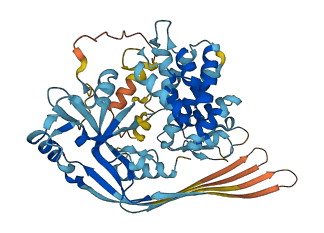
Descriptions
The cytosolic adaptors GGA1-3 mediate sorting of transmembrane proteins. GGA1 contains an autoinhibitory region in hinge region that is activated by the phosphorylation of a serine positioned three residues upstream of the DXXLL motif. Autoinhibition is achieved by the interaction between DXXLL site and the VHS domain in CGGA1, and the phosphoserine upstream of the DXXLL motif facilitates this interaction.
Autoinhibitory domains (AIDs)
Target domain |
4-243 (N-terminal gasdermin domain) |
Relief mechanism |
Cleavage |
Assay |
|
Accessory elements
No accessory elements
Autoinhibited structure

Activated structure
5 structures for Q9D8T2
| Entry ID | Method | Resolution | Chain | Position | Source |
|---|---|---|---|---|---|
| 6AO3 | X-ray | 176 A | A/B/C/D | 277-487 | PDB |
| 6KMV | X-ray | 335 A | PDB | ||
| 6N9N | X-ray | 330 A | A/B | 1-487 | PDB |
| 6VIE | X-ray | 340 A | C/D | 1-487 | PDB |
| AF-Q9D8T2-F1 | Predicted | AlphaFoldDB |
10 variants for Q9D8T2
| Variant ID(s) | Position | Change | Description | Diseaes Association | Provenance |
|---|---|---|---|---|---|
| rs265945110 | 91 | I>V | No | Ensembl | |
| rs245939094 | 233 | V>I | No | Ensembl | |
| rs37791112 | 308 | M>T | No | Ensembl | |
| rs264191939 | 309 | E>A | No | Ensembl | |
| rs220408390 | 314 | I>L | No | Ensembl | |
| rs864288592 | 367 | V>A | No | Ensembl | |
| rs239891108 | 368 | P>S | No | Ensembl | |
| rs864276041 | 412 | L>S | No | Ensembl | |
| rs36886474 | 441 | T>N | No | Ensembl | |
| rs37105413 | 463 | P>L | No | Ensembl |
No associated diseases with Q9D8T2
3 regional properties for Q9D8T2
| Type | Name | Position | InterPro Accession |
|---|---|---|---|
| conserved_site | Heat shock protein 70, conserved site | 9 - 16 | IPR018181-1 |
| conserved_site | Heat shock protein 70, conserved site | 197 - 210 | IPR018181-2 |
| conserved_site | Heat shock protein 70, conserved site | 334 - 348 | IPR018181-3 |
Functions
6 GO annotations of cellular component
| Name | Definition |
|---|---|
| cytosol | The part of the cytoplasm that does not contain organelles but which does contain other particulate matter, such as protein complexes. |
| extracellular space | That part of a multicellular organism outside the cells proper, usually taken to be outside the plasma membranes, and occupied by fluid. |
| integral component of membrane | The component of a membrane consisting of the gene products and protein complexes having at least some part of their peptide sequence embedded in the hydrophobic region of the membrane. |
| NLRP3 inflammasome complex | An inflammasome complex that consists of three components, NLRP3 (NALP3), PYCARD and caspase-1. It is activated upon exposure to whole pathogens, as well as a number of structurally diverse pathogen- and danger-associated molecular patterns (PAMPs and DAMPs) and environmental irritants. Whole pathogens demonstrated to activate the NLRP3 inflammasome complex include the fungi Candida albicans and Saccharomyces cerevisiae, bacteria that produce pore-forming toxins, including Listeria monocytogenes and Staphylococcus aureus, and viruses such as Sendai virus, adenovirus, and influenza virus. |
| nucleoplasm | That part of the nuclear content other than the chromosomes or the nucleolus. |
| plasma membrane | The membrane surrounding a cell that separates the cell from its external environment. It consists of a phospholipid bilayer and associated proteins. |
6 GO annotations of molecular function
| Name | Definition |
|---|---|
| cardiolipin binding | Binding to cardiolipin. |
| phosphatidic acid binding | Binding to phosphatidic acid, any of a class of glycerol phosphate in which both the remaining hydroxyl groups of the glycerol moiety are esterified with fatty acids. |
| phosphatidylinositol-4,5-bisphosphate binding | Binding to phosphatidylinositol-4,5-bisphosphate, a derivative of phosphatidylinositol in which the inositol ring is phosphorylated at the 4' and 5' positions. |
| phosphatidylinositol-4-phosphate binding | Binding to phosphatidylinositol-4-phosphate, a derivative of phosphatidylinositol in which the inositol ring is phosphorylated at the 4' position. |
| phosphatidylserine binding | Binding to phosphatidylserine, a class of glycophospholipids in which a phosphatidyl group is esterified to the hydroxyl group of L-serine. |
| wide pore channel activity | Enables the transport of a solute across a membrane via a large pore, un-gated channel. Examples include gap junctions, which transport substances from one cell to another; and porins which transport substances in and out of bacteria, mitochondria and chloroplasts. |
11 GO annotations of biological process
| Name | Definition |
|---|---|
| cellular response to extracellular stimulus | Any process that results in a change in state or activity of a cell (in terms of movement, secretion, enzyme production, gene expression, etc.) as a result of an extracellular stimulus. |
| defense response to bacterium | Reactions triggered in response to the presence of a bacterium that act to protect the cell or organism. |
| defense response to Gram-negative bacterium | Reactions triggered in response to the presence of a Gram-negative bacterium that act to protect the cell or organism. |
| defense response to Gram-positive bacterium | Reactions triggered in response to the presence of a Gram-positive bacterium that act to protect the cell or organism. |
| inflammatory response | The immediate defensive reaction (by vertebrate tissue) to infection or injury caused by chemical or physical agents. The process is characterized by local vasodilation, extravasation of plasma into intercellular spaces and accumulation of white blood cells and macrophages. |
| innate immune response | Innate immune responses are defense responses mediated by germline encoded components that directly recognize components of potential pathogens. |
| pore complex assembly | The aggregation, arrangement and bonding together of a set of components to form a pore complex. A pore complex is a small opening in a membrane that allows the passage of liquids and/or gases. |
| pore formation in membrane of other organism | The aggregation, arrangement and bonding together of a set of components by an organism to form a pore complex in a membrane of another organism. |
| positive regulation of interleukin-1 beta production | Any process that activates or increases the frequency, rate, or extent of interleukin-1 beta production. |
| protein homooligomerization | The process of creating protein oligomers, compounds composed of a small number, usually between three and ten, of identical component monomers. Oligomers may be formed by the polymerization of a number of monomers or the depolymerization of a large protein polymer. |
| pyroptosis | A caspase-1-dependent cell death subroutine that is associated with the generation of pyrogenic mediators such as IL-1beta and IL-18. |
12 homologous proteins in AiPD
| UniProt AC | Gene Name | Protein Name | Species | Evidence Code |
|---|---|---|---|---|
| Q96QA5 | GSDMA | Gasdermin-A | Homo sapiens (Human) | SS |
| Q9BYG8 | GSDMC | Gasdermin-C | Homo sapiens (Human) | SS |
| P57764 | GSDMD | Gasdermin-D | Homo sapiens (Human) | EV |
| Q8TAX9 | GSDMB | Gasdermin-B | Homo sapiens (Human) | EV |
| Q8CB12 | Gsdmc3 | Gasdermin-C3 | Mus musculus (Mouse) | SS |
| Q2KHK6 | Gsdmc2 | Gasdermin-C2 | Mus musculus (Mouse) | SS |
| Q3TR54 | Gsdmc4 | Gasdermin-C4 | Mus musculus (Mouse) | SS |
| Q5Y4Y6 | Gsdma3 | Gasdermin-A3 | Mus musculus (Mouse) | EV |
| Q99NB5 | Gsdmc | Gasdermin-C | Mus musculus (Mouse) | SS |
| Q9EST1 | Gsdma | Gasdermin-A | Mus musculus (Mouse) | SS |
| Q32M21 | Gsdma2 | Gasdermin-A2 | Mus musculus (Mouse) | SS |
| P85967 | Gsdmc | Gasdermin-C | Rattus norvegicus (Rat) | SS |
| 10 | 20 | 30 | 40 | 50 | 60 |
| MAEAEGESLE | SWLNKATNPS | NRQEDWEYII | GFCDQINKEL | EGPQIAVRLL | AHKIQSPQEW |
| 70 | 80 | 90 | 100 | 110 | 120 |
| EAVQALTVLE | ACMKNCGRRL | HNEVGKFRFL | NELIKVVSPK | YLGDRVSEKV | KTKVIELLFS |
| 130 | 140 | 150 | 160 | 170 | 180 |
| WTLALPEEAK | IKDAYHMLKR | QGIVQSDPPI | PMDRTLIPSP | PPRPKNPVFD | DEEKSKLLAR |
| 190 | 200 | 210 | 220 | 230 | 240 |
| LLKSKNPDDL | QEANRLIKSM | VKEDEARIQK | VTKRLHTLEE | VNNNVKLLHE | MLLHYSQEYS |
| 250 | 260 | 270 | 280 | 290 | 300 |
| SDADKELMKE | LFDRCENKRR | TLFKLASETE | DNDNSLGDIL | QASDNLSRVI | NSYKTIIEGQ |
| 310 | 320 | 330 | 340 | 350 | 360 |
| IVNGEVTTST | MPDSEGNSHC | GNQGALIDLA | ELDAPSNSSP | ALAPPTSGIP | ILPPPPQTSG |
| 370 | 380 | 390 | 400 | 410 | 420 |
| PPRSRSSSQA | EAPPGSDSTN | NALSLLDEEL | LCLGLTDPAP | TAPKESPGSS | QWHLFQNEPP |
| 430 | 440 | 450 | 460 | 470 | 480 |
| SDLDFFSPRP | VPAASCPSDG | PQLPPPVSTS | SMSQAPLPAA | FPAPVVPASA | PTHSTGSFMF |
| 490 | 500 | 510 | 520 | 530 | 540 |
| SSGPAPALAP | KAEPKGPEYP | SSSTSHRLDA | LDQLLEEAKV | TSGLVKPVSC | FSPGPTASPL |
| 550 | 560 | 570 | 580 | 590 | 600 |
| LPASAPARPL | LPFSTGPGSP | LFQSQGSPQK | GPELSLASVH | VPLESIKPSS | ALPVTAYDKN |
| 610 | 620 | 630 | 640 | 650 | 660 |
| GFRILFHFAK | ECPPGRPDVL | VVVVSMLNTA | PLPVKSIVLQ | AAVPKSMKVK | LQPPSGTELS |
| 670 | 680 | 690 | 700 | 710 | |
| PFSPIQPPAA | ITQVMLLANP | MKEKVRLRYK | LTFALGEQLS | TELGEVDQFP | PVEQWGNL |