Q8CB12
Gene name |
Gsdmc3 |
Protein name |
Gasdermin-C3 |
Names |
|
Species |
Mus musculus (Mouse) |
KEGG Pathway |
mmu:270328 |
EC number |
|
Protein Class |
|
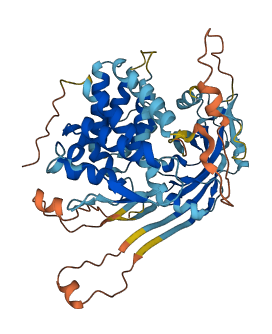
Descriptions
Autoinhibitory domains (AIDs)
Target domain |
5-232 (N-terminal gasdermin domain) |
Relief mechanism |
Cleavage |
Assay |
|
Accessory elements
No accessory elements
Autoinhibited structure

Activated structure
1 structures for Q8CB12
| Entry ID | Method | Resolution | Chain | Position | Source |
|---|---|---|---|---|---|
| AF-Q8CB12-F1 | Predicted | AlphaFoldDB |
19 variants for Q8CB12
| Variant ID(s) | Position | Change | Description | Diseaes Association | Provenance |
|---|---|---|---|---|---|
| rs586546419 | 89 | A>S | No | Ensembl | |
| rs584051040 | 98 | R>G | No | Ensembl | |
| rs580893779 | 116 | T>K | No | Ensembl | |
| rs580270709 | 120 | N>T | No | Ensembl | |
| rs583661902 | 120 | N>Y | No | Ensembl | |
| rs587530464 | 125 | I>N | No | Ensembl | |
| rs583105517 | 224 | A>D | No | Ensembl | |
| rs261191775 | 246 | I>T | No | Ensembl | |
| rs242492495 | 247 | Y>S | No | Ensembl | |
| rs216373874 | 250 | E>Q | No | Ensembl | |
| rs586701301 | 260 | E>D | No | Ensembl | |
| rs579909765 | 260 | E>V | No | Ensembl | |
| rs31091089 | 278 | Y>N | No | Ensembl | |
| rs31091088 | 312 | N>K | No | Ensembl | |
| rs1133190004 | 315 | H>Y | No | Ensembl | |
| rs579662830 | 324 | S>N | No | Ensembl | |
| rs585191529 | 354 | L>P | No | Ensembl | |
| rs31090214 | 390 | T>K | No | Ensembl | |
| rs215541887 | 465 | Q>R | No | Ensembl |
2 associated diseases with Q8CB12
[MIM: 602482]: Axenfeld-Rieger syndrome 3 (RIEG3)
An autosomal dominant disorder of morphogenesis that results in abnormal development of the anterior segment of the eye, and results in blindness from glaucoma in approximately 50% of affected individuals. Features include posterior corneal embryotoxon, prominent Schwalbe line and iris adhesion to the Schwalbe line, hypertelorism, hypodontia, sensorineural deafness, redundant periumbilical skin, and cardiovascular defects such as patent ductus arteriosus and atrial septal defect. When associated with tooth anomalies, the disorder is known as Rieger syndrome. {ECO:0000269|PubMed:11170889, ECO:0000269|PubMed:11179011, ECO:0000269|PubMed:11589884, ECO:0000269|PubMed:11740218, ECO:0000269|PubMed:12454026, ECO:0000269|PubMed:12592227, ECO:0000269|PubMed:14506133, ECO:0000269|PubMed:14578375, ECO:0000269|PubMed:15277473, ECO:0000269|PubMed:15477465, ECO:0000269|PubMed:16449236, ECO:0000269|PubMed:16936096, ECO:0000269|PubMed:17210863, ECO:0000269|PubMed:17653043, ECO:0000269|PubMed:19279310, ECO:0000269|PubMed:23239455, ECO:0000269|PubMed:24914578, ECO:0000269|PubMed:25786029, ECO:0000269|PubMed:27804176, ECO:0000269|PubMed:9792859}. Note=The disease is caused by variants affecting the gene represented in this entry.
[MIM: 601631]: Anterior segment dysgenesis 3 (ASGD3)
A form of anterior segment dysgenesis, a group of defects affecting anterior structures of the eye including cornea, iris, lens, trabecular meshwork, and Schlemm canal. Anterior segment dysgeneses result from abnormal migration or differentiation of the neural crest derived mesenchymal cells that give rise to components of the anterior chamber during eye development. Different anterior segment anomalies may exist alone or in combination, including iris hypoplasia, enlarged or reduced corneal diameter, corneal vascularization and opacity, posterior embryotoxon, corectopia, polycoria, abnormal iridocorneal angle, ectopia lentis, and anterior synechiae between the iris and posterior corneal surface. Clinical conditions falling within the phenotypic spectrum of anterior segment dysgeneses include aniridia, Axenfeld anomaly, Reiger anomaly/syndrome, Peters anomaly, and iridogoniodysgenesis. ASGD3 inheritance is autosomal dominant. {ECO:0000269|PubMed:12614756, ECO:0000269|PubMed:18484311, ECO:0000269|PubMed:19279310, ECO:0000269|PubMed:19793056, ECO:0000269|PubMed:20881294, ECO:0000269|PubMed:9620769}. Note=The disease is caused by variants affecting the gene represented in this entry.
Without disease ID
- An autosomal dominant disorder of morphogenesis that results in abnormal development of the anterior segment of the eye, and results in blindness from glaucoma in approximately 50% of affected individuals. Features include posterior corneal embryotoxon, prominent Schwalbe line and iris adhesion to the Schwalbe line, hypertelorism, hypodontia, sensorineural deafness, redundant periumbilical skin, and cardiovascular defects such as patent ductus arteriosus and atrial septal defect. When associated with tooth anomalies, the disorder is known as Rieger syndrome. {ECO:0000269|PubMed:11170889, ECO:0000269|PubMed:11179011, ECO:0000269|PubMed:11589884, ECO:0000269|PubMed:11740218, ECO:0000269|PubMed:12454026, ECO:0000269|PubMed:12592227, ECO:0000269|PubMed:14506133, ECO:0000269|PubMed:14578375, ECO:0000269|PubMed:15277473, ECO:0000269|PubMed:15477465, ECO:0000269|PubMed:16449236, ECO:0000269|PubMed:16936096, ECO:0000269|PubMed:17210863, ECO:0000269|PubMed:17653043, ECO:0000269|PubMed:19279310, ECO:0000269|PubMed:23239455, ECO:0000269|PubMed:24914578, ECO:0000269|PubMed:25786029, ECO:0000269|PubMed:27804176, ECO:0000269|PubMed:9792859}. Note=The disease is caused by variants affecting the gene represented in this entry.
- A form of anterior segment dysgenesis, a group of defects affecting anterior structures of the eye including cornea, iris, lens, trabecular meshwork, and Schlemm canal. Anterior segment dysgeneses result from abnormal migration or differentiation of the neural crest derived mesenchymal cells that give rise to components of the anterior chamber during eye development. Different anterior segment anomalies may exist alone or in combination, including iris hypoplasia, enlarged or reduced corneal diameter, corneal vascularization and opacity, posterior embryotoxon, corectopia, polycoria, abnormal iridocorneal angle, ectopia lentis, and anterior synechiae between the iris and posterior corneal surface. Clinical conditions falling within the phenotypic spectrum of anterior segment dysgeneses include aniridia, Axenfeld anomaly, Reiger anomaly/syndrome, Peters anomaly, and iridogoniodysgenesis. ASGD3 inheritance is autosomal dominant. {ECO:0000269|PubMed:12614756, ECO:0000269|PubMed:18484311, ECO:0000269|PubMed:19279310, ECO:0000269|PubMed:19793056, ECO:0000269|PubMed:20881294, ECO:0000269|PubMed:9620769}. Note=The disease is caused by variants affecting the gene represented in this entry.
4 regional properties for Q8CB12
4 GO annotations of cellular component
| Name | Definition |
|---|---|
| cytoplasm | The contents of a cell excluding the plasma membrane and nucleus, but including other subcellular structures. |
| cytosol | The part of the cytoplasm that does not contain organelles but which does contain other particulate matter, such as protein complexes. |
| integral component of membrane | The component of a membrane consisting of the gene products and protein complexes having at least some part of their peptide sequence embedded in the hydrophobic region of the membrane. |
| plasma membrane | The membrane surrounding a cell that separates the cell from its external environment. It consists of a phospholipid bilayer and associated proteins. |
3 GO annotations of molecular function
| Name | Definition |
|---|---|
| phosphatidylinositol-4,5-bisphosphate binding | Binding to phosphatidylinositol-4,5-bisphosphate, a derivative of phosphatidylinositol in which the inositol ring is phosphorylated at the 4' and 5' positions. |
| phosphatidylinositol-4-phosphate binding | Binding to phosphatidylinositol-4-phosphate, a derivative of phosphatidylinositol in which the inositol ring is phosphorylated at the 4' position. |
| phosphatidylserine binding | Binding to phosphatidylserine, a class of glycophospholipids in which a phosphatidyl group is esterified to the hydroxyl group of L-serine. |
2 GO annotations of biological process
| Name | Definition |
|---|---|
| defense response to bacterium | Reactions triggered in response to the presence of a bacterium that act to protect the cell or organism. |
| pyroptosis | A caspase-1-dependent cell death subroutine that is associated with the generation of pyrogenic mediators such as IL-1beta and IL-18. |
12 homologous proteins in AiPD
| UniProt AC | Gene Name | Protein Name | Species | Evidence Code |
|---|---|---|---|---|
| P57764 | GSDMD | Gasdermin-D | Homo sapiens (Human) | EV |
| Q96QA5 | GSDMA | Gasdermin-A | Homo sapiens (Human) | SS |
| Q9BYG8 | GSDMC | Gasdermin-C | Homo sapiens (Human) | SS |
| Q8TAX9 | GSDMB | Gasdermin-B | Homo sapiens (Human) | EV |
| Q2KHK6 | Gsdmc2 | Gasdermin-C2 | Mus musculus (Mouse) | SS |
| Q32M21 | Gsdma2 | Gasdermin-A2 | Mus musculus (Mouse) | SS |
| Q3TR54 | Gsdmc4 | Gasdermin-C4 | Mus musculus (Mouse) | SS |
| Q5Y4Y6 | Gsdma3 | Gasdermin-A3 | Mus musculus (Mouse) | EV |
| Q99NB5 | Gsdmc | Gasdermin-C | Mus musculus (Mouse) | SS |
| Q9D8T2 | Gsdmd | Gasdermin-D | Mus musculus (Mouse) | SS |
| Q9EST1 | Gsdma | Gasdermin-A | Mus musculus (Mouse) | SS |
| P85967 | Gsdmc | Gasdermin-C | Rattus norvegicus (Rat) | SS |
| 10 | 20 | 30 | 40 | 50 | 60 |
| MGYSFDRASK | DVVKKLQGRD | LRPVECLSDA | TKFRLFHILQ | ETPRSGWETE | DIPVGFTLLD |
| 70 | 80 | 90 | 100 | 110 | 120 |
| LLEPNFPVPE | PEVSAPKPFI | HVQSTDLEAN | LNVADIARGG | VGYVGYGGYN | IEVQSTSIPN |
| 130 | 140 | 150 | 160 | 170 | 180 |
| PKLEILQNRK | LLDKLPTFMK | FCRMERKNLY | VVTEAYEVSK | DTMLTGLSSV | NLLVKGFFKQ |
| 190 | 200 | 210 | 220 | 230 | 240 |
| LFKVRGKAGR | SEKYSIPIPK | GSVLAYKKQQ | LVIENNTCVI | LPSATKKKMT | FPGTPKYASA |
| 250 | 260 | 270 | 280 | 290 | 300 |
| SEPTEIYRTE | LQGLWINDIE | PIGRIQEPAH | LDFKCLQYEV | SEQTRLLPEL | SKDVQEVVLS |
| 310 | 320 | 330 | 340 | 350 | 360 |
| SFLSMLYEGD | RNVLHDLMKM | LELSQLGHMD | GPGGKILDEL | RKDSSNPCVD | LKDLILYLLQ |
| 370 | 380 | 390 | 400 | 410 | 420 |
| ALMVLSDSQL | NLLARSVEMR | LLPHQVELVT | SILQPNFKYP | WNIPFTVQPQ | LLAPLQGEGL |
| 430 | 440 | 450 | 460 | 470 | |
| AITYELLEEC | GLKMELNNPR | STWDLEAKMP | LSALYGSLSF | LQQLQKANSS | FKPSLRPGYI |