Q99KP6
Gene name |
Prpf19 |
Protein name |
Pre-mRNA-processing factor 19 |
Names |
Nuclear matrix protein 200, PRP19/PSO4 homolog, RING-type E3 ubiquitin transferase PRP19, Senescence evasion factor |
Species |
Mus musculus (Mouse) |
KEGG Pathway |
mmu:28000 |
EC number |
2.3.2.27: Aminoacyltransferases |
Protein Class |
|
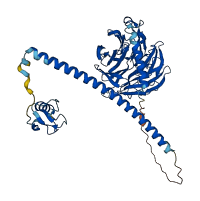
Descriptions
The autoinhibited protein was predicted that may have potential autoinhibitory elements via cis-regPred.
Autoinhibitory domains (AIDs)
Target domain |
|
Relief mechanism |
|
Assay |
cis-regPred |
Accessory elements
No accessory elements
Autoinhibited structure

Activated structure
3 structures for Q99KP6
| Entry ID | Method | Resolution | Chain | Position | Source |
|---|---|---|---|---|---|
| 8D5J | X-ray | 195 A | C | 206-214 | PDB |
| 8D5K | X-ray | 207 A | C | 206-214 | PDB |
| AF-Q99KP6-F1 | Predicted | AlphaFoldDB |
22 variants for Q99KP6
| Variant ID(s) | Position | Change | Description | Diseaes Association | Provenance |
|---|---|---|---|---|---|
| rs3389531608 | 13 | E>* | No | EVA | |
| rs3389434223 | 125 | T>S | No | EVA | |
| rs3389527172 | 209 | Q>L | No | EVA | |
| rs3389506107 | 242 | A>S | No | EVA | |
| rs3407007419 | 293 | V>G | No | EVA | |
| rs3408261749 | 297 | S>T | No | EVA | |
| rs3409337372 | 301 | V>G | No | EVA | |
| rs3389434179 | 303 | R>W | No | EVA | |
| rs3408944265 | 304 | A>D | No | EVA | |
| rs3409137309 | 306 | E>A | No | EVA | |
| rs3389522279 | 311 | G>C | No | EVA | |
| rs3389506095 | 316 | A>T | No | EVA | |
| rs3389493616 | 316 | A>V | No | EVA | |
| rs3389475609 | 324 | S>F | No | EVA | |
| rs3389434178 | 355 | C>Y | No | EVA | |
| rs3389506079 | 359 | H>Q | No | EVA | |
| rs3409337407 | 370 | M>I | No | EVA | |
| rs3409013085 | 371 | D>E | No | EVA | |
| rs3408865926 | 379 | L>M | No | EVA | |
| rs3407939516 | 379 | L>S | No | EVA | |
| rs3389526058 | 424 | L>W | No | EVA | |
| rs3409337354 | 483 | F>C | No | EVA |
No associated diseases with Q99KP6
10 regional properties for Q99KP6
| Type | Name | Position | InterPro Accession |
|---|---|---|---|
| repeat | WD40 repeat | 206 - 250 | IPR001680-1 |
| repeat | WD40 repeat | 253 - 334 | IPR001680-2 |
| repeat | WD40 repeat | 337 - 463 | IPR001680-3 |
| repeat | WD40 repeat | 464 - 504 | IPR001680-4 |
| domain | U-box domain | 1 - 73 | IPR003613 |
| domain | Pre-mRNA-splicing factor 19 | 68 - 133 | IPR013915 |
| conserved_site | WD40 repeat, conserved site | 407 - 421 | IPR019775 |
| repeat | G-protein beta WD-40 repeat | 279 - 293 | IPR020472-1 |
| repeat | G-protein beta WD-40 repeat | 365 - 379 | IPR020472-2 |
| repeat | G-protein beta WD-40 repeat | 407 - 421 | IPR020472-3 |
Functions
| Description | ||
|---|---|---|
| EC Number | 2.3.2.27 | Aminoacyltransferases |
| Subcellular Localization |
|
|
| PANTHER Family | ||
| PANTHER Subfamily | ||
| PANTHER Protein Class | ||
| PANTHER Pathway Category | No pathway information available | |
12 GO annotations of cellular component
| Name | Definition |
|---|---|
| catalytic step 2 spliceosome | A spliceosomal complex that contains three snRNPs, including U5, bound to a splicing intermediate in which the first catalytic cleavage of the 5' splice site has occurred. The precise subunit composition differs significantly from that of the catalytic step 1, or activated, spliceosome, and includes many proteins in addition to those found in the associated snRNPs. |
| cytoplasm | The contents of a cell excluding the plasma membrane and nucleus, but including other subcellular structures. |
| DNA replication factor A complex | A conserved heterotrimeric complex that binds nonspecifically to single-stranded DNA and is required for multiple processes in eukaryotic DNA metabolism, including DNA replication, DNA repair, and recombination. In all eukaryotic organisms examined the complex is composed of subunits of approximately 70, 30, and 14 kDa. |
| lipid droplet | An intracellular non-membrane-bounded organelle comprising a matrix of coalesced lipids surrounded by a phospholipid monolayer. May include associated proteins. |
| nuclear speck | A discrete extra-nucleolar subnuclear domain, 20-50 in number, in which splicing factors are seen to be localized by immunofluorescence microscopy. |
| nucleus | A membrane-bounded organelle of eukaryotic cells in which chromosomes are housed and replicated. In most cells, the nucleus contains all of the cell's chromosomes except the organellar chromosomes, and is the site of RNA synthesis and processing. In some species, or in specialized cell types, RNA metabolism or DNA replication may be absent. |
| Prp19 complex | A protein complex consisting of Prp19 and associated proteins that is involved in the transition from the precatalytic spliceosome to the activated form that catalyzes step 1 of splicing, and which remains associated with the spliceosome through the second catalytic step. It is widely conserved, found in both yeast and mammals, though the exact composition varies. In S. cerevisiae, it contains Prp19p, Ntc20p, Snt309p, Isy1p, Syf2p, Cwc2p, Prp46p, Clf1p, Cef1p, and Syf1p. |
| site of double-strand break | A region of a chromosome at which a DNA double-strand break has occurred. DNA damage signaling and repair proteins accumulate at the lesion to respond to the damage and repair the DNA to form a continuous DNA helix. |
| spindle | The array of microtubules and associated molecules that forms between opposite poles of a eukaryotic cell during mitosis or meiosis and serves to move the duplicated chromosomes apart. |
| spliceosomal complex | Any of a series of ribonucleoprotein complexes that contain snRNA(s) and small nuclear ribonucleoproteins (snRNPs), and are formed sequentially during the spliceosomal splicing of one or more substrate RNAs, and which also contain the RNA substrate(s) from the initial target RNAs of splicing, the splicing intermediate RNA(s), to the final RNA products. During cis-splicing, the initial target RNA is a single, contiguous RNA transcript, whether mRNA, snoRNA, etc., and the released products are a spliced RNA and an excised intron, generally as a lariat structure. During trans-splicing, there are two initial substrate RNAs, the spliced leader RNA and a pre-mRNA. |
| U2-type catalytic step 1 spliceosome | A spliceosomal complex that is formed by the displacement of the U1 and U4 snRNPs from the precatalytic spliceosome; the U2, U5 and U6 snRNPs remain associated with the mRNA. This complex, sometimes called the activated spliceosome, is the catalytically active form of the spliceosome, and includes many proteins in addition to those found in the U2, and U5 and U6 snRNPs. |
| U2-type catalytic step 2 spliceosome | A spliceosomal complex that contains the U2, U5 and U6 snRNPs bound to a splicing intermediate in which the first catalytic cleavage of the 5' splice site has occurred. The precise subunit composition differs significantly from that of the catalytic step 1, or activated, spliceosome, and includes many proteins in addition to those found in the U2, U5 and U6 snRNPs. |
4 GO annotations of molecular function
| Name | Definition |
|---|---|
| identical protein binding | Binding to an identical protein or proteins. |
| ubiquitin protein ligase activity | Catalysis of the transfer of ubiquitin to a substrate protein via the reaction X-ubiquitin + S -> X + S-ubiquitin, where X is either an E2 or E3 enzyme, the X-ubiquitin linkage is a thioester bond, and the S-ubiquitin linkage is an amide bond: an isopeptide bond between the C-terminal glycine of ubiquitin and the epsilon-amino group of lysine residues in the substrate or, in the linear extension of ubiquitin chains, a peptide bond the between the C-terminal glycine and N-terminal methionine of ubiquitin residues. |
| ubiquitin-protein transferase activity | Catalysis of the transfer of ubiquitin from one protein to another via the reaction X-Ub + Y --> Y-Ub + X, where both X-Ub and Y-Ub are covalent linkages. |
| ubiquitin-ubiquitin ligase activity | Isoenergetic transfer of ubiquitin from one protein to an existing ubiquitin chain via the reaction X-ubiquitin + Y-ubiquitin -> Y-ubiquitin-ubiquitin + X, where both the X-ubiquitin and Y-ubiquitin-ubiquitin linkages are thioester bonds between the C-terminal glycine of ubiquitin and a sulfhydryl side group of a cysteine residue. |
13 GO annotations of biological process
| Name | Definition |
|---|---|
| DNA damage checkpoint signaling | A signal transduction process that contributes to a DNA damage checkpoint. |
| double-strand break repair via nonhomologous end joining | The repair of a double-strand break in DNA in which the two broken ends are rejoined with little or no sequence complementarity. Information at the DNA ends may be lost due to the modification of broken DNA ends. This term covers instances of separate pathways, called classical (or canonical) and alternative nonhomologous end joining (C-NHEJ and A-NHEJ). These in turn may further branch into sub-pathways, but evidence is still unclear. |
| lipid biosynthetic process | The chemical reactions and pathways resulting in the formation of lipids, compounds soluble in an organic solvent but not, or sparingly, in an aqueous solvent. |
| mRNA splicing, via spliceosome | The joining together of exons from one or more primary transcripts of messenger RNA (mRNA) and the excision of intron sequences, via a spliceosomal mechanism, so that mRNA consisting only of the joined exons is produced. |
| positive regulation of astrocyte differentiation | Any process that activates or increases the frequency, rate or extent of astrocyte differentiation. |
| positive regulation of mRNA splicing, via spliceosome | Any process that activates or increases the rate or extent of mRNA splicing via a spliceosomal mechanism. |
| positive regulation of neuron differentiation | Any process that activates or increases the frequency, rate or extent of neuron differentiation. |
| proteasomal protein catabolic process | The chemical reactions and pathways resulting in the breakdown of a protein or peptide by hydrolysis of its peptide bonds that is mediated by the proteasome. |
| protein K63-linked ubiquitination | A protein ubiquitination process in which a polymer of ubiquitin, formed by linkages between lysine residues at position 63 of the ubiquitin monomers, is added to a protein. K63-linked ubiquitination does not target the substrate protein for degradation, but is involved in several pathways, notably as a signal to promote error-free DNA postreplication repair. |
| protein localization | Any process in which a protein is transported to, or maintained in, a specific location. |
| protein polyubiquitination | Addition of multiple ubiquitin groups to a protein, forming a ubiquitin chain. |
| spliceosomal complex assembly | The aggregation, arrangement and bonding together of a spliceosomal complex, a ribonucleoprotein apparatus that catalyzes nuclear mRNA splicing via transesterification reactions. |
| spliceosomal tri-snRNP complex assembly | The formation of a tri-snRNP complex containing U4 and U6 (or U4atac and U6atac) snRNAs and U5 snRNAs and associated proteins. This includes reannealing of U4 and U6 (or U4atac and U6atac) snRNAs released from previous rounds of splicing to reform the U4/U6 snRNP (or U4atac/U6atac snRNP) as well as the subsequent association of the U5 snRNP with the U4/U6 snRNP (or U4atac/U6atac snRNP) to form a tri-snRNP that is ready to reassemble into another spliceosome complex. |
3 homologous proteins in AiPD
| 10 | 20 | 30 | 40 | 50 | 60 |
| MSLICSISNE | VPEHPCVSPV | SNHVYERRLI | EKYIAENGTD | PINNQPLSEE | QLIDIKVAHP |
| 70 | 80 | 90 | 100 | 110 | 120 |
| IRPKPPSATS | IPAILKALQD | EWDAVMLHSF | TLRQQLQTTR | QELSHALYQH | DAACRVIARL |
| 130 | 140 | 150 | 160 | 170 | 180 |
| TKEVTAAREA | LATLKPQAGL | IVPQAVPSSQ | PSVVGAGEPM | DLGELVGMTP | EIIQKLQDKA |
| 190 | 200 | 210 | 220 | 230 | 240 |
| TVLTTERKKR | GKTVPEELVK | PEELSKYRQV | ASHVGLHSAS | IPGILALDLC | PSDTNKILTG |
| 250 | 260 | 270 | 280 | 290 | 300 |
| GADKNVVVFD | KSTEQILATL | KGHTKKVTSV | VFHPSQELVF | SASPDATIRI | WSVPNTSCVQ |
| 310 | 320 | 330 | 340 | 350 | 360 |
| VVRAHESAVT | GLSLHATGDY | LLSSSDDQYW | AFSDIQTGRV | LTKVTDETSG | CSLTCAQFHP |
| 370 | 380 | 390 | 400 | 410 | 420 |
| DGLIFGTGTM | DSQIKIWDLK | ERTNVANFPG | HSGPITSIAF | SENGYYLATA | ADDSSVKLWD |
| 430 | 440 | 450 | 460 | 470 | 480 |
| LRKLKNFKTL | QLDNNFEVKS | LIFDQSGTYL | ALGGTDVQIY | ICKQWTEILH | FTEHSGLTTG |
| 490 | 500 | ||||
| VAFGHHAKFI | ASTGMDRSLK | FYSL |